























A footnote in a Whitby library
Abraham Stoker (1847-1912) was not a full-time writer: he ran the Lyceum Theatre in London for the actor Henry Irving. In July 1890 he took a holiday in Whitby, on the Yorkshire coast, and on 8 August he borrowed a book of 1820 from the library on the quay, William Wilkinson's An Account of the Principalities of Wallachia and Moldavia; Wilkinson had been British consul in Bucharest. A footnote told him that «Dracula in the Wallachian language means Devil».
Stoker's working notes bear it out: the novel was to be set in Styria and the villain was called Count Wampyr, struck out and replaced by hand. Those papers are now in the Rosenbach Museum & Library in Philadelphia. Stoker never set foot in Transylvania, and he did not bring the word «nosferatu» back from there either: he read it in Transylvanian Superstitions (1885), by the Scotswoman Emily Gerard. Dracula appeared in May 1897 from Archibald Constable and Company, in yellow cloth with red lettering, priced at six shillings, and with no narrator at all: it is diaries, letters, telegrams, newspaper cuttings and phonograph cylinders.
Hair on the palms of his hands
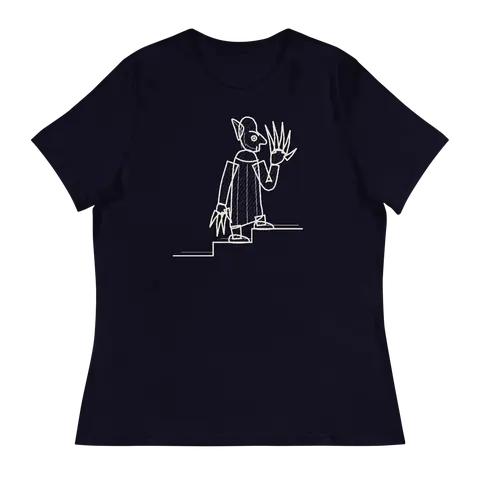
Harker describes the count dressed in black «from head to foot, without a single speck of colour about him anywhere». He looks at his hands and notes that they are broad, with squat fingers, hair growing in the centre of the palms and long nails filed to a point; he smells his breath. Days later he watches him leave by the castle window:
«I saw the whole man slowly emerge from the window and begin to crawl down the castle wall over that dreadful abyss, face down, with his cloak spreading out around him like great wings… just as a lizard moves along a wall.»
The inventory stays every bit as specific. Fifty boxes of earth from his castle, which the hunters tick off a list one by one. The Demeter running aground on Tate Hill Sands with the captain lashed to the wheel and an enormous dog that leaps ashore and vanishes: Stoker lifted a real wreck, that of the Russian Dmitry, driven onto the same sands around 1885. Blue flames on St George's Eve above the spots where treasure lies buried. Renfield, the «zoöphagous patient», breeding flies to feed spiders and spiders to feed a sparrow. Lucy come back from the dead, whom the papers call «the bloofer lady» because that is how children pronounce «beautiful». A consecrated wafer that scars Mina's forehead.
And the ending, which almost no film respects: there is no stake. Harker cuts the count's throat with a Nepalese kukri while Quincey Morris drives a bowie knife into his heart, and the body crumbles to dust.
The cape came out of a stage trap
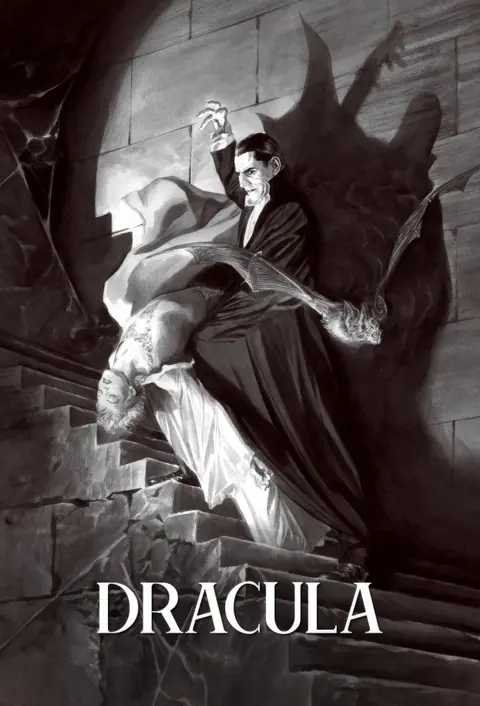
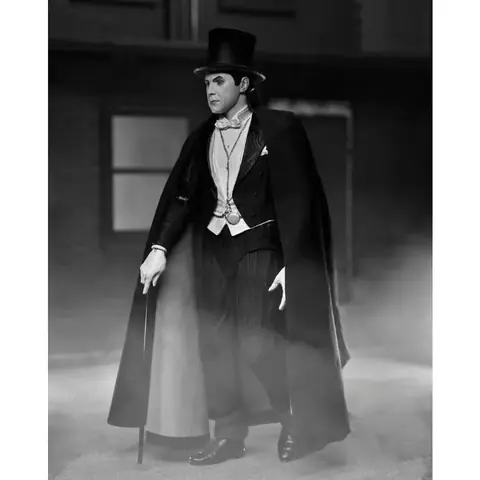
Stoker's count wears black and a cloak, but the evening dress and the stiff fan-shaped collar are not his: they come from the theatre. In 1924 the Irish actor Hamilton Deane staged the first adaptation authorised by Stoker's widow and put the count in white tie, with a black cloak and a towering collar. The collar had a technical job to do: it hid the actor's head as he dropped through a stage trap and made him seem to melt away.
John L. Balderston rewrote the play for America and it opened at the Fulton Theatre on Broadway in October 1927 with Béla Lugosi. Universal bought the rights to the play, not the novel, which is why Tod Browning's Dracula (1931) is Lugosi in Deane's cloak. The silhouette that still sells T-shirts is a piece of stage machinery.
Wisborg, the rats and the dawn
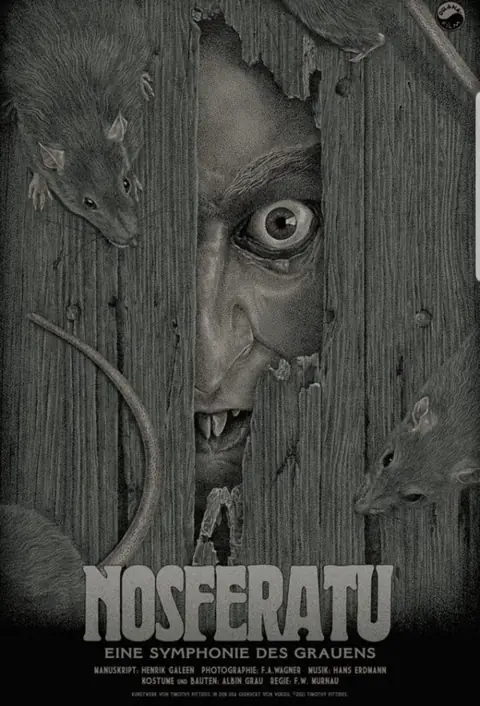
Prana Film was founded in 1921 by Enrico Dieckmann and Albin Grau, an artist and occultist of the Fraternitas Saturni. They commissioned the screenplay from Henrik Galeen and the direction from F. W. Murnau, and premiered Nosferatu, eine Symphonie des Grauens on 4 March 1922 in the Marmorsaal at Berlin Zoo. They had bought no rights: Dracula became Orlok, Harker became Hutter, Mina became Ellen, Renfield became Knock and London became the invented town of Wisborg.
Grau designed the sets, the costumes and that contract scrawled in Enochian signs which Knock signs. And the film put two things into the canon that Stoker never wrote: the vampire dies at dawn, and the plague travels with the rats. In the novel the count walks down Piccadilly in broad daylight, simply without his powers. Florence Stoker sued, Prana went bankrupt during the case, and in 1925 the court ordered every negative and print destroyed. It survived because prints had already been sold outside Germany.
From Villarías to Skarsgård
The strangest case is from 1931. While Browning shot by day, George Melford shot by night on the same sets, making a Spanish-language version with Carlos Villarías and Lupita Tovar; in the evening the crew watched the English rushes and hunted for better set-ups. It was given up for lost until April 1991, when the Cinemateca de Cuba announced a complete print in good condition.
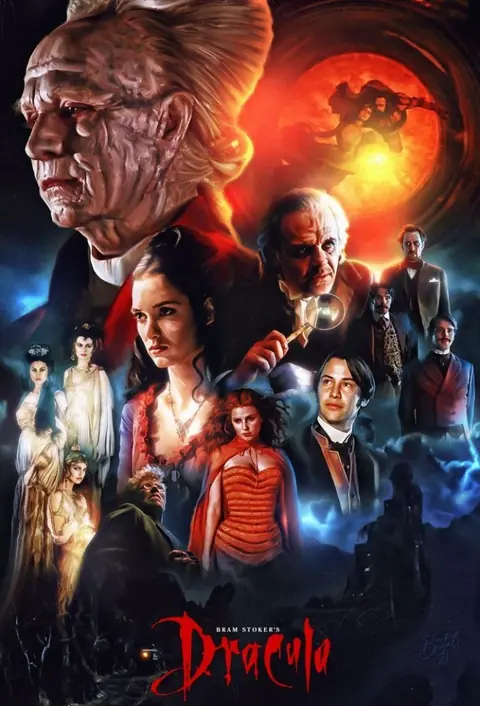
Terence Fisher's Dracula (1958) for Hammer, released in America as Horror of Dracula, put Christopher Lee in colour, with fangs and blood. Nosferatu the Vampyre (1979) is Herzog remaking Murnau with Klaus Kinski, and this time the count is allowed to be called Dracula: the novel is out of copyright. On Bram Stoker's Dracula (1992), Coppola sacked the effects team for telling him the job needed computers and set his son Roman to solve it with rear projection, models and double exposures; Eiko Ishioka won the Oscar for costume design. Shadow of the Vampire (2000) plays with the idea that Max Schreck really was a vampire. Van Helsing (2004) turns the Dutch professor into an action hero. The Last Voyage of the Demeter (2023) stretches a single chapter, the captain's log, to feature length. Renfield (2023) opens by dropping Nicolas Cage and Nicholas Hoult into the 1931 footage, in black and white. And Robert Eggers's Nosferatu (2024) gives Orlok back the moustache of a Transylvanian nobleman and the skin of a corpse.
The Swedish Dracula nobody asked for
From 10 June 1899 to 7 February 1900, the Stockholm newspaper Dagen serialised Mörkrets makter, «Powers of Darkness». It was sold as Dracula and it was not: nearly twice as long, with the count named Draculitz and turned into the head of an international social-Darwinist cult that stages sacrifices and means to rule the world. The three brides are a single blonde woman; the castle has a deaf-mute housekeeper.
In 1900 a far shorter version began to appear in Iceland, Makt myrkranna, signed by Valdimar Ásmundsson (1852-1902) in his newspaper Fjallkonan and published as a book in August 1901, with a preface signed «B. S.» hinting at a link to the Jack the Ripper murders. For a century it was taken for an ordinary translation. In 2014 the researcher Hans Corneel de Roos tracked down the full Icelandic text and saw that it was a different novel; in 2017 the Swede Rickard Berghorn pointed out that the Icelandic came from the Swedish. How much Stoker knew is still unclear.