









The draper's apprentice who studied under Darwin's bulldog
Herbert George Wells was born in Bromley, Kent, on 21 September 1866, and died in London on 13 August 1946. In between came three years as a draper's apprentice at Hyde's Drapery Emporium in Southsea (1880-1883), and the scholarship that got him out: from 1884 to 1887 he read biology at the Normal School of Science in South Kensington under Thomas Henry Huxley, the zoologist they called “Darwin's bulldog”.
That is what sets his monsters apart from everyone else's: they have anatomy, and they have a reason. The Martian is no little green man, it is an organism whose body evolution has withered and whose brain it has swollen. The Eloi and the Morlocks are a class difference stretched across a million years. He was nominated for the Nobel Prize in Literature four times and never won it.
Four novels in four years
Four books written almost back to back, when Wells was around thirty:
- The Time Machine (1895). It grew out of The Chronic Argonauts, an 1888 story published in his college magazine. It was serialised in The New Review between January and May 1895 and came out as a book from Heinemann on 29 May. The phrase “time machine” is his: before that it did not exist.
- The Island of Doctor Moreau (1 January 1896). The Times dismissed it as loathsome and repulsive, and the zoologist Peter Chalmers Mitchell accused him of scientific heresy. Sales went up.
- The Invisible Man (1897), serialised first in Pearson's Weekly and then published as a book by C. Arthur Pearson.
- The War of the Worlds: serialised in Pearson's Magazine from April to December 1897 — he was paid £200 for the rights — and published as a book by Heinemann on 19 January 1898.
Later came The First Men in the Moon (1901), with its sphere of Cavorite, and The Shape of Things to Come (1933), which he would take to the screen himself.
The inventory: brass, bandages and three legs
Wells describes things, not atmospheres, and that is why he can be drawn. The Martian of 1898 has an enormous head and brain, two large eyes and a beaked mouth on an octopus body, with whip-like tentacles that do duty as hands and as legs. What frightens is the machinery: the hooded tripod, the Heat-Ray, the Black Smoke, the handling-machines, and the red weed that swallows the landscape wherever there is water.
The time machine is the opposite: Victorian furniture, brass, a saddle and a couple of levers the traveller slips into his pocket. Around it, the White Sphinx that hides the apparatus, the Palace of Green Porcelain turned into a ruined museum and, at the end, a beach of crab-like creatures under a dying red sun.
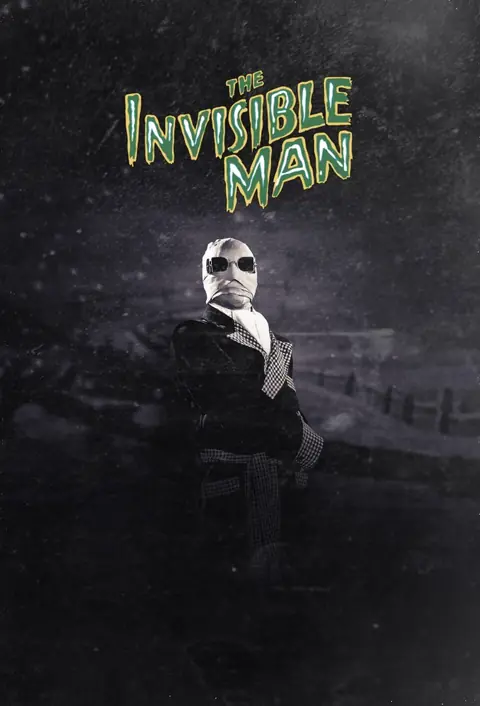
The invisible man is recognised by what he puts on: wide-brimmed hat, overcoat, gloves and a face bandaged all over save for a false nose, at the Coach and Horses inn in Iping. And on Moreau's island there are the House of Pain, the Leopard Man, the Hyena-Swine and the Sayer of the Law reciting the litany: “Not to go on all-fours; that is the Law. Are we not Men?”
What the cinema took, and what it made up on its own
Island of Lost Souls (Paramount, 1932), directed by Erle C. Kenton, with Charles Laughton as Moreau and Bela Lugosi as the Sayer of the Law, was banned in the United Kingdom until 1958; Wells loathed it. The Invisible Man (Universal, 1933) was directed by James Whale with Claude Rains, and the effect was signed by John P. Fulton: black velvet tights against black velvet sets, and some 63,000 frames retouched by hand. Rains's face is seen only as he dies. Four sequels between 1940 and 1944.
Things to Come (1936) is the odd one out: produced by Alexander Korda, directed by William Cameron Menzies and written by Wells himself, who left instructions down to the costumes and the music; of everything László Moholy-Nagy shot for the rebuilding of Everytown, ninety seconds survive.
George Pal's two classics both won the Oscar for effects. In The War of the Worlds (1953), directed by Byron Haskin, the designer Albert Nozaki swapped the tripod for a copper manta ray floating on three invisible legs that spark where they touch the ground, with the Heat-Ray set in a cobra's head; 1.4 million of the 2 million budget went on effects. In The Time Machine (1960), with Rod Taylor, the brass sledge with its spinning disc was designed by Bill Ferrari and built by Wah Chang; the plate on it reads “H. George Wells”.
Then came the Selenites Ray Harryhausen animated for Nathan Juran's First Men in the Moon (1964); the 2002 The Time Machine, directed by Simon Wells, the writer's great-grandson; Spielberg's tripods (2005), buried there all along and switched on by the lightning; the BBC's three-part Edwardian miniseries (2019); and Leigh Whannell's The Invisible Man (2020), with Elisabeth Moss and an optical suit in place of a serum.
The Brazilian who drew the Martians better than anyone
The first illustrations, the ones for the serialisation and for the 1898 English edition, were by Warwick Goble; the ones that founded the image of the Martian are other ones altogether. Henrique Alvim Corrêa, born in Rio de Janeiro in 1876 and settled in Belgium, began drawing the novel in 1903 with no commission from anybody; in 1905 he showed the drawings to Wells, who gave his blessing and preferred them to Goble's.
They appeared in a deluxe French edition, translated by Henry D. Davray and printed by L. Vandamme & Cie in Brussels in 1906: 132 illustrations, 32 of them full-page, in a print run of 500 copies. Alvim Corrêa died of tuberculosis in Brussels in 1910, aged 34. His long-legged tripods striding over the rooftops are still the look the genre cannot shake off.
Three footnotes that stand up to checking
- Wells coined the phrase “atomic bomb” in The World Set Free (1914). The novel fell into the hands of Leó Szilárd in 1932; the following year he conceived the nuclear chain reaction, and he acknowledged the debt.
- The panic over Orson Welles's broadcast of 30 October 1938 on CBS, with the invasion landing at Grovers Mill, New Jersey, was largely an invention of the newspapers, which were competing with radio for advertising. Jefferson Pooley, Michael Socolow and A. Brad Schwartz have documented that the frightened listeners were very few indeed.
- Devo's refrain “Are we not men? We are Devo!”, in Jocko Homo (1977), comes from the litany in the 1932 film, not from the book: Mark Mothersbaugh has said as much.