

Eleven years, four dead men and one old rope
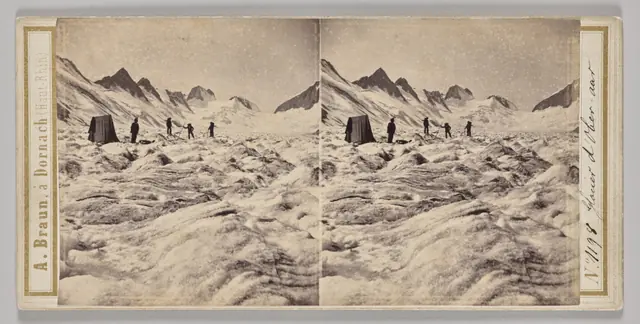
Mountaineering as a sport fits into eleven years. The golden age runs from 1854, when Alfred Wills climbed the Wetterhorn — it was the fourth ascent, not the first, but it was the one that made the whole business fashionable in England — to 1865. In between, in 1857, the Alpine Club was founded in London: the first mountaineering club in the world.
On 14 July 1865 seven men reached the summit of the Matterhorn by the Hörnli ridge: Edward Whymper, the French guide Michel Croz, the Reverend Charles Hudson, Lord Francis Douglas, the young and inexperienced Douglas Hadow, and the two Peter Taugwalders, father and son. Four of them died on the way down. The rope joining Douglas to the elder Taugwalder snapped: by mistake, it was the oldest and weakest of the three they were carrying. Douglas's body was never found. Three days later, on 17 July, Jean-Antoine Carrel finished the Italian ridge from the other side.
That accident is the reason this imagery exists at all. A sporting success would never have travelled across Europe; four deaths and a broken rope did.
The mountaineer cut his own plates
Edward Whymper (London, 27 April 1840 – Chamonix, 16 September 1911) was neither a writer nor a painter. He was a wood engraver, son of Josiah Wood Whymper (1813-1903), who ran one of the soundest xylography workshops in London — Charles Keene, Fred Walker and John William North all passed through it. He first went to the Alps in 1860 on a commission to draw landscapes; the climbing came afterwards.
When John Murray published Scrambles Amongst the Alps in the Years 1860-69 in 1871, the book carried 90 illustrations in the text, 21 full-page plates and 5 folding maps. In the credits Whymper did something unusual: he named the seven draughtsmen who transferred the drawings onto the wood — H. J. Boot, C. Johnson, J. Mahoney, J. W. North, P. Skelton, W. G. Smith and C. J. Staniland — and signed the engraving itself «J. W. and Edward Whymper». Father and son, cutting the blocks side by side. He printed the loose plates himself.
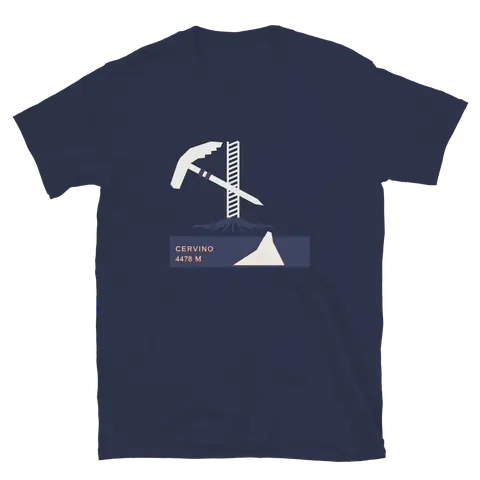
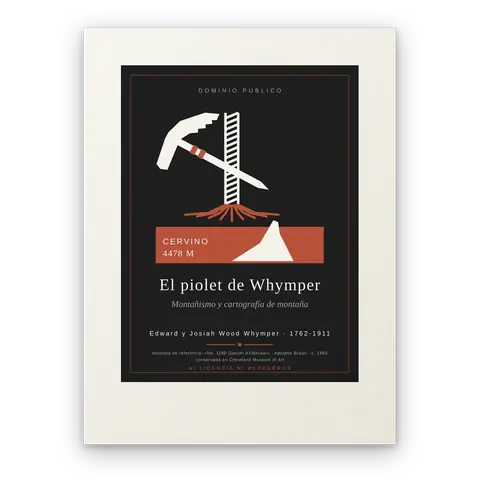
The tool came out of the same head. Until then the ice axe carried its blade in line with the shaft, like a woodsman's axe; in the 1860s Whymper turned it through ninety degrees and the adze appeared, letting a climber cut steps below him without hanging off the slope. That axe — broad adze, drooping pick, long ash shaft, iron ferrule — still lies crossed on half the mountaineering club badges in Europe.
The steeper the slope, the blacker the page
The other half of the collection is paper. Nicolaas Cruquius drew a riverbed in 1727 with depth contours at one-fathom intervals, and Dupain-Triel published a map of France in 1791 with contour lines every twenty metres. But the rule that governed the next hundred years was written by a Saxon: Johann Georg Lehmann (Baruth, 11 May 1765 – Dresden, 6 September 1811), in Darstellung einer neuen Theorie der Bezeichnung der schiefen Flächen im Grundriss, 1799. His system is a proportion, not a decoration: the steeper the slope, the thicker and closer the hachure, until at 45 degrees the paper goes entirely black. A map like that is read with the eye before the legend.
The classic Alpine map is built on that rule. The Dufour Map, directed by Guillaume-Henri Dufour (1787-1875) from the topographical office he founded at Carouge in 1838, appeared between 1845 and 1864: 25 sheets of 70 by 48 centimetres at a scale of 1:100,000, engraved on copper. From 1870 it was succeeded by Hermann Siegfried's (1819-1879) Siegfried Atlas, and by then the contour line was in charge: every 10 metres at 1:25,000, every 30 at 1:50,000.
Before any of them there was a model maker. Franz Ludwig Pfyffer von Wyher (1716-1802) spent twenty-four years, from 1762 to 1786, building a relief of central Switzerland out of ground brick, clay, charcoal, wax and card — 3.90 by 6.70 metres, at 1:11,500 and with no vertical exaggeration. It has been on display in the Gletschergarten in Lucerne since 1873.
The Matterhorn has been filmed four times
The first ascent reached the cinema sooner than you would expect, and it keeps coming back:
- 1928 — Der Kampf ums Matterhorn (The Fight for the Matterhorn), by Mario Bonnard and Nunzio Malasomma, from Carl Haensel's novel of the same name, with Luis Trenker as Carrel and Peter Voss as Whymper.
- 1938 — remade twice at once: the German Der Berg ruft (The Mountain Calls), directed by Trenker himself, and the British The Challenge, by Milton Rosmer and Trenker, scripted by Emeric Pressburger, produced by Alexander Korda, with Robert Douglas as Whymper.
- 1959 — Disney released Third Man on the Mountain (Ken Annakin), from James Ramsey Ullman's novel Banner in the Sky (1954), shot in Zermatt and at Rotenboden, with the Matterhorn renamed the Citadel.
Behind all of it sits the Bergfilm, the German mountain genre Arnold Fanck assembled from Das Wunder des Schneeschuhs (The Wonder of Skiing, 1920) onwards, which gave us Der heilige Berg (The Holy Mountain, 1926), Die weisse Hölle vom Piz Palü (The White Hell of Piz Palü, 1929) and Das blaue Licht (The Blue Light, 1932). Its rule was to shoot on the rock face rather than on a set, and the habit has never been broken. Clint Eastwood filmed The Eiger Sanction on the north face of the Eiger between August and September 1974; on 13 August a falling stone killed the 26-year-old British climber David Knowles and fractured the pelvis of cameraman Mike Hoover. Nordwand (North Face, 2008, Philipp Stölzl) returns to that same wall to tell the story of the 1936 attempt and the slow death of Toni Kurz.
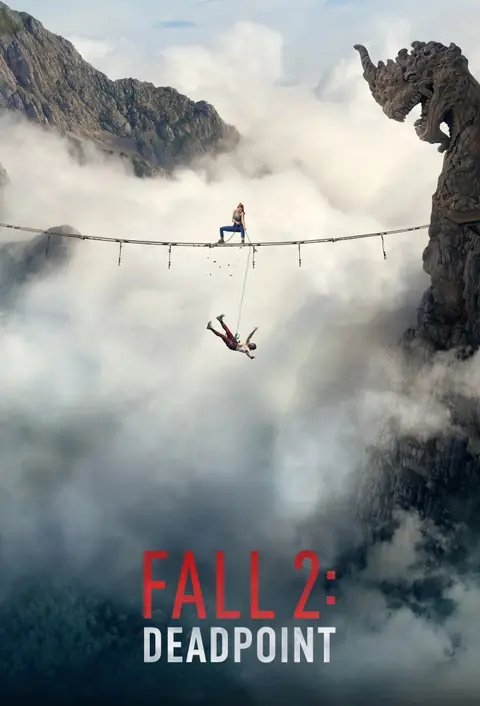
Cliffhanger (1993, Renny Harlin) says Rockies and shows you the Dolomites: Cortina d'Ampezzo, the Cristallo, the Tofane, Faloria. Simon Crane was paid a million dollars to cross from one aeroplane to another at 4,600 metres — the most expensive aerial stunt ever filmed, according to Guinness. The 2026 reboot, by Jaume Collet-Serra with Lily James and Pierce Brosnan, puts the story back in the Dolomites, though it was shot in Austria.
The postcard Walt Disney sent to himself
While Third Man on the Mountain was shooting in Zermatt, Walt Disney bought a postcard of the Matterhorn from a souvenir stall, put it in an envelope and posted it to the architect Vic Greene with four words written on the back:
Vic. Build This. Walt.
The Matterhorn Bobsleds opened at Disneyland on 14 June 1959, the same year as the film, with the trees shrinking towards the summit to fake the scale.
The whole chain: the shape millions of people picture when they think «mountain» is a four-ridged pyramid fixed by a London engraver cutting boxwood blocks alongside his father, turned into plot by a German novelist, filmed twice by Trenker, and ending its days as a rollercoaster in California.