









RELIC

Collection

Gods, Monsters and Meanders

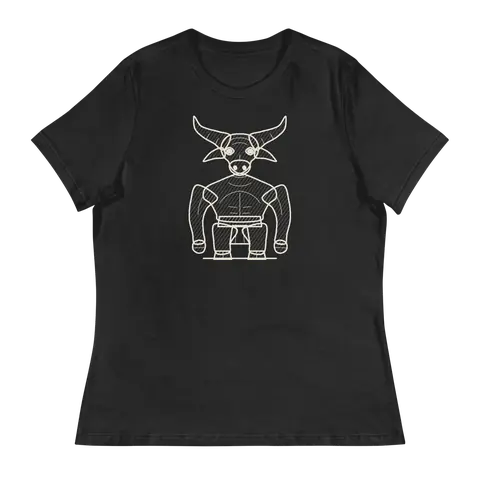
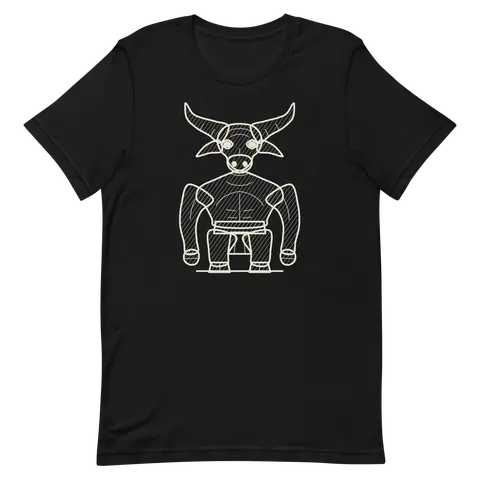
This is the raw material behind the Minotaur in The Hunger Games, the rattlesnake-tailed Medusa of Clash of the Titans and Guillermo del Toro's faun. Here are the originals — a pediment from Corfu, a handful of coins from Knossos, some Attic vases — each with its date and its museum, and what every film helped itself to.

Medusa · el Minotauro y el laberinto · Prometeo · Icaro · Cerbero · las Moiras · Caronte y el óbolo · la lechuza de Atenea · el laurel · columnas dóricas · cerámica ática

Author
Homero, Hesíodo y Ovidio para los textos; los pintores de vasos áticos y los grabadores neoclásicos para las imágenes
Period
s. VIII a.C. – s. II d.C.
Works drawing on it
12
Pieces
21

What you see in this collection

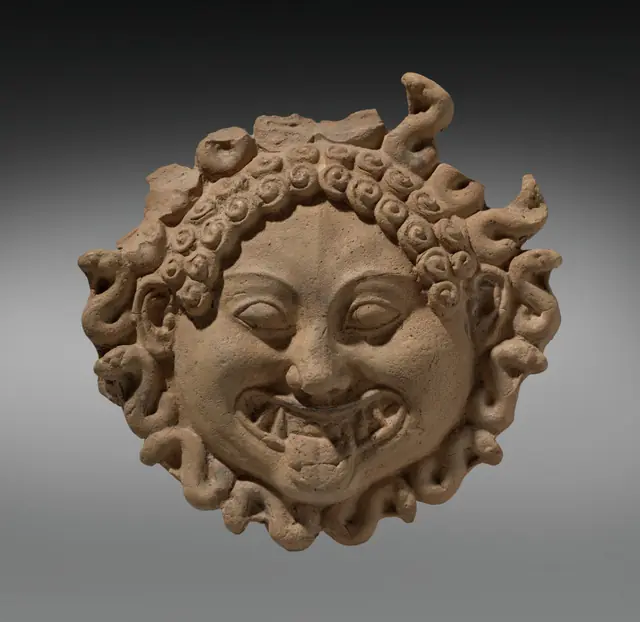
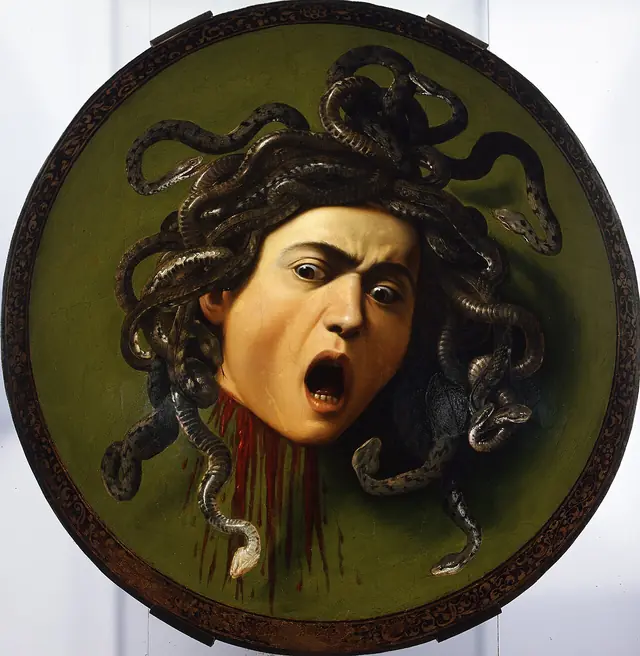
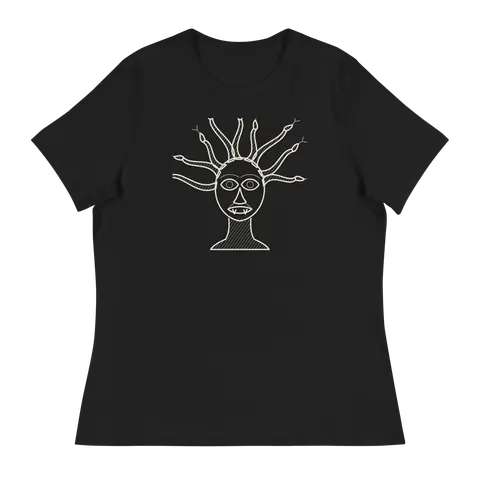
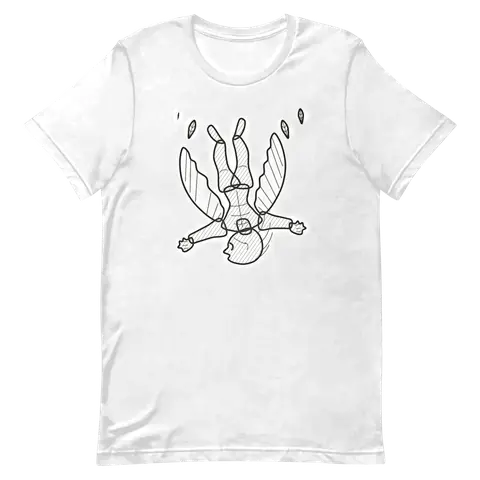
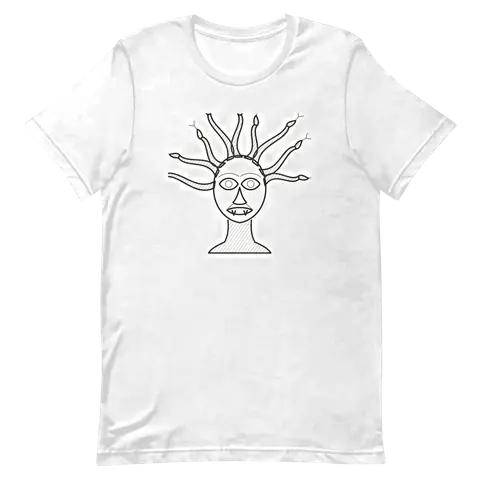
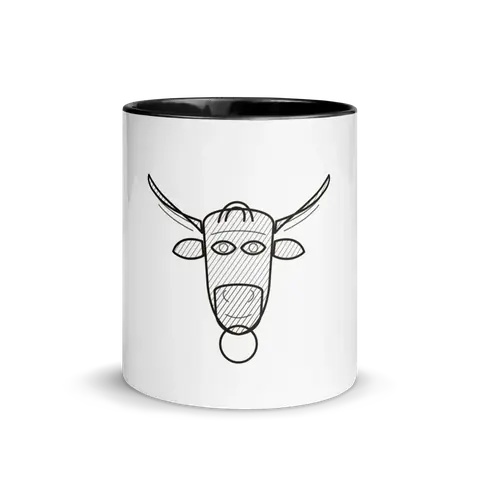
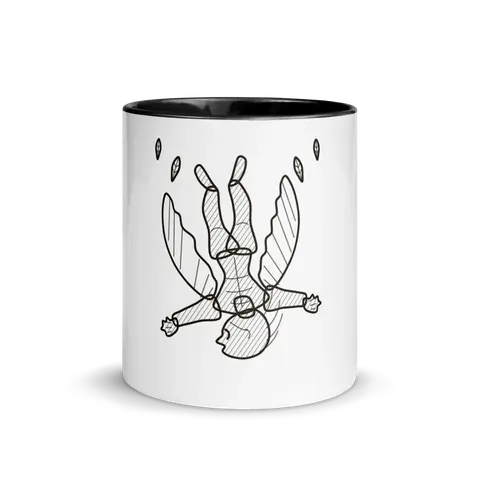
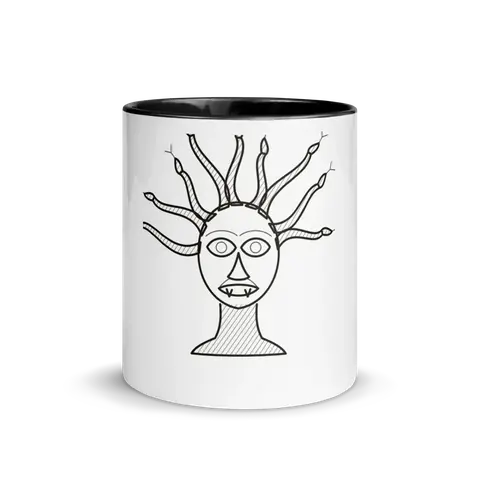
The archaic gorgoneion seen head-on: tongue out, fangs, snakes knotted at the belt. Unicursal labyrinths from coinage, square and circular, and the meander fret that spawns them. Plus a very specific repertoire of scenes: the eagle at Prometheus's liver, Cerberus with two heads rather than three, Charon leaning on the pole of his boat, the spindle and the cut thread of the Moirai, the frontal owl with its crescent moon and the letters ΑΘΕ, the laurel crown and the fluted Doric shaft with no base.

The face carved on Corfu

The Medusa we all recognise doesn't come from a text, it comes from a building. Around 580 BC the temple of Artemis went up on Corcyra — Corfu — one of the first Doric temples built entirely in stone. Its west pediment, roughly 22 metres wide and 3.15 high, is the oldest surviving sculpted pediment in Greece, and almost three metres of it is taken up by a Gorgon: knees bent in mid-run, tongue out, fangs, snakes knotted at the belt. Her sons flank her, Pegasus on the left and Chrysaor on the right, with two large panthers beyond them.

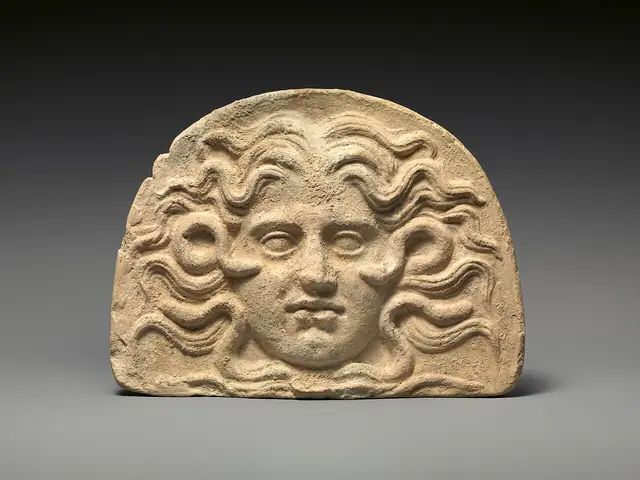
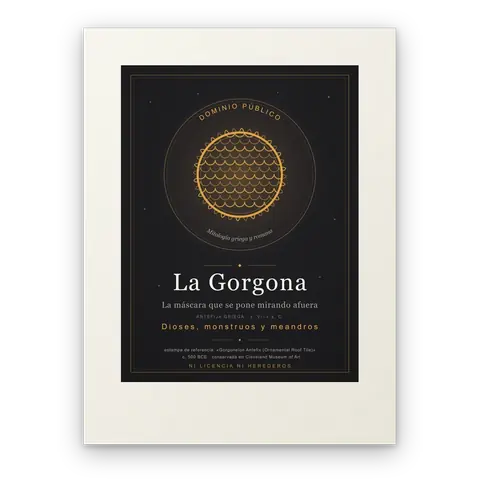
That frontal face — the gorgoneion — circulated as a charm long before it was a character: it went on shields, on kilns, on roof tiles, to frighten off whatever might be coming. The beautiful, sorrowful Medusa now taken as the default is much later. The archaic one is a deliberately ugly mask, made to look straight at you rather than at the rest of the scene. Both registers live side by side in this collection, and they don't make the same T-shirt.

A labyrinth that fitted on a coin

The labyrinth entered art not as a floor plan but as a stamp. Knossos began minting shortly after 425 BC with a design of interlocking meanders; the square labyrinth followed, and then the circular one on silver of 300-270 BC. On some pieces the Minotaur sits at the centre.

What matters is what they actually drew: a unicursal route. A single path, no forks and no dead ends, winding to the centre and back out again. You don't get lost in a Greek labyrinth — you just take a long time. Confusing it with the branching maze, the sort made of English hedges, is a modern habit, and it explains why so many labyrinth films draw the wrong shape. The meander on the coin, what's more, is the same motif as the fret running round the rim of half the Attic pottery ever made: the ornament and the myth are literally the same stroke.

Red and black without a drop of paint

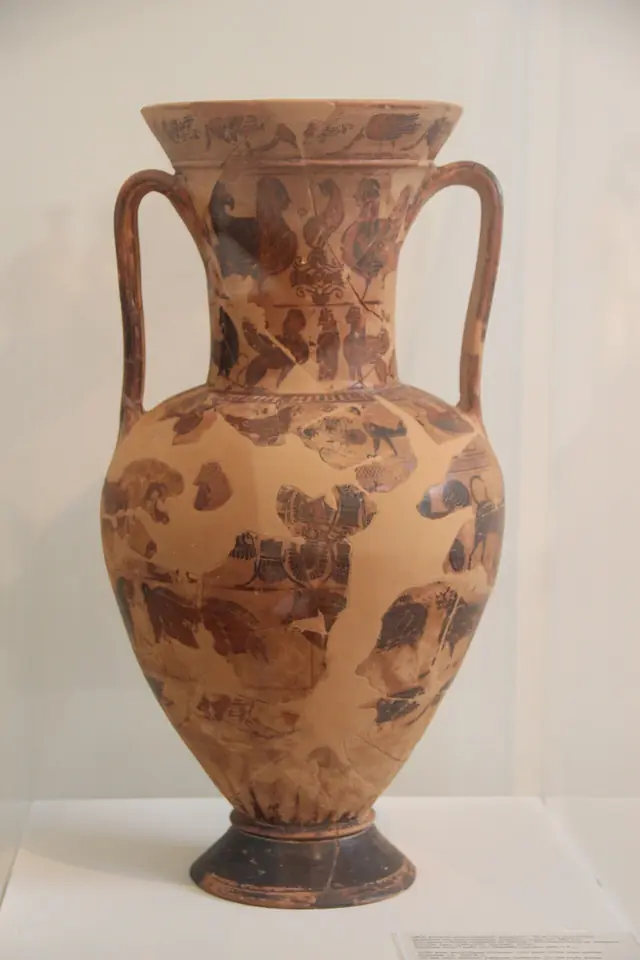
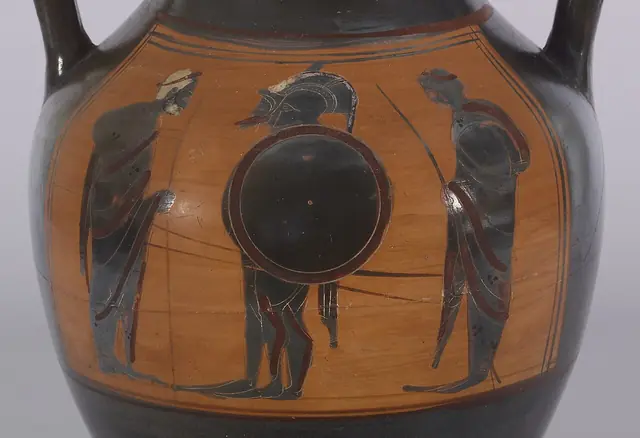
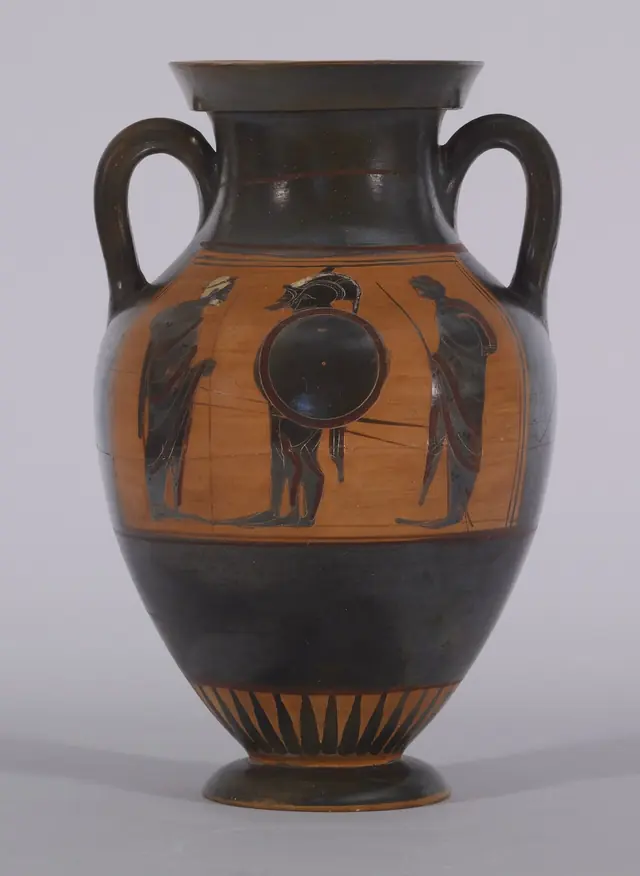
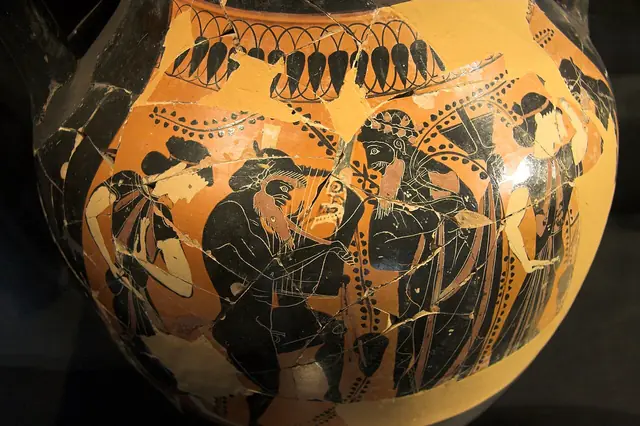
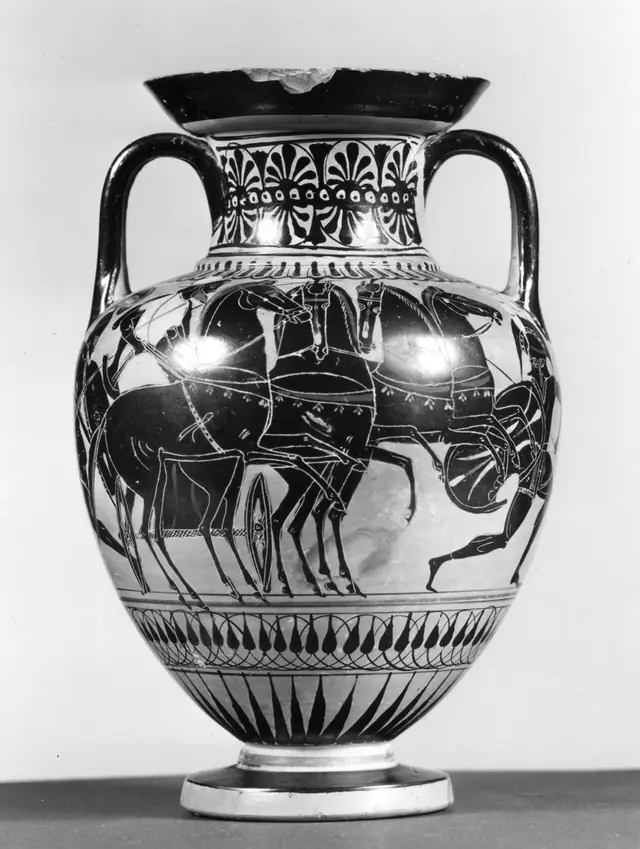
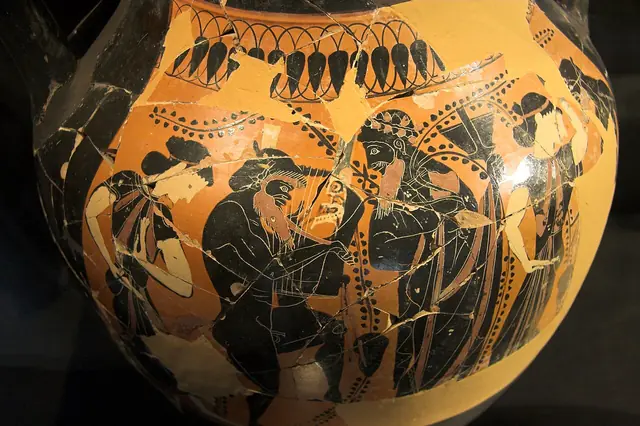
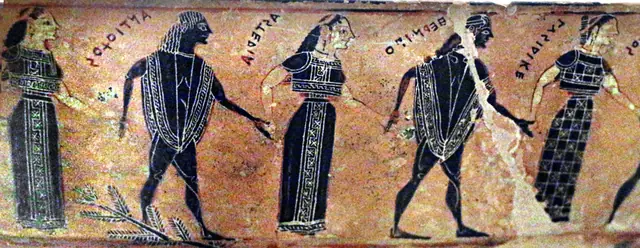
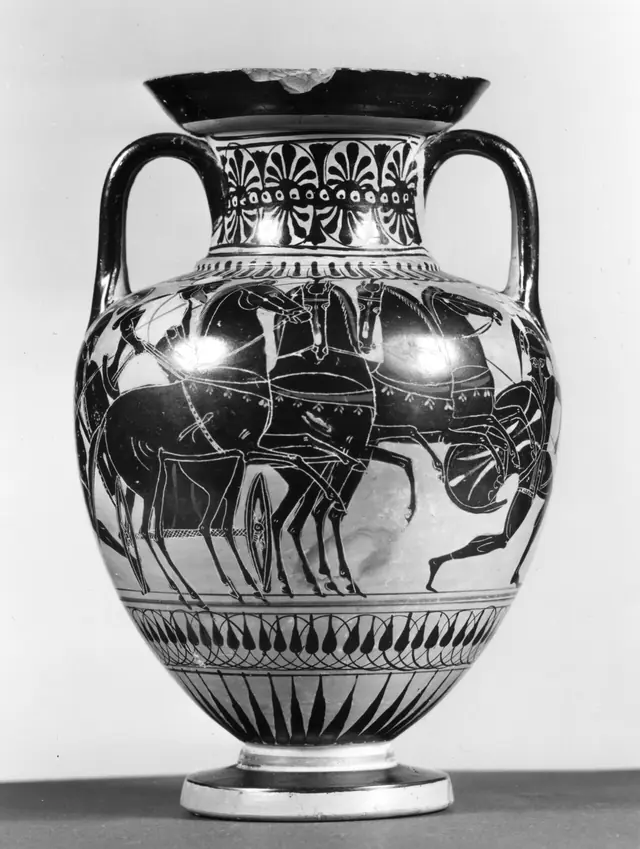
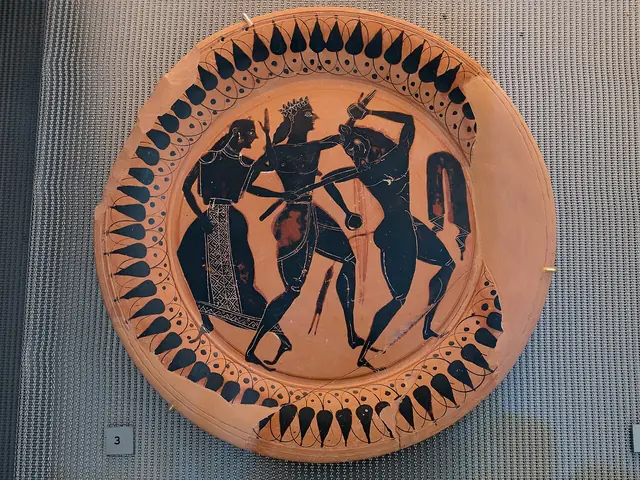
Here's the fact almost nobody knows, and the one that decides how this collection gets printed: there is no black pigment on an Attic vase. No glaze, no ink. The painter worked with a slip made from the same clay as the pot, levigated until it was extremely fine. The colour comes from the kiln.

Firing runs in three stages. First oxidising, vents open, up to around 800 °C: pot and drawing come out the same red. Then the vents are shut and green wood or damp leaves are thrown in, taking it to roughly 950 °C; with the oxygen gone, red iron oxide turns to black magnetite and the fine layer sinters. Finally the draught is opened again: the porous body takes in air and goes back to red, while the compacted film stays black for good. Two colours, one material, three changes of air. Around 530 BC someone in Athens reversed the arrangement — figures in red against a black ground — and for a few years bilingual amphorae were made with the same scene in black on one side and red on the other.

Scenes with a date and an inventory number

Prometheus isn't a concept: he's a Laconian black-figure cup by the Arkesilas Painter, 560-550 BC, now in the Vatican's Museo Gregoriano Etrusco under inventory 16592. The same tondo carries both sibling punishments: Atlas holding up the sky and Prometheus bound with the eagle at his liver.

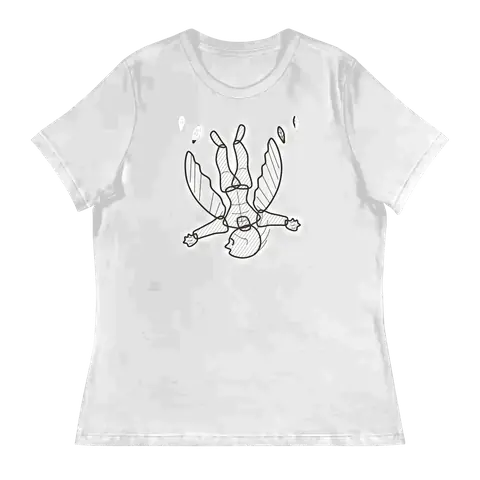
Charon turns up around 450 BC on white-ground lekythoi, the oil flasks left in Attic graves: a gaunt ferryman, coarse tunic over one shoulder, leaning on his pole while Hermes pushes the dead towards the boat. The obol in the mouth is documented in Kerameikos burials from the fifth century BC, though whether it was general practice or an occasional gesture is still argued over. The owl comes off a coin: the Athenian tetradrachm, struck from about 510 BC, with Athena in profile on the obverse — three olive leaves on the helmet — and on the reverse the owl with its head turned to the front, a two-leaf olive sprig, a crescent moon and three letters, ΑΘΕ. Neither the helmet leaves nor the moon appear on the earliest dies: they were added after the Persian Wars. And Cerberus, who has fifty heads in Hesiod, usually gets two on the vases: the textbook three are a compromise between what the myth said and what would fit on the belly of a pot.

Who put all this on paper

Between the ancient object and a printable design lies a chain of engravers. In 1793 John Flaxman's compositions for the Iliad and the Odyssey were published in Rome, engraved by Tommaso Piroli: 34 plates for one and 28 for the other, drawn while Flaxman was living in Rome between 1787 and 1794. They are pure outline, with no shading and no volume. That bare line was copied for half a century and is still visible in any clean-line comic.

The other pillar is a dictionary. The Ausführliches Lexikon der griechischen und römischen Mythologie, founded by Wilhelm Heinrich Roscher in 1884 and published by Teubner in Leipzig until 1937 — six volumes and four supplements — remains the fullest catalogue of mythological names, and it is scattered throughout with engravings of pieces that in many cases are no longer where they were when they were drawn.

From Crete to District 12

Suzanne Collins has said where The Hunger Games came from: the myth of Theseus. Athens sent its young to Crete as tribute for the Minotaur, and tribute is precisely the word Collins uses for the children who leave the districts. Katniss, by her own account, is a futuristic Theseus; on top of that she built in the rules of the Roman arena and her childhood memory of Spartacus (1960), the gladiator film she grew up with. The saga rolls on: Sunrise on the Reaping, the 2025 novel, reaches cinemas on 20 November 2026.

The labyrinth has produced two films that eye each other warily. Labyrinth (1986) sends a girl to rescue her brother on the other side; Pan's Labyrinth (2006) makes the same descent against the backdrop of a war. Guillermo del Toro has insisted that his creature is a faun and not Pan — the Spanish title, El laberinto del fauno, says so — and the English release renamed it after Pan anyway.

Then there's what cinema invented and can never take back. The Medusa of Clash of the Titans (1981) has a serpent's body ending in a rattle because Ray Harryhausen decided she should: he was the first to give her one, explaining that earlier screen Medusas were an actress with rubber snakes in her hair that all bounced in unison when she walked, which is why he redesigned her with a serpentine body. Nobody had depicted her that way in two and a half thousand years, and today it's the default image. On 17 July 2026 Christopher Nolan released The Odyssey, the first film shot entirely with IMAX film cameras.
Where the designs come from

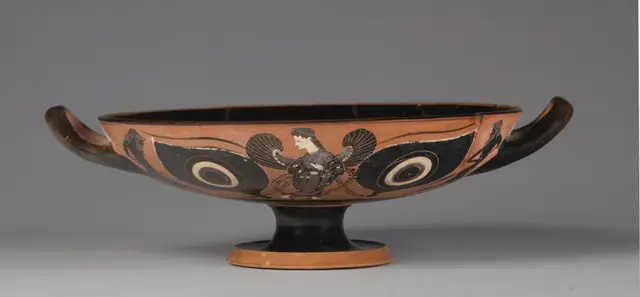
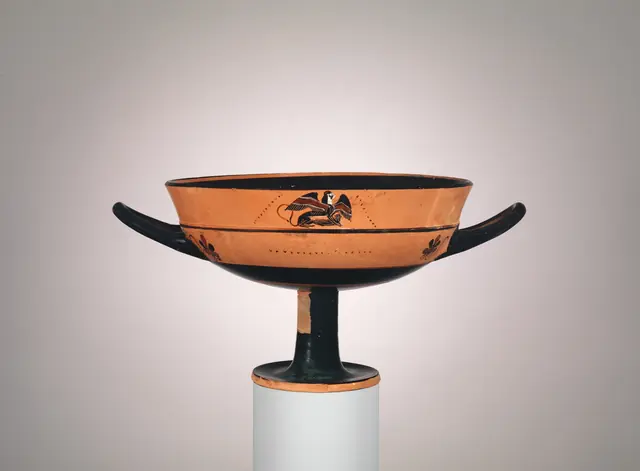
Terracotta Little Master cup
Terracotta Little Master cup · ca. 565–550 BCE record
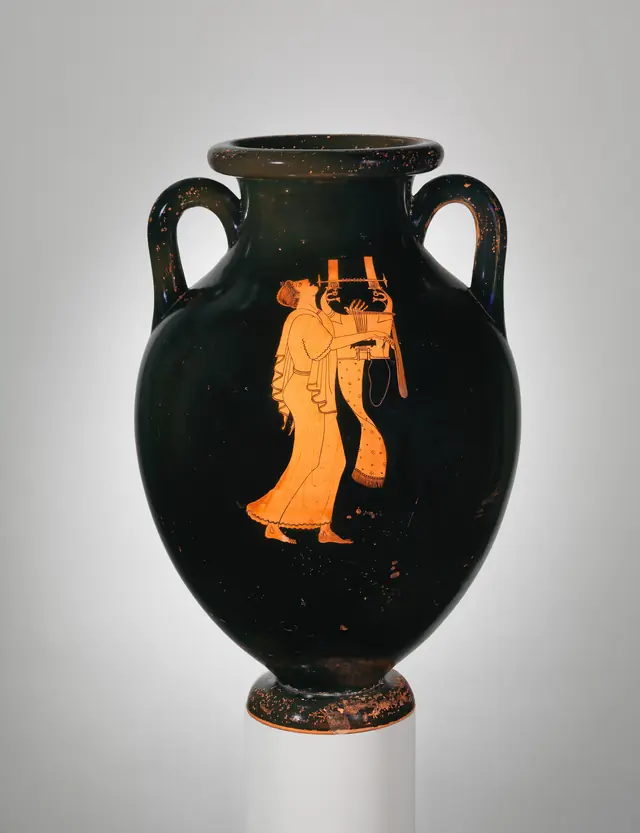
Terracotta amphora (jar)
Terracotta amphora (jar) · Berlin Painter · ca. 490 BCE record
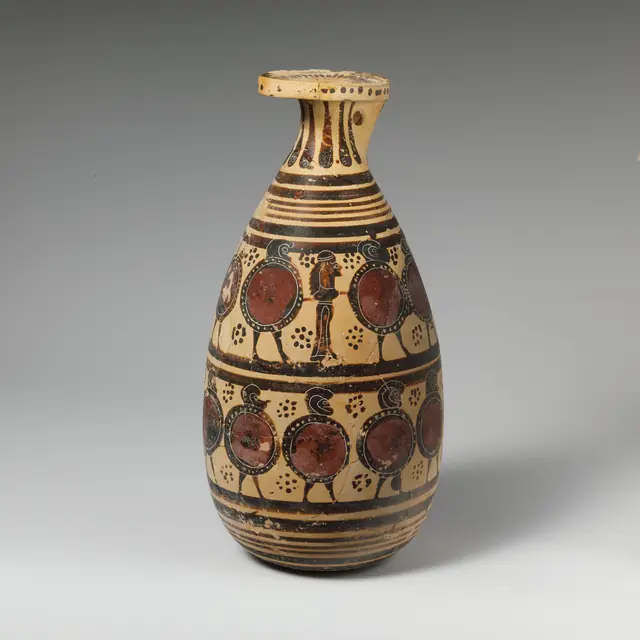
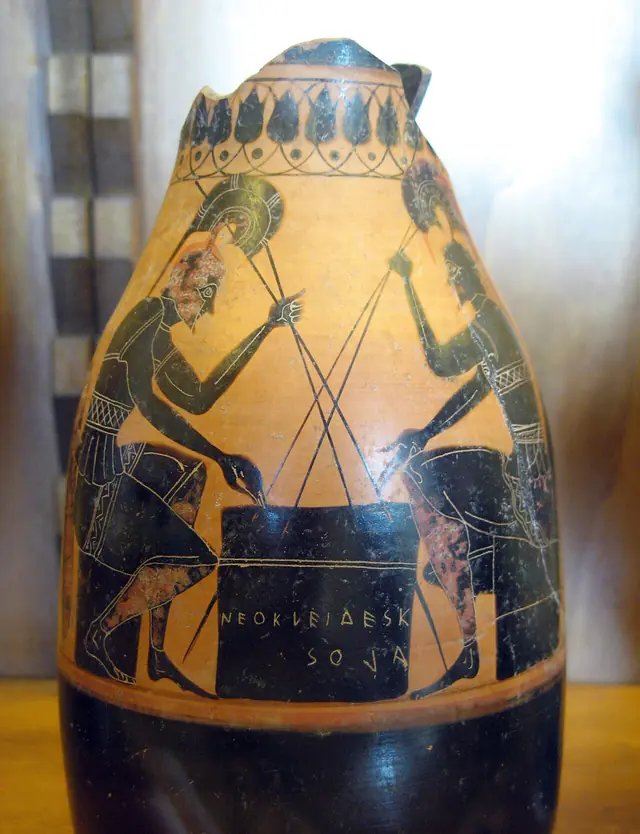
Terracotta alabastron (perfume vase)
Terracotta alabastron (perfume vase) · Late Warrior Frieze Vases · ca. 590–570 BCE record
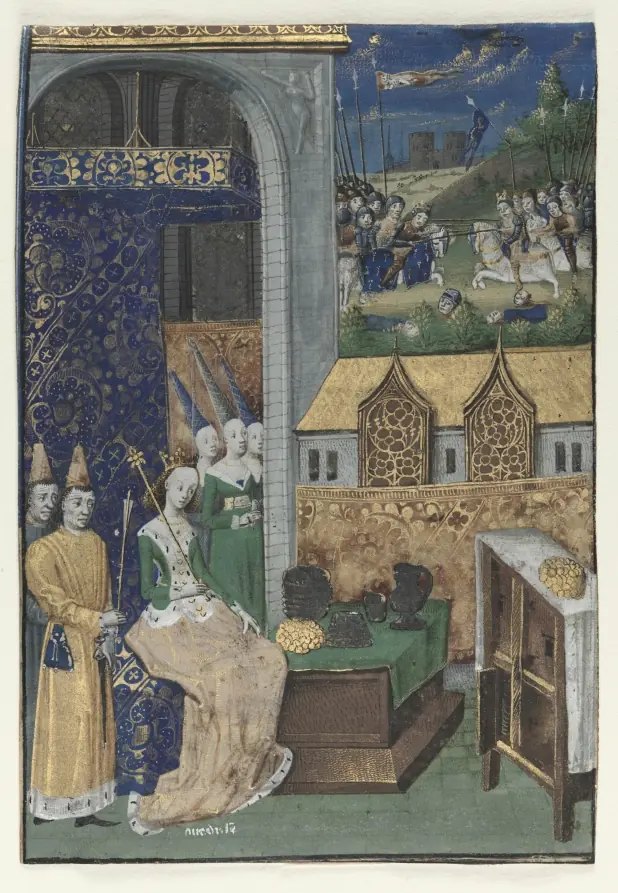
Single Miniature Excised from Boccaccio's Des Cleres et nobles femmes: Queen Medusa and Her Court
Single Miniature Excised from Boccaccio's Des Cleres et nobles femmes: Queen Medusa and Her Court · Maître François (French) · c. 1470 record
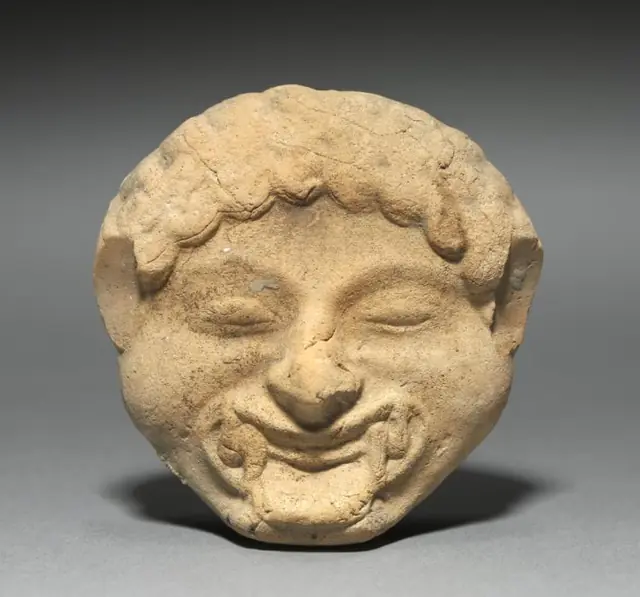
Gorgoneion Antefix (Ornamental Roof Tile)
Gorgoneion Antefix (Ornamental Roof Tile) · c. 500 BCE record
Black-Figure Eye Cup: Iris and Satyrs (A, B); Gorgoneion (I)
Black-Figure Eye Cup: Iris and Satyrs (A, B); Gorgoneion (I) · c. 520–510 BCE record
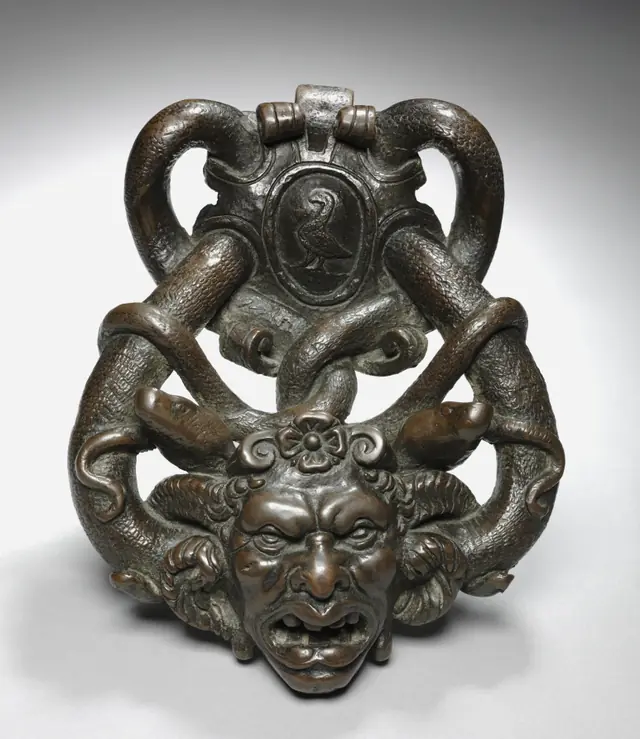
Doorknocker with Gorgon Head
Doorknocker with Gorgon Head · mid-1500s record
Gorgoneion Plaque
Gorgoneion Plaque · c. 525–475 BCE record
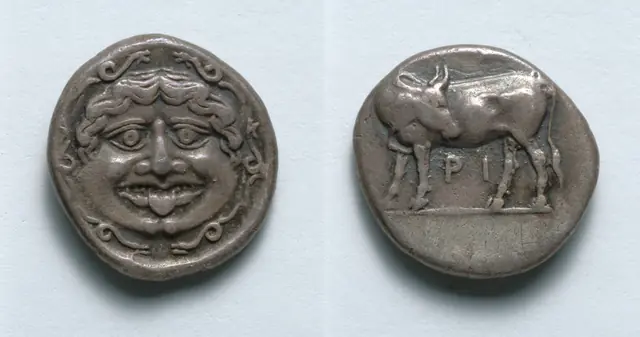
Hemidrachm: Gorgoneion (obverse); Bull (reverse)
Hemidrachm: Gorgoneion (obverse); Bull (reverse) · c. 400 BCE record
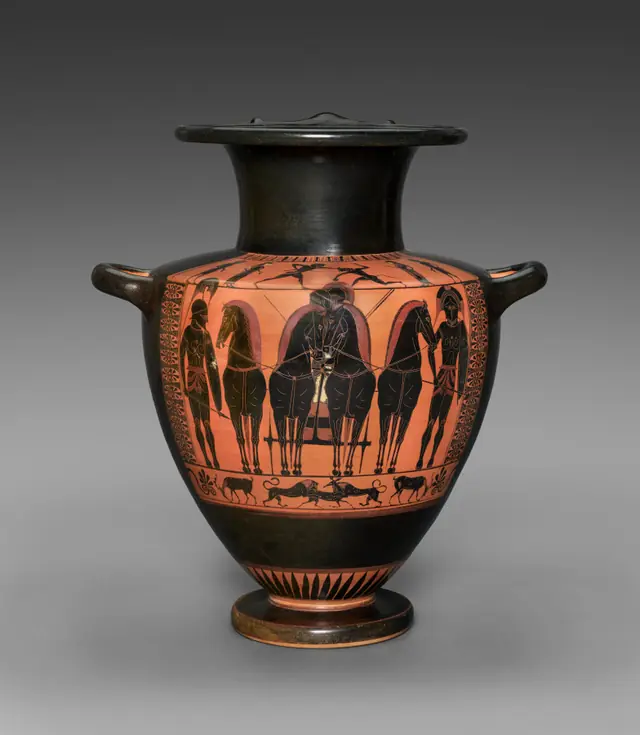
Black-Figure Hydria (Water Vessel): Frontal Quadriga (Body); Theseus and Minotaur (Shoulder)
Black-Figure Hydria (Water Vessel): Frontal Quadriga (Body); Theseus and Minotaur (Shoulder) · Antimenes Painter (Greek, Attic, active c. 530–510 BCE) · c. 520 BCE record
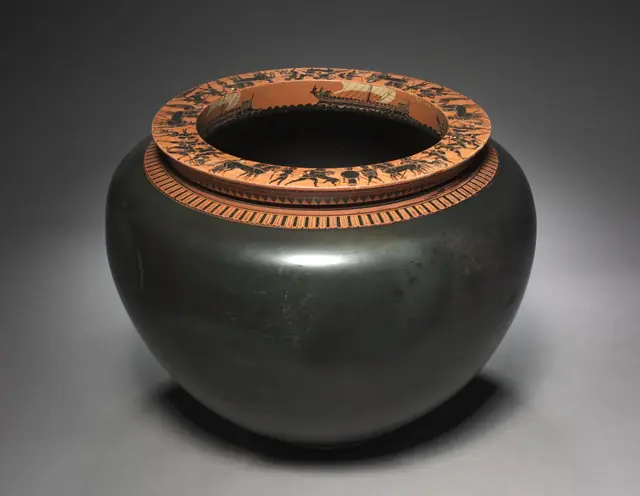
Black-Figure Dinos (Mixing Vessel): Warships (Int.); Heroic Scenes (Top)
Black-Figure Dinos (Mixing Vessel): Warships (Int.); Heroic Scenes (Top) · Antimenes Painter (Greek, Attic, active c. 530–510 BCE) · c. 520–515 BCE record
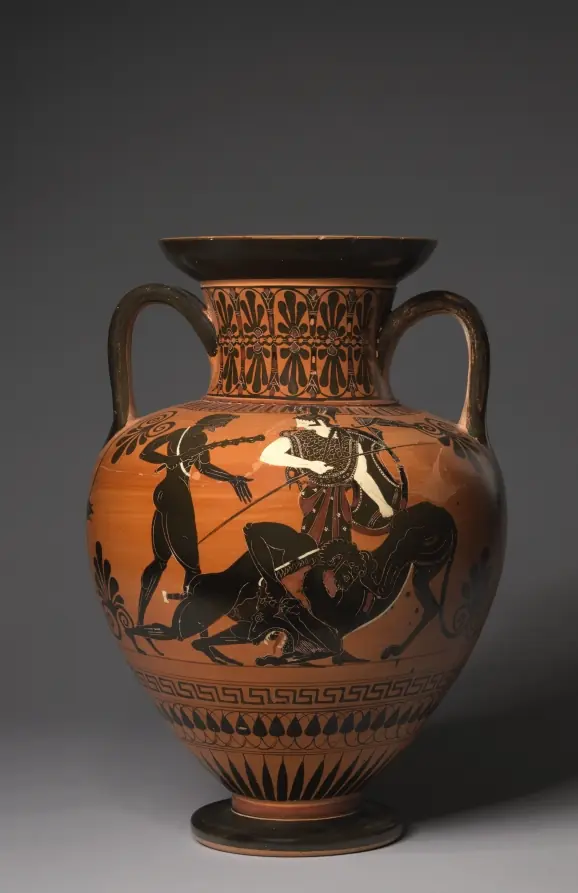
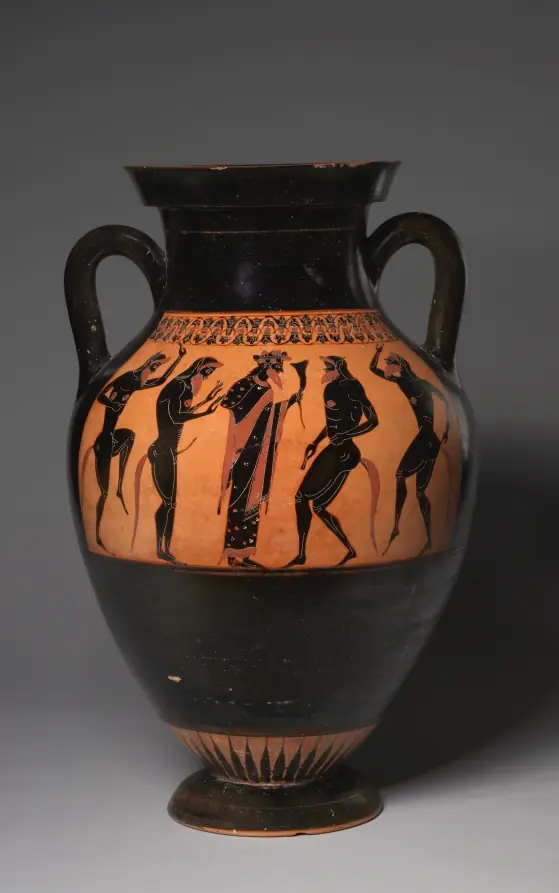
Black-Figure Neck-Amphora (Storage Vessel): Herakles and Nemean Lion (A); Dionysos, Satyrs, and Maenads (B)
Black-Figure Neck-Amphora (Storage Vessel): Herakles and Nemean Lion (A); Dionysos, Satyrs, and Maenads (B) · Painter of Berlin 1899 (Greek, Attic) · 515–510 BCE record
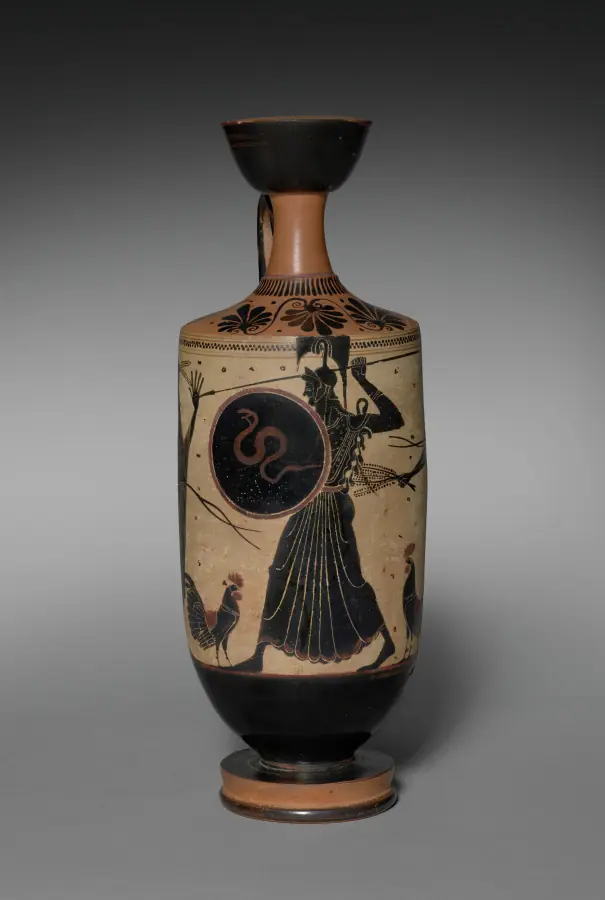
Black-Figure White-Ground Lekythos (Oil Vessel): Athena between Cocks and Hieropoioi (Officials)
Black-Figure White-Ground Lekythos (Oil Vessel): Athena between Cocks and Hieropoioi (Officials) · Athena Painter (Greek, c. 500–475 BCE) · 500–485 BCE record
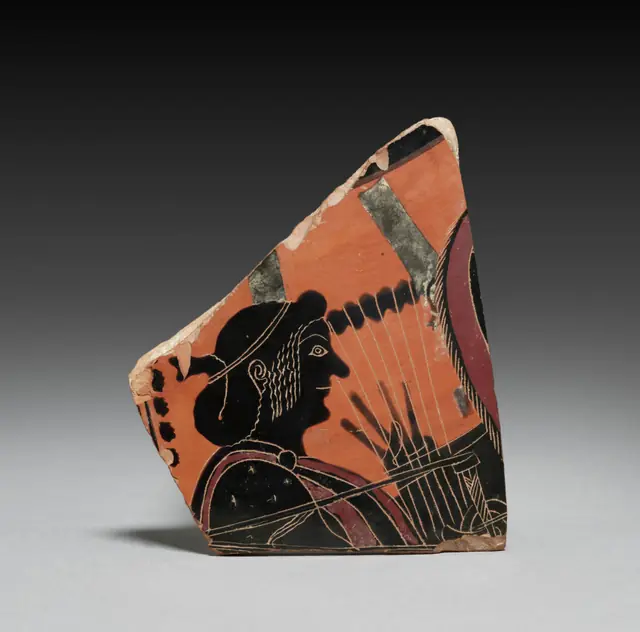
Fragment from Black-Figure Neck-Amphora of Panathenaic Shape (Storage Vessel): Apollo with Lyre
Fragment from Black-Figure Neck-Amphora of Panathenaic Shape (Storage Vessel): Apollo with Lyre · Antimenes Painter (Greek, Attic, active c. 530–510 BCE) · c. 520 BCE record
Black-Figure Amphora (Type B; Storage Vessel): Battling Warriors (A); Dionysos and Satyrs (B)
Black-Figure Amphora (Type B; Storage Vessel): Battling Warriors (A); Dionysos and Satyrs (B) · The Bateman Group · c. 530–520 BCE record
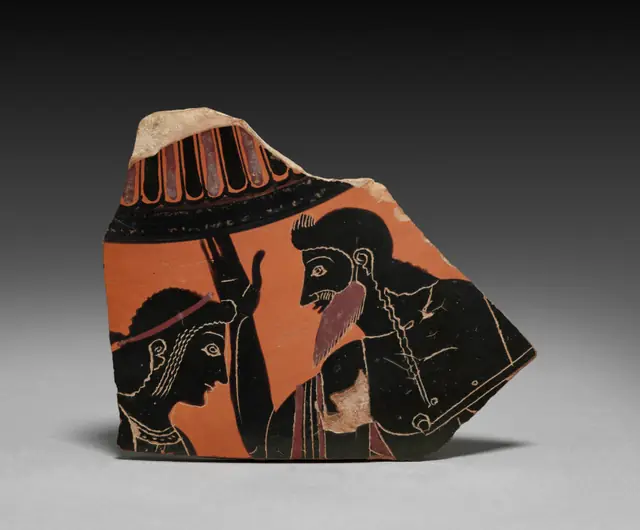
Fragment from Black-Figure Neck-Amphora of Panathenaic Shape (Storage Vessel): Apollo and Zeus
Fragment from Black-Figure Neck-Amphora of Panathenaic Shape (Storage Vessel): Apollo and Zeus · Antimenes Painter (Greek, Attic, active c. 530–510 BCE) · c. 520 BCE record
149Medusa (Lightcurve Inversion)
149Medusa (Lightcurve Inversion) · Astronomical Institute of the Charles University : Josef Ďurech, Vojtěch Sidorin · 2014-04-15 13:09:12 record
Alain-Fournier - Il grande amico (Le Grand Meaulnes) - n.1 collana Medusa Mondadori 1933 AA204968
Alain-Fournier - Il grande amico (Le Grand Meaulnes) - n.1 collana Medusa Mondadori 1933 AA204968 · Arnoldo Mondadori Editore · 1933 record
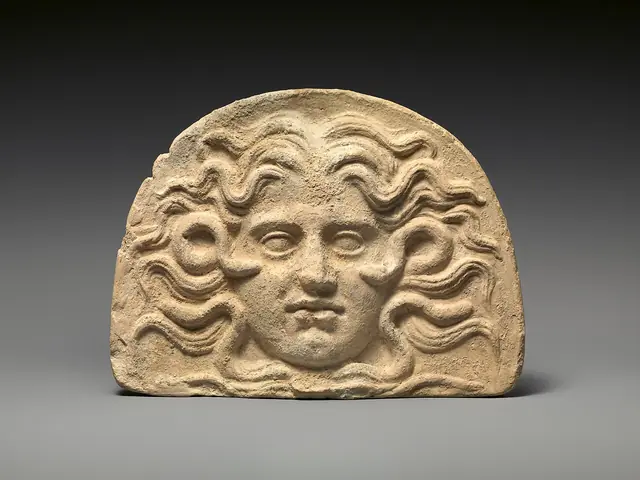
Antefix, head of Medusa
Antefix, head of Medusa · 4th century BC record
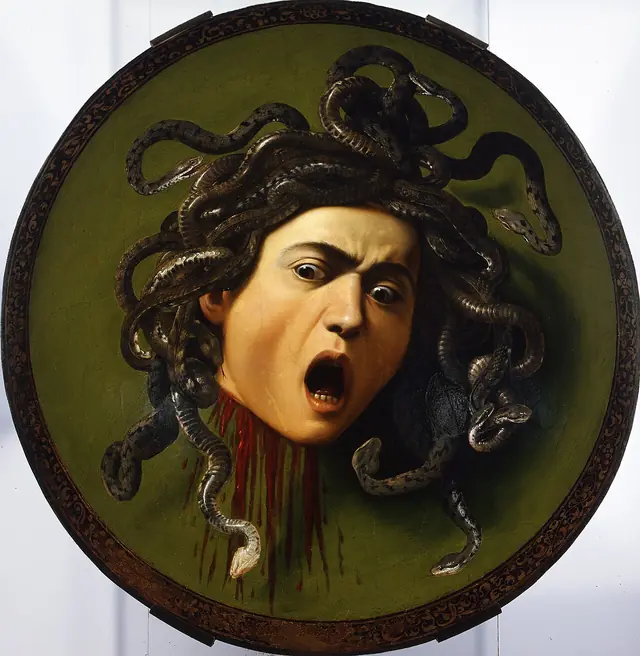
Medusa title QS:P1476,en:"Medusa" label QS:Len,"Medusa"
Medusa title QS:P1476,en:"Medusa" label QS:Len,"Medusa" · Caravaggio · from 1597 until 1598 date QS:P571,+1597-00-00T00:00:00Z/8,P5 record
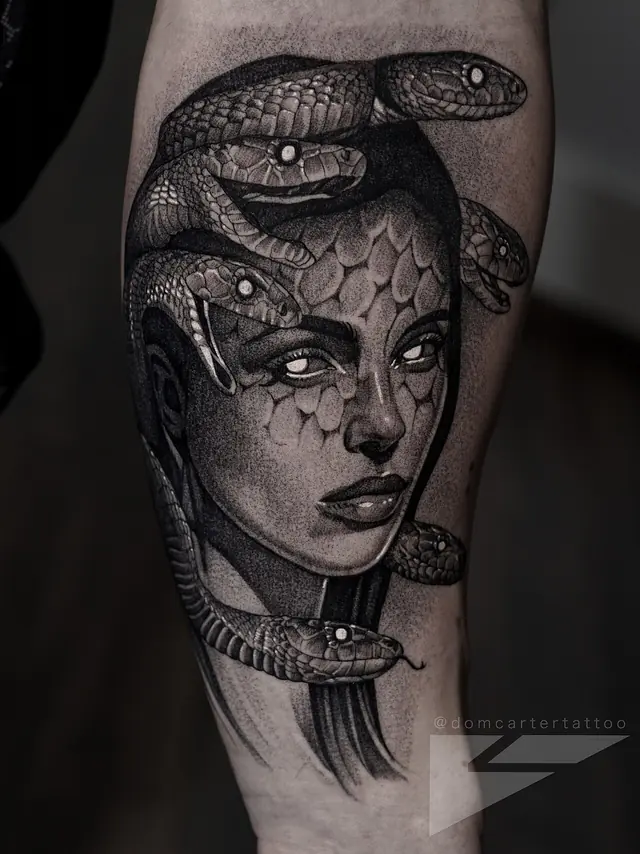
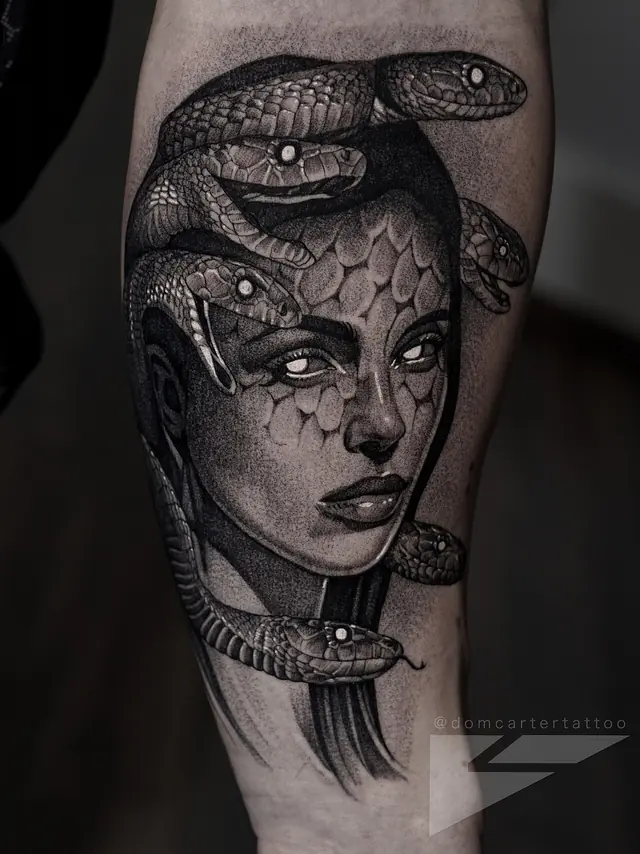
Dom Carter Medusa Tattoo
Dom Carter Medusa Tattoo · DomCarterTattoo · 2018-12-30 record
Medusa (Six Flags Discovery Kingdom) 01
Medusa (Six Flags Discovery Kingdom) 01 · Tinned Elk · taken in 30 Oct 2007 uploaded on the same date record
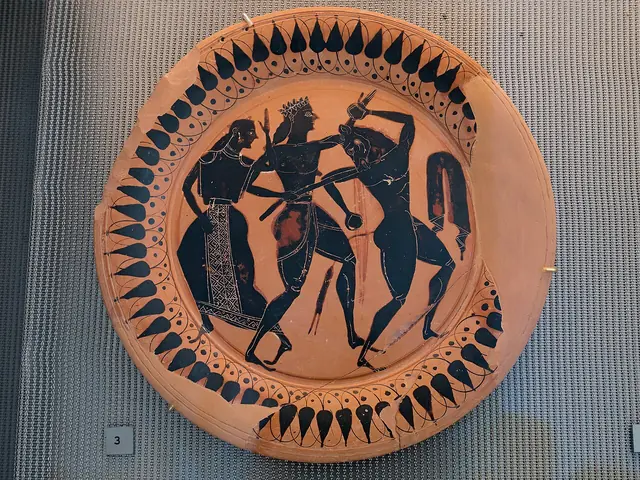
Black figure plate, Lydos, Theseus and Minotaur, ACMA, 190737
Black figure plate, Lydos, Theseus and Minotaur, ACMA, 190737 · Zde · 2019-06-11 08:08:50 record
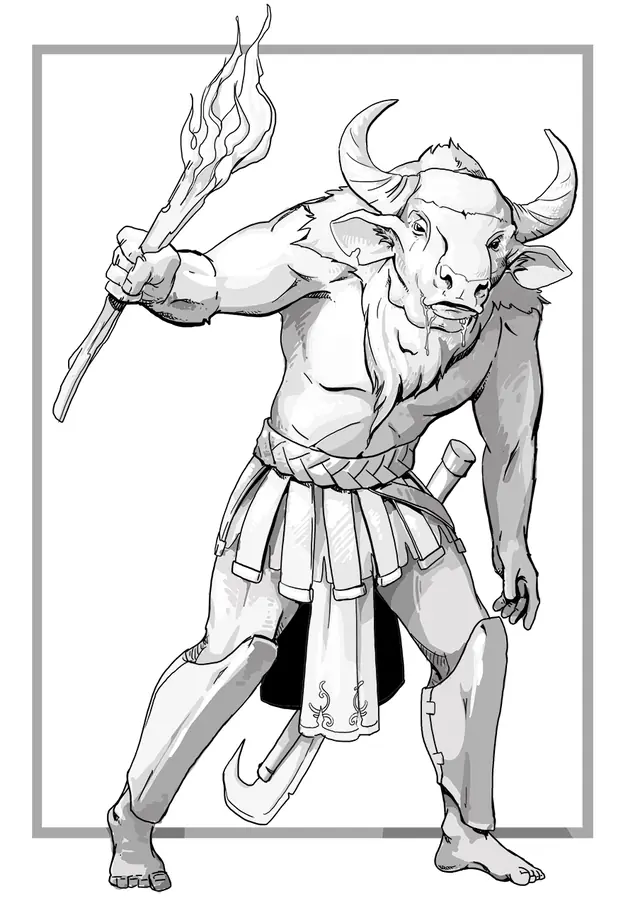
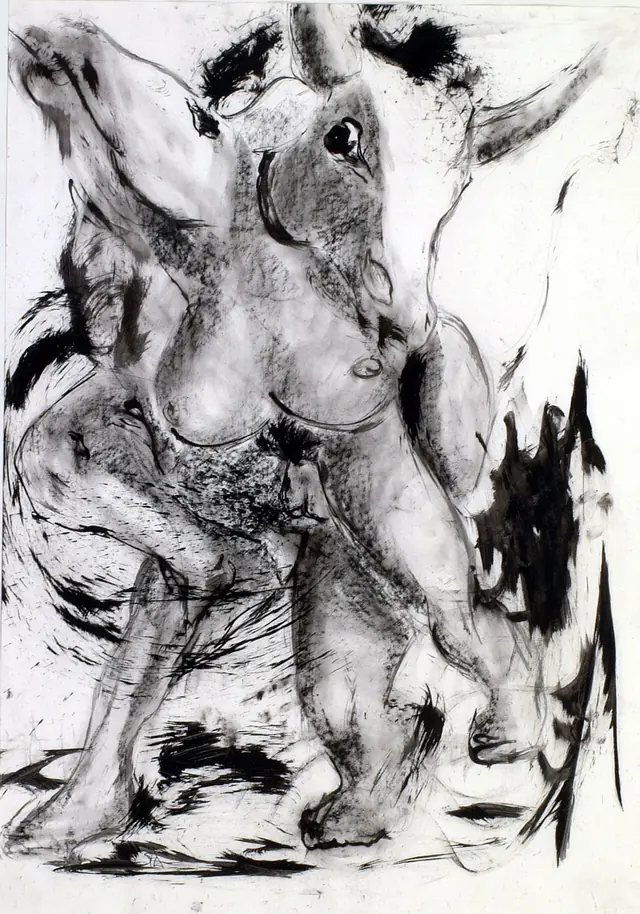
DnD Minotaur
DnD Minotaur · LadyofHats · 2017-10-26 record
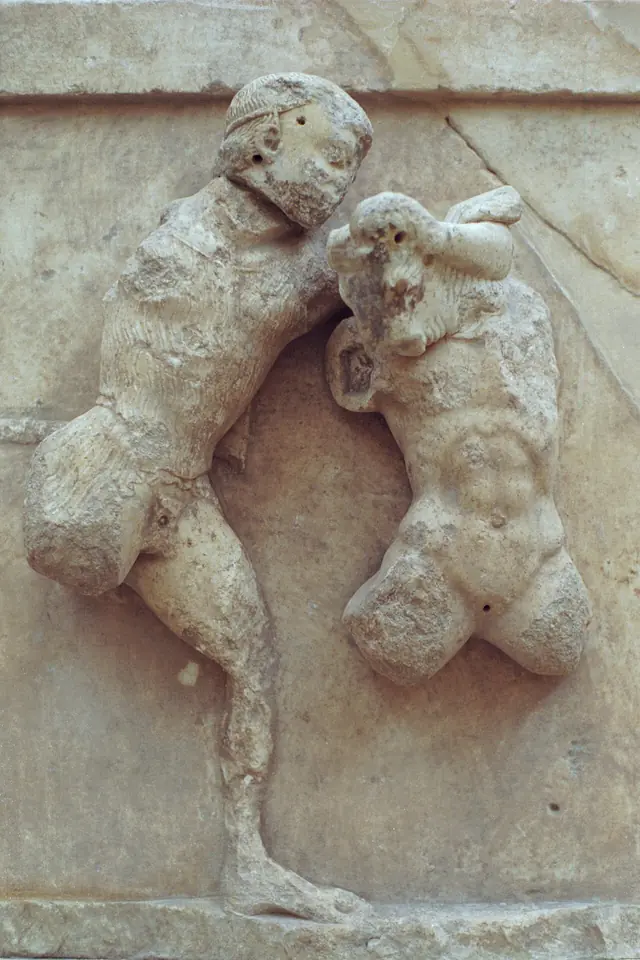
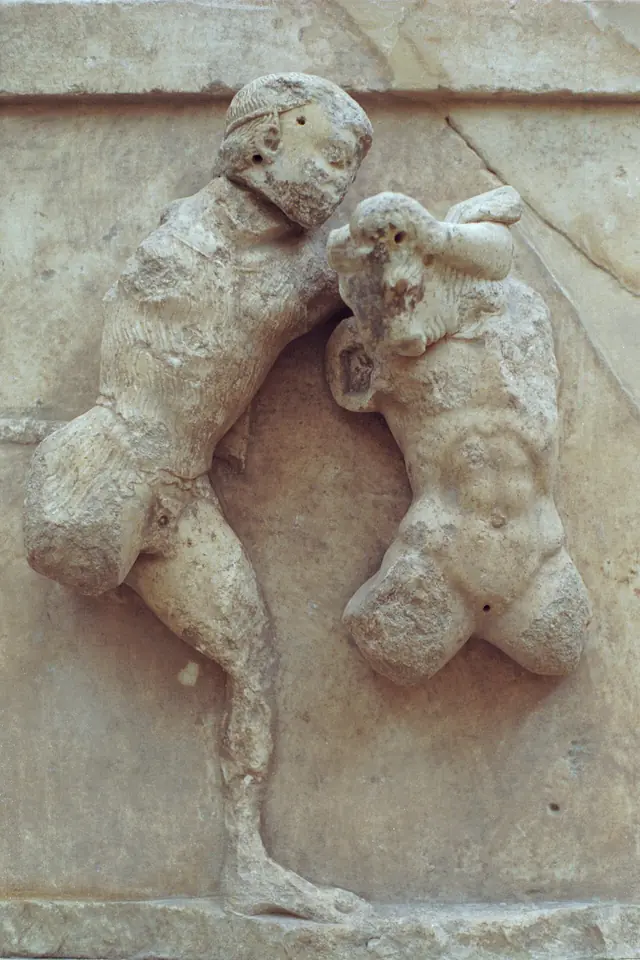
Metope, Treasury of Athenians, Theseus and Minotaur, 500 BC AM Delphi, Dlfm409
Metope, Treasury of Athenians, Theseus and Minotaur, 500 BC AM Delphi, Dlfm409 · Zde · 2000-06-29 record
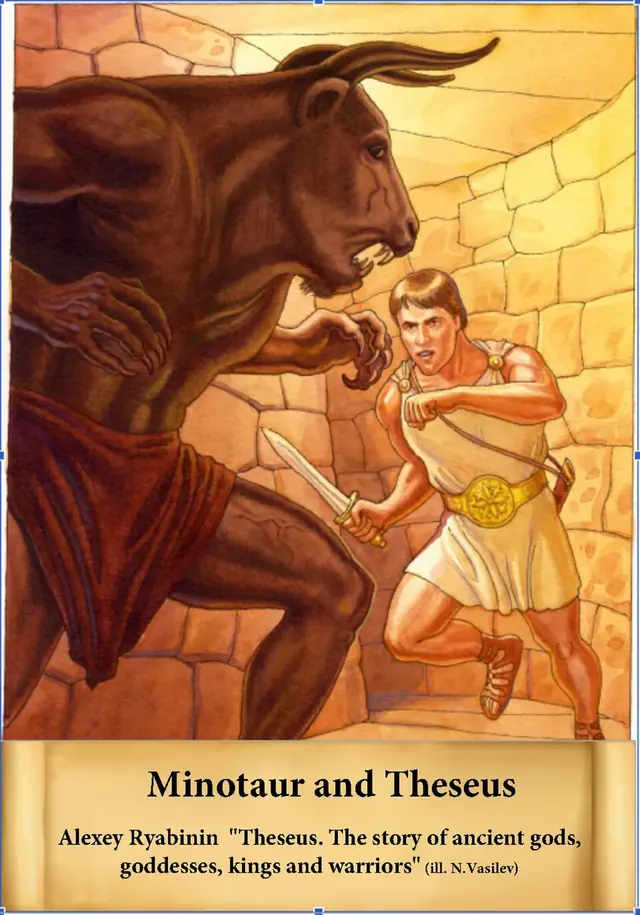
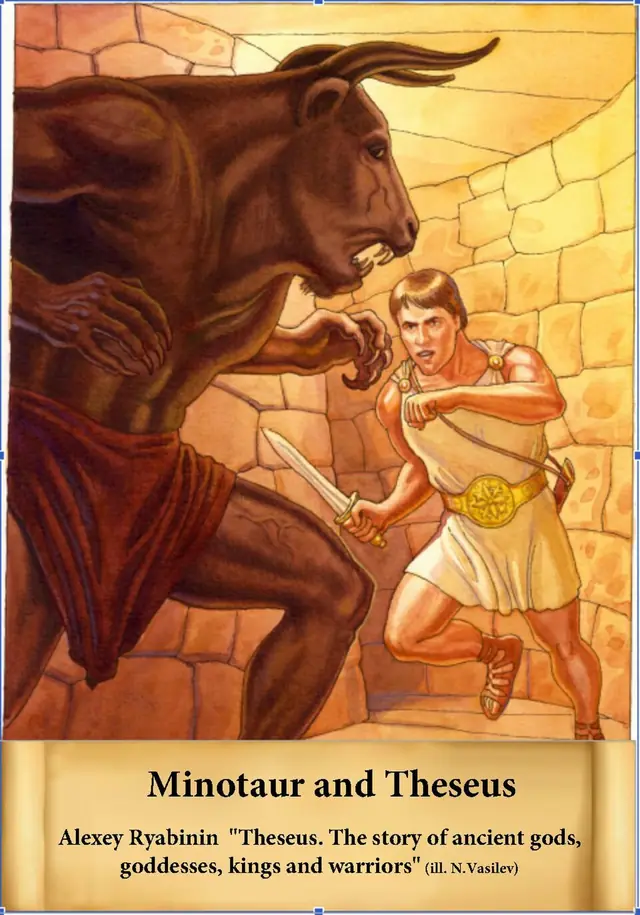
Minotaur (A.Ryabinin. "Theseus.The story of ancient gods, goddesses, kings and warriors")
Minotaur (A.Ryabinin. "Theseus.The story of ancient gods, goddesses, kings and warriors") · Правообладатель - Рябинин Алексей Валерьевич, художник - Н.А. Васильев · 2018 record
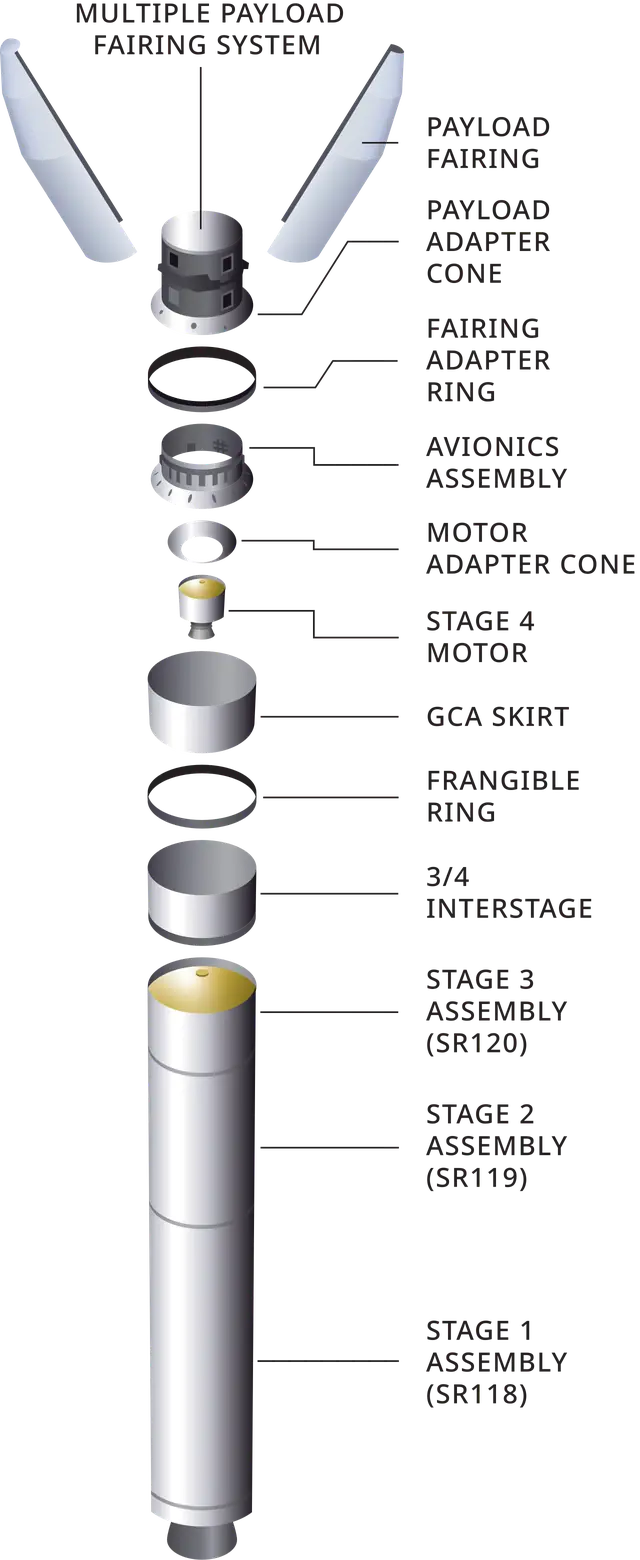
Minotaur IV exploded-view diagram
Minotaur IV exploded-view diagram · National Reconnaissance Office · 2025-04-10 record
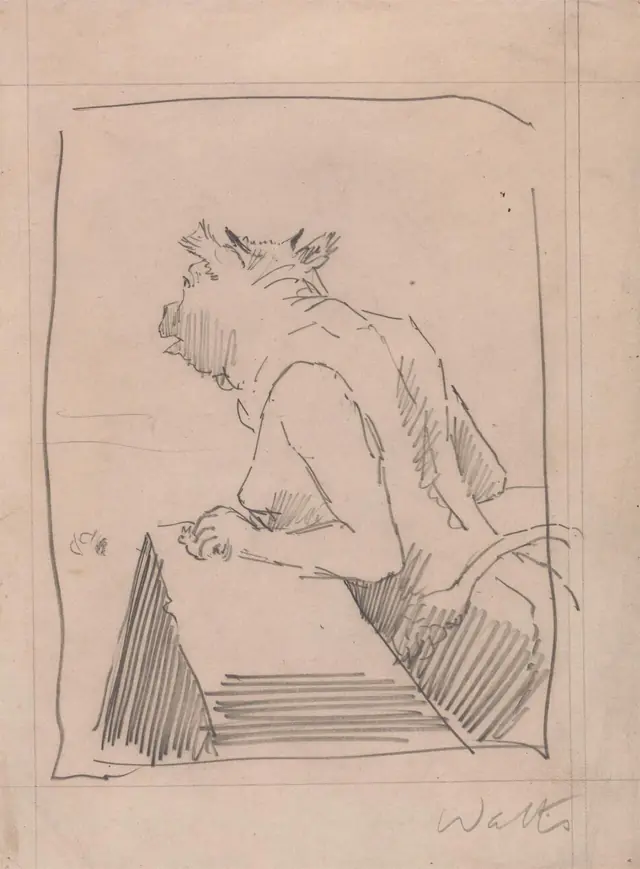
Minotaur title QS:P1476,en:"Minotaur " label QS:Len,"Minotaur "
Minotaur title QS:P1476,en:"Minotaur " label QS:Len,"Minotaur " · James McNeill Whistler record
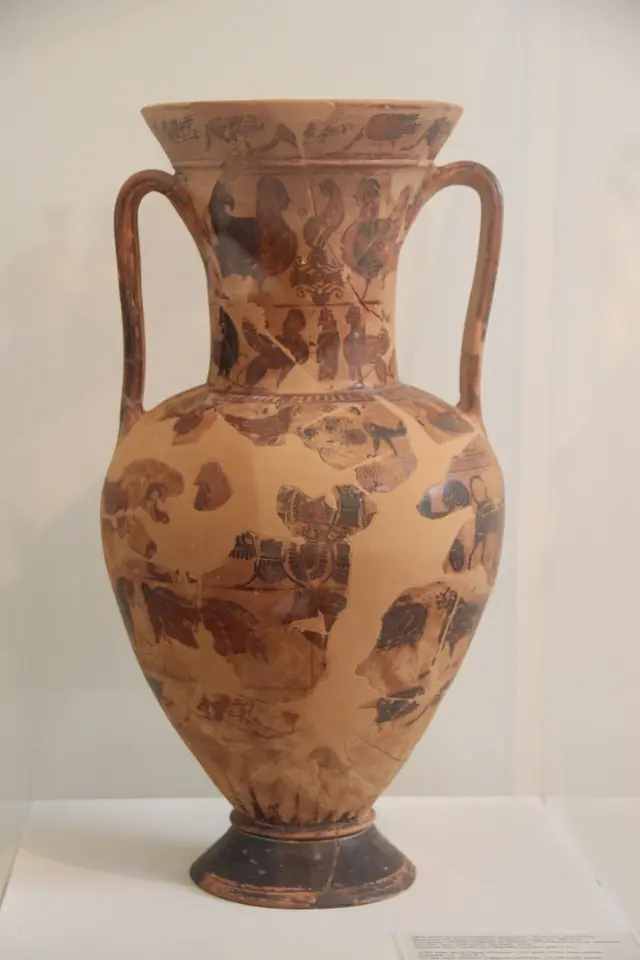
Attic Black-figure Amphora by Vase Painter Sophilos, c. 580 BC, found at Marathon in the Tumulus of the Athenians, 490 BC
Attic Black-figure Amphora by Vase Painter Sophilos, c. 580 BC, found at Marathon in the Tumulus of the Athenians, 490 BC · Gary Todd from Xinzheng, China · 2016-07-20 16:11 record
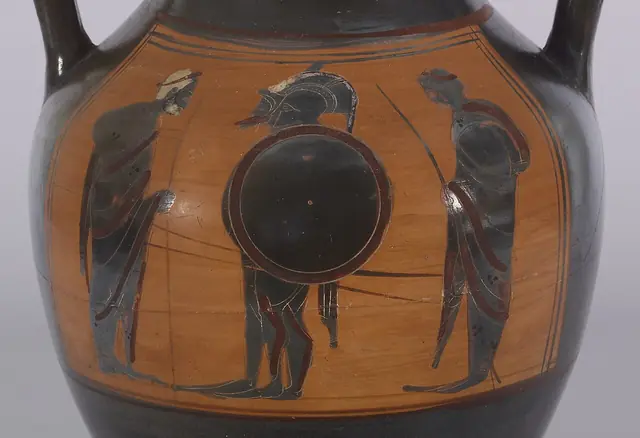
Black-Figure Amphora
Black-Figure Amphora · Anonymous ( Greece ) Unknown author · between circa 520 and circa 510 BC ( Archaic Greece era QS:P record
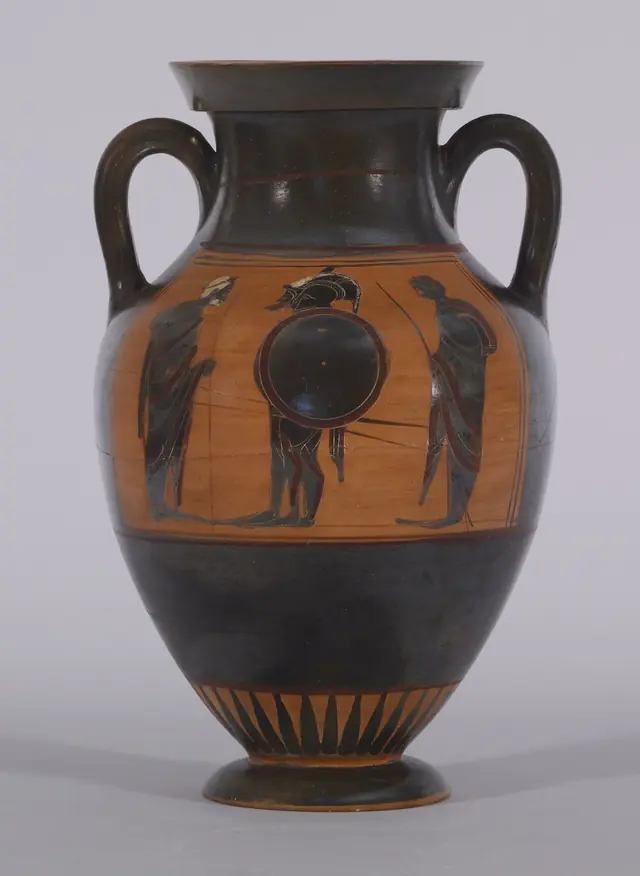
Black-Figure Amphora
Black-Figure Amphora · Anonymous ( Greece ) Unknown author · between circa 520 and circa 510 BC ( Archaic Greece era QS:P record

Pieces from this collection

Reading

Works drawn from this source

Why this can be used

The texts and the objects are free by sheer age: Homer, Hesiod, Ovid and the Attic potters have been dead for between two and three thousand years. What needs looking at closely are the modern plates we work from. In Spain the rule is article 26 of the Spanish Intellectual Property Act (the Texto Refundido de la Ley de Propiedad Intelectual) — 70 years from the author's death — unless the author died before 7 December 1987, in which case the fourth transitional provision applies the 80-year term of the 1879 Act, counted from 1 January of the year after the death. John Flaxman died in 1826, so his Homeric outlines have been free since 1 January 1907; Tommaso Piroli, who engraved them, died around 1824. Wilhelm Heinrich Roscher died in 1923, so his lexicon entered the public domain on 1 January 2004. The portion finished by Konrat Ziegler (1884-1974) — the final volume, closed in 1937 — has not, which is why we leave it alone. One more thing: a museum photograph of a vase is not the vase, because as a mere photograph it carries 25 years of protection of its own (art. 128 of the same Spanish Act). That is why the designs are redrawn from the engraving and never traced from the photo.

RELIC does not sell official merchandise of any film or series. The designs are our own and come from works whose rights have expired. Legal notice.