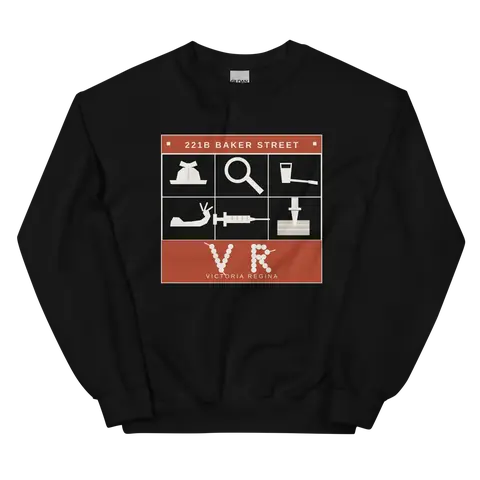

Twenty-five pounds for a detective
Arthur Conan Doyle was 27, with a medical practice in Southsea that almost nobody visited, when he sold A Study in Scarlet to Ward, Lock & Co. They offered him £25 for all rights, no percentage, on condition that it came out the following year; he asked for royalties and did not get them. The novel appeared on 21 November 1887 in Beeton's Christmas Annual, and nothing happened.
What changed things was the format. In July 1891 The Strand Magazine began running standalone stories with the same two leads, and Holmes became a monthly appointment. Doyle grew so sick of him that he threw him over the Reichenbach Falls in 1893 and left him there for nearly ten years. The strike was broken by a round of golf: in March 1901, on holiday in Norfolk with the journalist Bertram Fletcher Robinson, he listened to the phantom-dog legends his friend had grown up with in Devon. Out of that came The Hound of the Baskervilles, serialised in the Strand between August 1901 and April 1902 and set before Reichenbach, so as not to concede the point entirely. The canon closes in 1927.
Somebody else drew the hat
The silhouette everyone recognises was not written by Doyle. It was drawn by Sidney Paget. For a century the story went that he landed the commission through a misdelivered letter: that the Strand had wanted his brother Walter, also an illustrator, and that the envelope ended up in Sidney's hands; a 2019 piece in the Baker Street Journal went back over the tale and found no evidence for it and a fair amount against. What is certain is the rest: he illustrated one novel and 37 stories before he died in 1908, aged 47.
In «The Boscombe Valley Mystery» (Strand, October 1891) he put Holmes in an ear-flapped hunting cap and an Inverness cape, country clothes the text never mentions. It worked so well that Doyle himself gave in: in «Silver Blaze» (1892) he wrote that Watson saw «his keen, eager face framed in his ear-flapped travelling-cap». The word deerstalker does not appear once in the sixty stories.
The other half of the uniform is American, and it comes from the stage. William Gillette opened his play Sherlock Holmes in Buffalo in October 1899, took it to the Garrick in New York on 6 November and ended up performing it some 1,300 times. He adopted a curved pipe for a practical reason: with the bowl hanging low he could hold it in his teeth without it shifting while he delivered his lines. His play also produced the formula: the script says «Elementary, my dear fellow», and out of that grew the «elementary, my dear Watson» that appears in none of the sixty stories and that the Rathbone films made famous. When Collier's commissioned the illustrations for The Return of Sherlock Holmes in 1903, Frederic Dorr Steele copied Gillette's profile without bothering to hide it. In America, Holmes's face is an actor's.
The inventory of the room
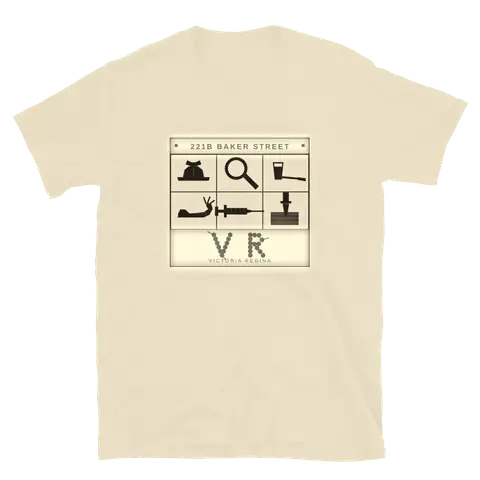
As a quarry for design, the good part of the canon is not the symbols: it's the clutter. The opening of «The Musgrave Ritual» (1893) is a list of domestic habits.
He kept his cigars in the coal-scuttle, his tobacco in the toe end of a Persian slipper, and his unanswered correspondence transfixed by a jack-knife into the very centre of his wooden mantelpiece.
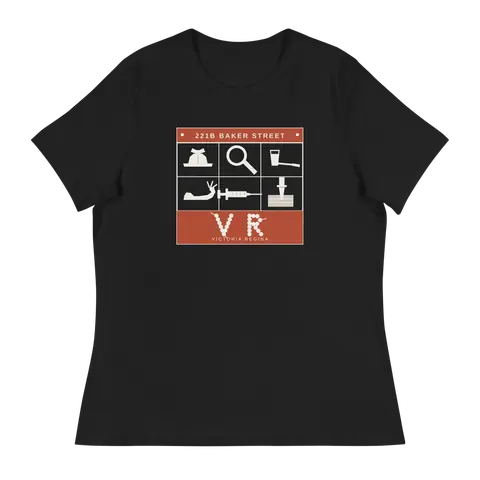
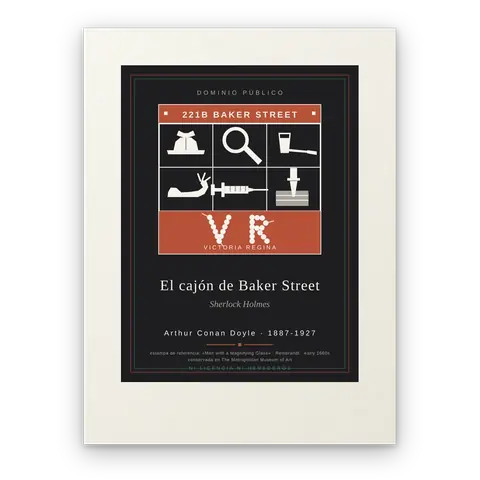
A few lines further down, Watson describes Holmes settling into his armchair with his hair-trigger revolver and a hundred Boxer cartridges to decorate the opposite wall with a patriotic «V. R.» picked out in bullet holes. The violin is a Stradivarius he bought for 55 shillings from a broker on Tottenham Court Road, worth at least five hundred guineas («The Cardboard Box», 1893). The Sign of the Four (1890) opens with the syringe and the seven-per-cent solution of cocaine. And the hound of Dartmoor turns out, once there is light on it, to be an enormous dog with phosphorus smeared on its muzzle.
From the fairground peephole to Cumberbatch
Holmes reached the cinema ahead of almost everyone. Sherlock Holmes Baffled was shot in April 1900 on the roof of the American Mutoscope and Biograph building on Broadway, with Arthur Marvin on camera: thirty seconds in which a burglar who appears and vanishes steals a sack from the detective, made to be watched through a peephole in fairground machines. It was given up for lost until a paper print copy surfaced in 1968.
Then come three phases you can tell apart at a glance. Eille Norwood — real name Anthony Edward Brett — made 47 silent films for Stoll between 1921 and 1923: still the record for appearances by one actor in the part, and Doyle adored him. Basil Rathbone and Nigel Bruce made fourteen between 1939 and 1946, and you can see the join: the first two are Fox pictures, with money and Victorian sets (The Hound of the Baskervilles, 1939); the twelve that follow are Universal B-pictures, and they move Holmes into the wartime present so he can hunt Nazi spies in Sherlock Holmes and the Voice of Terror (1942) and the two that came after it. Granada Television shot 41 episodes between 1984 and 1994 with Jeremy Brett, a full-size Baker Street built in Manchester and a fixation on respecting the text.
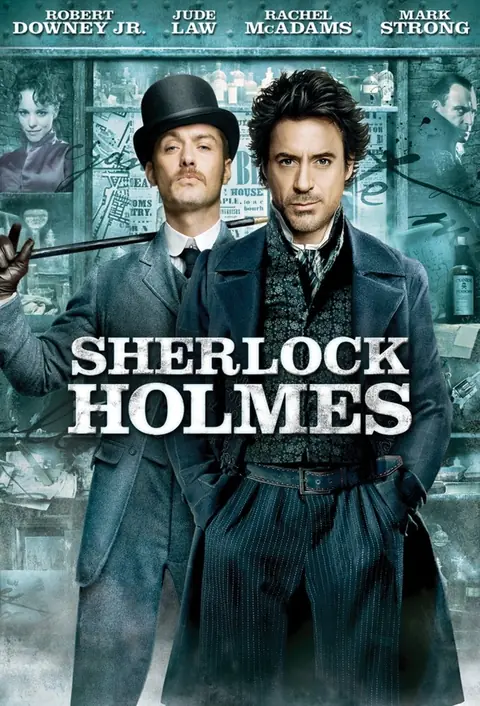
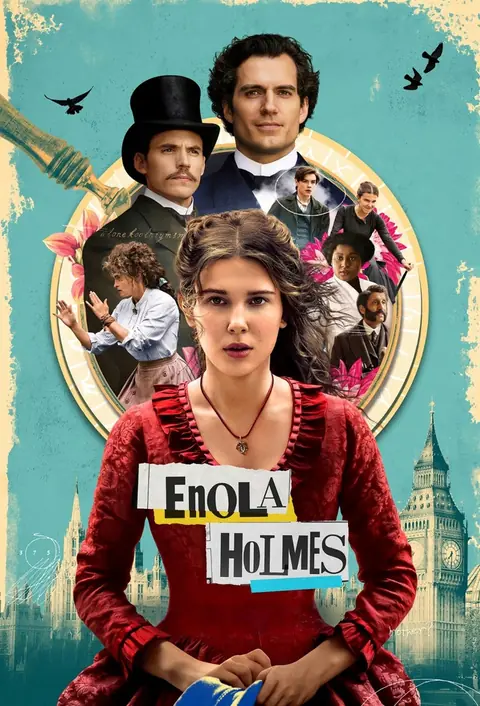
From there on, the game is to move the piece: Billy Wilder taking him apart in The Private Life of Sherlock Holmes (1970), Guy Ritchie turning him into a boxer with Robert Downey Jr. (2009), Moffat and Gatiss handing him a mobile in Sherlock (2010), Elementary (2012) shipping him off to New York with a Joan Watson, Enola Holmes (2020) giving him a sister. In 2012 Guinness recognised him as the most portrayed human literary character on screen: 254 versions and more than 75 actors, 48 ahead of Hamlet. Only Dracula beats him, and Dracula does not count as human.
The knight in the stained glass
In 1985 Barry Levinson directed Young Sherlock Holmes (released in Spain as El secreto de la pirámide), which imagines Holmes and Watson as teenagers at a boarding school. It flopped at the American box office and is still a date in the history of cinema: it contains the first entirely computer-generated character in a feature film. An armed knight steps out of a stained-glass window and attacks a priest.
It runs to seven shots, less than a minute on screen, and it took six months of work by Lucasfilm's Graphics Group — Ed Catmull, Alvy Ray Smith, John Lasseter — the team Steve Jobs bought shortly afterwards and renamed Pixar. They started from an acrylic painting by Chris Evans, scanned into Lucasfilm's Pixar system: the first digital matte painting in cinema. Before Woody and Buzz, the first thing Pixar animated was a stained-glass window chasing Sherlock Holmes.