
Fifteen days of rain in Braemar
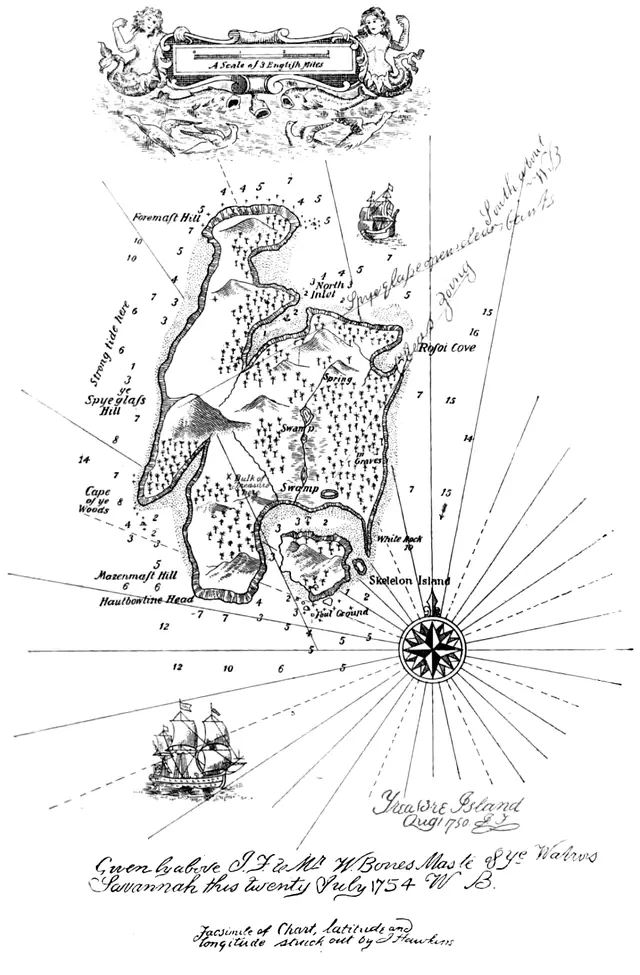
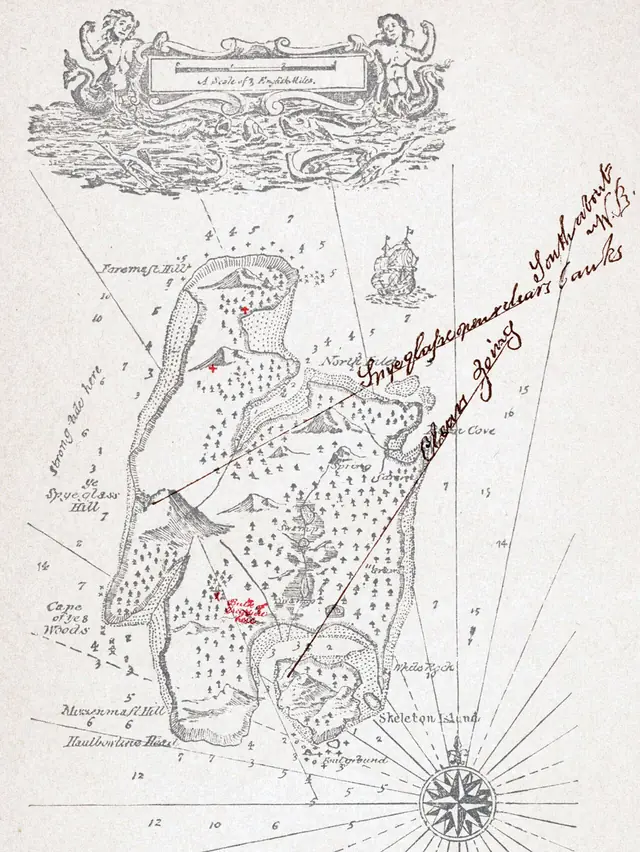
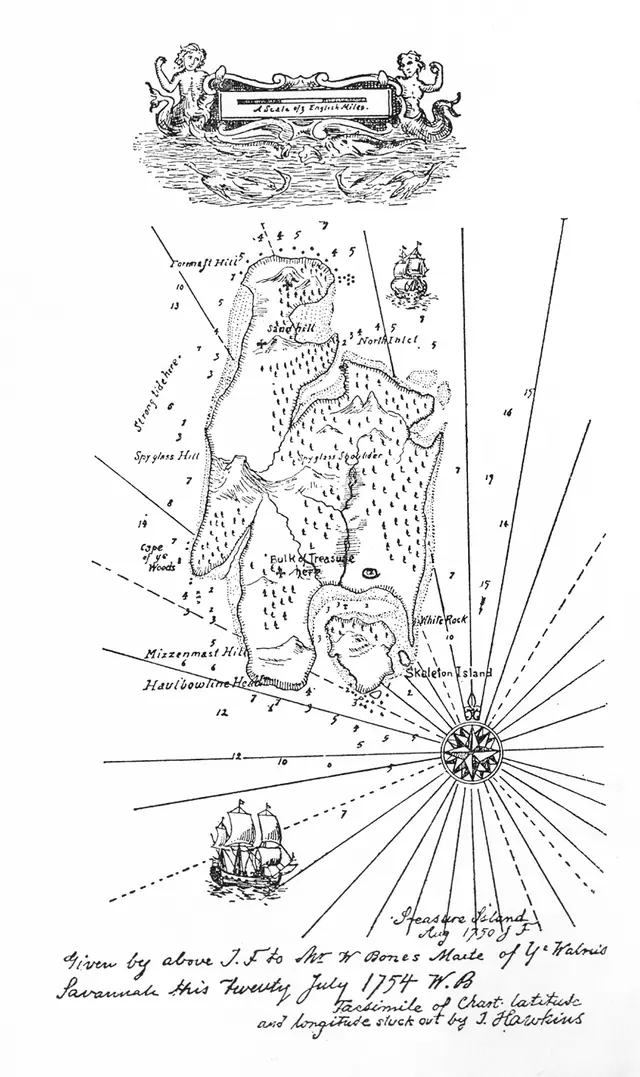
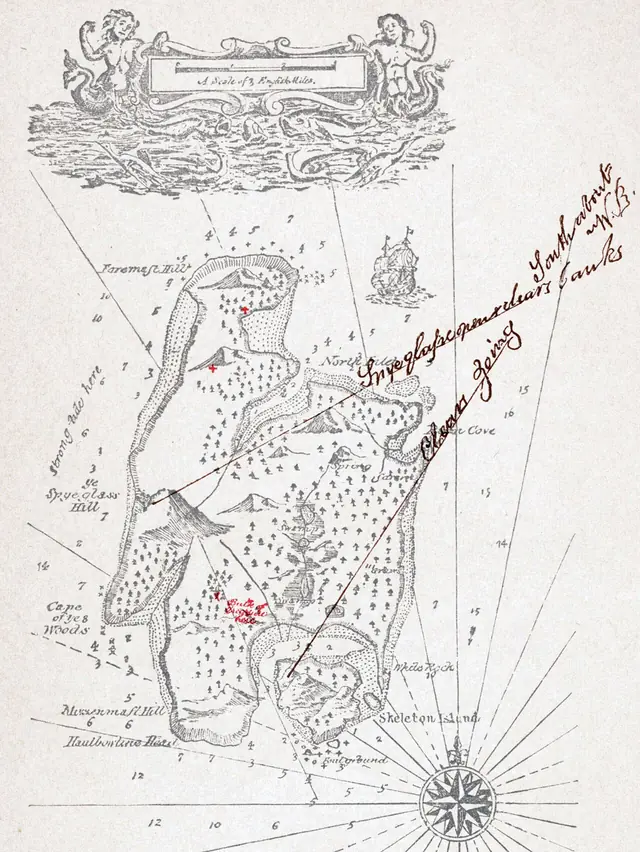
August 1881, Braemar, in the Highlands. It rains without stopping. Robert Louis Stevenson is thirty years old with a pair of lungs that will not let him leave the house, and he kills the afternoons with his stepson Lloyd Osbourne, a schoolboy on holiday. Between them they paint the watercolour map of an imaginary island, with its coves, its anchorage and its hills, writing in the names by hand.
The map came first. The novel came out of looking at it. Stevenson wrote it at a chapter a day until he ran dry: "Fifteen days I stuck to it, and turned out fifteen chapters; and then, in the early paragraphs of the sixteenth, ignominiously lost hold." He picked the book up again months later in Davos and finished it there at the same rate.
It was serialised in Young Folks, a children's magazine, across seventeen weekly instalments between 1 October 1881 and 28 January 1882, under the byline of one Captain George North. Stevenson had called it The Sea Cook, but that title never reached the newsagent: by his own account it was Mr Henderson who struck out the first title, The Sea Cook, and the magazine's editor ran it as Treasure Island, or the Mutiny of the Hispaniola. Nobody paid it any attention. The book appeared on 14 November 1883, from Cassell, in a print run of 2,000 copies. That changed everything.
His father, Thomas Stevenson, a lighthouse engineer, got so caught up in the story that he spent an entire day drawing up the exact contents of Billy Bones's chest. His son copied the lot, word for word. The apple-barrel scene was his idea too, and so was the name of Flint's ship, the Walrus, put in at the father's express request.
The map that got lost in the post
Stevenson sent the original map to Cassell to be engraved. It never arrived: it vanished on the way, and the Braemar watercolour went with it.
He had to make another, and make it by reading his own novel to reconstruct a geography he had invented himself: where the anchorage lay, how far off the stockade stood, which way the Hispaniola slipped out. The second map was drawn in his father's office, decorated with spouting whales and ships under sail, and it was the father who forged Captain Flint's signature and Billy Bones's sailing directions by hand. The map printed in every edition since — the one the art departments of half the adventure films ever made keep copying — is that second version, done grudgingly and against the clock. Nobody has seen the first one since 1883.
Inventory of a sailor's chest
Almost everything that sounds "piratical" today was invented here. It is not collected folklore: it is the furniture of a single book.
- The black spot. A disc of blackened paper with the sentence written on the back. The mutineers cut it out of a Bible page and even Silver is appalled: "What fool's been cutting a Bible?" There is no record of any real pirate using anything of the kind.
- The parrot on the shoulder. It is called Cap'n Flint, and Silver explains it in the text: he calls his parrot Cap'n Flint after the famous buccaneer. It screeches "Pieces of eight!" until you tire of it. The talking bird was not his and he admitted as much: no doubt, he wrote, the parrot had once belonged to Robinson Crusoe. What did not exist before this book is the parrot perched on a pirate's shoulder.
- The crutch, not the wooden leg. Long John Silver's left leg is cut off close by the hip and he props himself on a crutch under his shoulder. The wooden leg was fitted later, by the cinema.
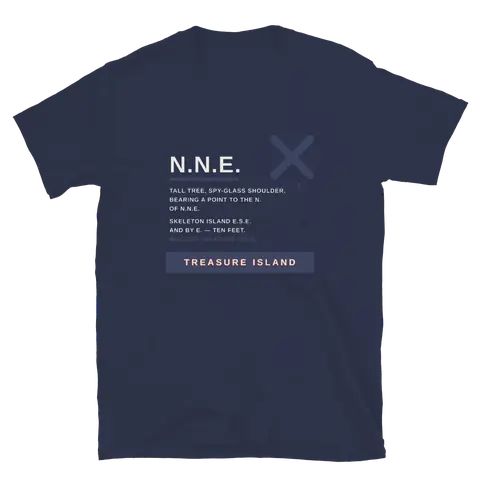
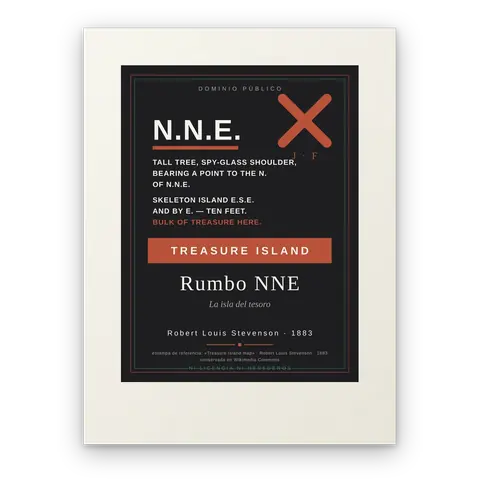
- The compass skeleton. A corpse laid out with its arms over its head, giving a bearing of E.S.E. and by E. Its name was Allardyce. Stevenson made no secret of the source either: he broke into Mr Poe's gallery, as he put it, and stole Flint's pointer. When he took stock of his own materials, the whole list came to "some reminiscences of Poe, Defoe and Washington Irving, a copy of Johnson's Buccaneers, the name of the Dead Man's Chest out of Kingsley's At Last […] and the map".
- The chest. A quadrant, a tin canikin, sticks of tobacco, two brace of very handsome pistols, a piece of bar silver, an old Spanish watch and five or six curious West Indian shells.
- The cheese. Ben Gunn has been alone on the island for three years and he does not dream of gold: he dreams of cheese. Doctor Livesey keeps a piece of Parmesan in his snuffbox.
Long John Silver also had a living model. Stevenson confessed it by letter to his friend the poet William Ernest Henley, who had lost a leg: it was the sight of his maimed strength and masterfulness that begot John Silver, and the idea of the maimed man ruling and dreaded by the sound was taken entirely from him.
From Tourneur's beached ship to the Nassau docks
The first adaptation is from 1908, silent, made by Vitagraph: The Story of Treasure Island. No director is on record. In 1918 the brothers Chester and Sidney Franklin shot it with a cast made up almost entirely of children. Then in 1920 came Maurice Tourneur's version, with Charles Ogle as Silver, Lon Chaney doubling up — he plays both Blind Pew and Merry — and a woman, Shirley Mason, as Jim Hawkins. They filmed aboard a genuinely abandoned barkentine, the Fremont. The film is lost: the posters survive.
Sound arrives in 1934 with MGM, directed by Victor Fleming five years before Gone with the Wind, with Wallace Beery and Jackie Cooper. In 1950 Disney takes it on: Treasure Island, directed by Byron Haskin, the studio's first fully live-action feature and the first treasure island in colour, with Bobby Driscoll as Jim and Robert Newton as Silver.
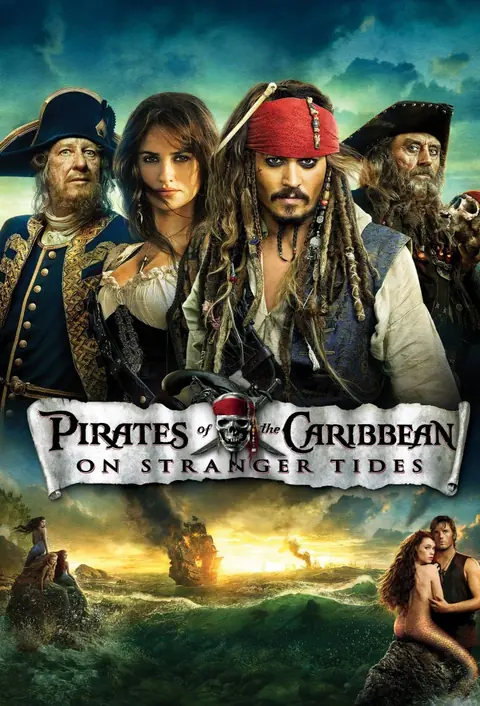
After that come Orson Welles in John Hough's version (1972); Charlton Heston as Silver in the TNT film first shown on 22 January 1990, directed by his own son, Fraser C. Heston, with a fifteen-year-old Christian Bale as Jim, Oliver Reed as Billy Bones and Christopher Lee as Pew; Tim Curry in Muppet Treasure Island (1996), directed by Brian Henson; and Treasure Planet (2002), by Ron Clements and John Musker, which moves the plot into space with solar-sail ships and remains, at 140 million dollars, the most expensive traditionally animated film ever made.
The most interesting offshoot does not carry the title at all. Black Sails (Starz, 2014-2017), created by Jonathan E. Steinberg and Robert Levine, is a prequel: it is set roughly two decades earlier in Nassau and splits the weight between Captain Flint, a young John Silver who still has both legs, Billy Bones and Israel Hands. That last one really existed: he was Blackbeard's second in command, and Blackbeard shot him in the knee. Stevenson lifted the name from a real pirate.
The Dorset actor who decided how pirates talk
When somebody does a pirate impression and says "arrr", they are unknowingly doing an impression of an English actor who died in 1956. Robert Newton was born in Dorset and grew up in Lamorna, in Cornwall, and for Disney's 1950 Silver he pushed his own West Country accent into caricature: the rolled r's, "be" in place of a properly conjugated "to be", "arrr" for yes. He ran the same register again in Blackbeard the Pirate (1952) and Long John Silver (1954), and the template was fixed for good. International Talk Like a Pirate Day takes him as its patron saint.
The other legacy is quieter. J. M. Barrie read the book and corresponded with Stevenson, and when he came to write Peter and Wendy he noted that Captain Hook was the only man Barbecue feared — Barbecue being what Long John Silver's own crew call him. The entire lineage of the fictional pirate starts with a watercolour painted on a wet Scottish afternoon.