A yeoman, not an earl
The first time anyone writes “Robin Hood” in a surviving text is around 1377, in William Langland's Piers Plowman: an idle priest admits he cannot get the Lord's Prayer right but does know his rymes of Robyn Hood. It is a complaint, not a tribute. The story was already circulating widely enough to be a nuisance.
The three oldest long texts are these. Robin Hood and the Monk, copied around 1450-1465 into manuscript Ff.5.48 at Cambridge University: ninety stanzas in a notebook that also carries devotional material and a Latin charm against thieves. Robin Hood and the Potter, from about 1500. And A Gest of Robyn Hode: eight fyttes, 456 stanzas, 1,824 lines, composed around 1450 and surviving only in sixteenth-century print — Wynkyn de Worde's London edition, later than 1500 and the only near-complete one, and Jan van Doesborch's Antwerp fragments, around 1510-1515.
The Robin of those texts is not the one on screen. He is no dispossessed earl: he is a yeoman, a free man without a title. There is no Marian. And the forest is almost never Sherwood: the Gest is set in Barnsdale, in Yorkshire, and never names Sherwood once; of the early texts only Robin Hood and the Monk puts him there. Nor does he hand money out by the fistful: he lends 400 pounds to a ruined knight, Sir Richard at the Lee, with the Virgin standing surety, and recovers the debt by robbing the monk of the abbot of St Mary's. The poem does sign off saying he “dyde pore men moch god”, that he did poor men much good. The court records throw up a “Robert Hod, fugitive” at the York assizes of 1226, “Hobbehod” the year after, and between 1261 and 1300 at least eight men called “Rabunhod” scattered across half of England. The name was already less a man than a byword for a criminal.
The greenwood inventory
Lincoln green does not mean “forest green”. It was a particular cloth from the city of Lincoln, dyed twice: first with woad, which gives blue, and over that with weld, which gives yellow. When the Gest says
Whan they were clothed in Lyncolne grene, / They keste away theyr graye.
an audience in 1500 heard a step up in the world: they have thrown off the poor man's grey and put on expensive cloth.
The prize arrow at the sheriff's shooting match is described with a jeweller's precision: “The shaft of syluer whyte, / the hede and the feders of ryche red golde”. A shaft of white silver, head and fletching of red gold.
The rest is just as physical:
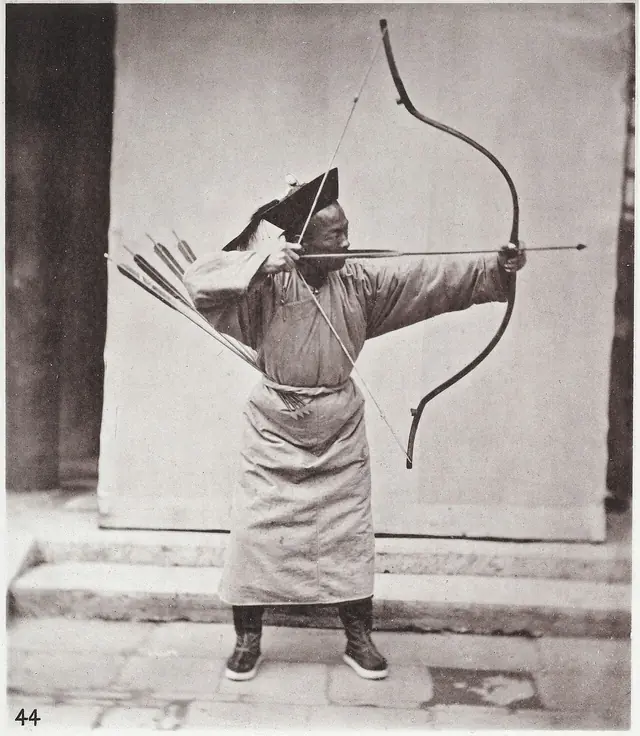
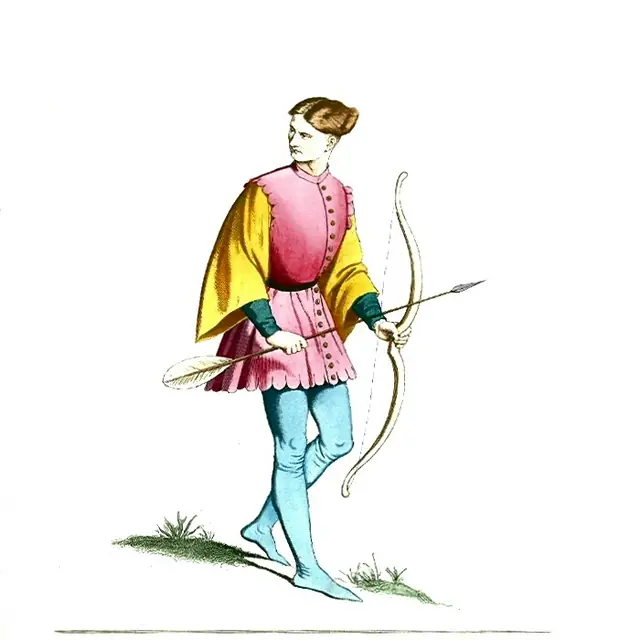
- the yew longbow, a weapon of war rather than a toy;
- the horn that calls the band together;
- the hood — hood — the word his surname either is or merely sounds like;
- Friar Tuck's habit and tonsure, absent from the early ballads: he arrives by way of the playhouse and the May games, in a short piece from about 1475;
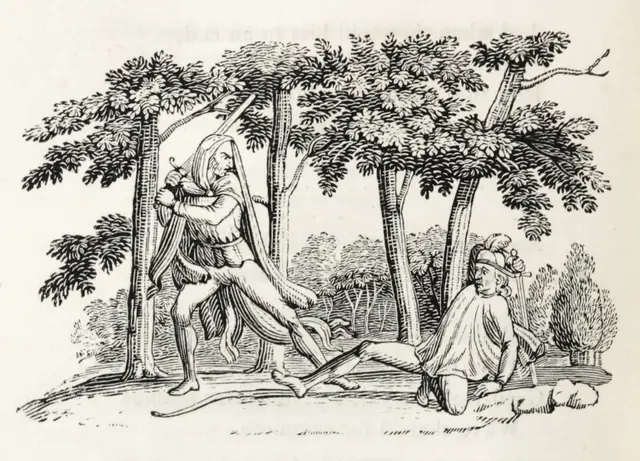
- the bleeding at Kirklees Priory, where he is bled to death by his own kinswoman, the prioress;
- and the last arrow, shot through the window to mark where he is to be buried, a detail found in full only in the late printed versions of the ballad of his death.
Everything else was added, and can be dated
The dispossessed nobleman first surfaces with Richard Grafton in 1569 and is fixed in place by Anthony Munday in two plays written in 1598 and printed in 1601: The Downfall of Robert, Earl of Huntingdon and The Death of Robert, Earl of Huntington. Munday also pairs Robin with Marian, a Matilda who changes her name on entering the forest.
Marian came from somewhere else entirely: from the Jeu de Robin et Marion by Adam de la Halle, around 1283, a French pastourelle with a shepherd called Robin and a shepherdess called Marion and no connection whatever to the English outlaw. The English May games brought the two together in the early sixteenth century: the Kingston upon Thames accounts record Marian in 1509-1510, and Alexander Barclay names her alongside Robin around 1513.
The king of the early ballads is not Richard the Lionheart either, but an Edward with no further identification. The man who moves Robin into the reign of Richard I is the Scot John Major, in 1521, in the very passage where he writes that Robin robbed only the rich and relieved the poor with what he took from abbots. Munday takes it from there, and everyone else takes it from Munday.
Robbing the rich to give to the poor as a slogan is pinned down by Joseph Ritson in 1795, in his anthology Robin Hood: A Collection of All the Ancient Poems, Songs and Ballads. Splitting a rival's arrow down the middle belongs to Walter Scott, Ivanhoe, 1819: Locksley splits Hubert's arrow and then shatters a willow wand at a hundred yards. Before Scott the gesture does not exist.
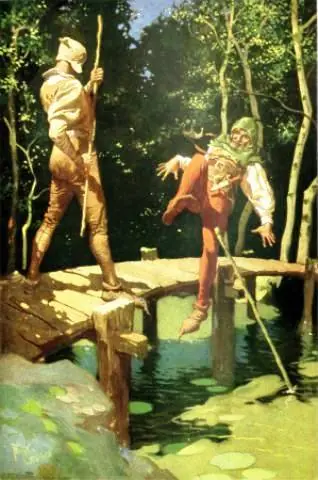
The look is Howard Pyle's, in The Merry Adventures of Robin Hood (Scribner's, 1883). Pyle arranged the loose ballads into a novel, cleaned the character up — in the ballad he kills fourteen foresters; in Pyle, one, in self-defence — and invented a mock-medieval English that is still being imitated. His drawings are the mould almost every Robin on film is cast from. Francis James Child numbered 38 ballads between 1882 and 1898, Child 117 to 154, and there they remain.
From a plaster castle to a pair of tights
The first big Robin is silent. Allan Dwan's Robin Hood (1922), with Douglas Fairbanks, cost some $930,000 and was the most expensive film made up to that point. The castle was the largest set ever raised for a silent picture: timber, wire and plaster over a concrete floor, with a steel drawbridge. It opened on 18 October 1922 at Grauman's Egyptian, the first Hollywood premiere properly so called.
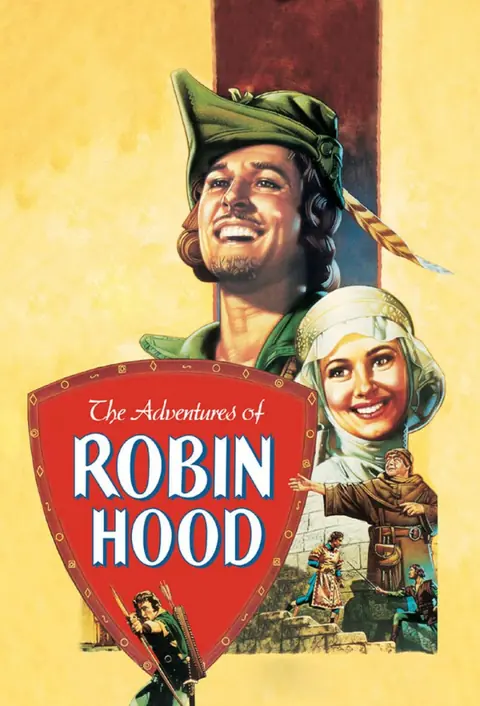
The Adventures of Robin Hood (1938), by Michael Curtiz and William Keighley, cost $2,033,000 and was Warner's third feature in three-strip Technicolor. It won three Oscars: art direction (Carl Jules Weyl), editing (Ralph Dawson) and score (Erich Wolfgang Korngold, who called his scores “operas without the singing”). Every arrow was shot by the archer Howard Hill; the split-arrow shot had to be redone as a trick — according to the stuntman Buster Wiles, the second arrow carried a broad, flat head and ran along a wire that shows for an instant in the finished footage. The Sherwood on screen is Bidwell Park in Chico, California.
A continuity oddity: Alan Hale played Little John in 1922 opposite Fairbanks, in 1938 opposite Flynn and once more in Rogues of Sherwood Forest (1950), his last film.
After that: Disney (1973), made on very little money and with sequences traced straight from The Jungle Book and The Aristocats. Robin and Marian (1976), by Richard Lester and James Goldman, with Sean Connery and Audrey Hepburn, which ends with the last arrow loosed from the bed through the window. Robin of Sherwood (1984-1986), by Richard Carpenter, which brings in Herne the Hunter and a Saracen, Nasir, written to die in the second episode and kept on for the whole run: Azeem in Prince of Thieves (1991) comes out of him. And Robin Hood: Men in Tights (1993), in which Mel Brooks parodies that film, with Roger Rees playing the sheriff Alan Rickman had played and Dave Chappelle making his screen debut.
In 1955, the outlaws were written by outlaws
In September 1955 ITV launched The Adventures of Robin Hood with Richard Greene: 143 episodes up to 1959 and some 32 million viewers a week on both sides of the Atlantic. The producer was Hannah Weinstein, an American settled in London, and her company, Sapphire Films, existed more or less for this: to give work to writers the Hollywood blacklist had stripped of their names. Close to two dozen of them wrote episodes under pseudonyms, with security measures in place so that nobody would find out who they were. The pilot is credited to “Lawrence McClellan” on the American prints and “Eric Heath” on the British ones: behind both were Ring Lardner Jr., one of the Hollywood Ten, and his partner Ian McLellan Hunter. Waldo Salt, Robert Lees and Adrian Scott passed through as well.
The series about men declared outlaws was written, in secret, by men declared outlaws.