












Two Icelandic books and a lucky bishop
Almost everything cinema calls «Norse mythology» comes from two books written in Iceland in the 13th century, by which time the island had been Christian for two hundred years. The first has an author: Snorri Sturluson (c. 1179-1241), lawyer, poet and twice Lawspeaker of the Alþingi. Around 1220 he put together the Prose Edda as a technical manual for young poets —Gylfaginning, Skáldskaparmál and Háttatal—: if a skald called gold «Freyja's tears», you had to know why. Snorri saved the mythology almost by accident, for reasons of craft. He was murdered at his house in Reykholt on 23 September 1241, on the orders of the king of Norway.
The second has no author at all. The Codex Regius (GKS 2365 4to) is 45 leaves of vellum copied in the 1270s, carrying 31 anonymous poems reckoned to be a good deal older: the Poetic Edda. It surfaced in 1643 in the hands of Brynjólfur Sveinsson, bishop of Skálholt, who in 1662 made a present of it to Frederick III of Denmark; hence «regius». It came home to Iceland on 21 April 1971 aboard the Danish vessel Vædderen, with the Reykjavík quayside packed and the whole country glued to the radio. Eight leaves are missing, torn out somewhere between the 13th and 17th centuries: the «great lacuna», which took almost the entire long Sigurd poem with it. Of some 250 stanzas, 22 survive.
The inventory: short hammers and impossible ropes
What makes these texts so usable is how concrete they are. They do not talk about «the power of thunder»: they describe objects, manufacturing faults included.
- Mjölnir has a short, ugly handle, and the text explains why. In Skáldskaparmál, while the dwarves Brokkr and Eitri are forging it, Loki turns himself into a fly and bites the eyelid of the one working the bellows; the dwarf puts a hand to his face, the bellows stop for an instant, and the hammer comes out with its handle too short. The flaw is part of the object.
- Gleipnir, the fetter that holds the wolf Fenrir, is made from six things that do not exist: the sound of a cat's footfall, a woman's beard, the roots of a mountain, the sinews of a bear, the breath of a fish and the spittle of a bird. That is why there is nothing in it to break. It costs Týr a hand.
- Draupnir, Odin's ring, drips eight identical rings every ninth night.
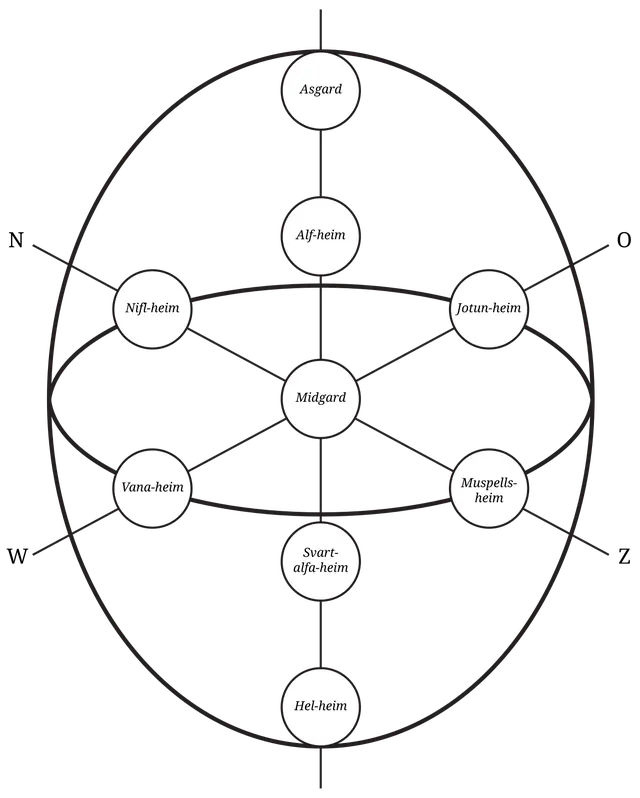
- Yggdrasil is no decorative tree: it has tenants. An eagle at the top, the dragon Níðhöggr gnawing at the root, four stags eating the branches, and a squirrel, Ratatoskr, running up and down the trunk carrying insults from one to the other.
- Naglfar, the ship that sets sail on the day of Ragnarök, is built from the fingernails of the dead.
There is visual evidence older than the books, too. The Tjängvide picture stone (Gotland, 8th century) already shows a rider on an eight-legged horse and a woman offering him a drinking horn; a row of valknuts separates that scene from the sailing ship that takes up the lower half. And the ravens: in stanza 20 of Grímnismál, Odin admits he fears Hugin (Thought) may not come back, but that he fears more for Munin (Memory).
What looks Viking and was invented the day before yesterday
Two of the most heavily printed symbols of the Viking imagination are modern. Worth knowing before you put them on a T-shirt.
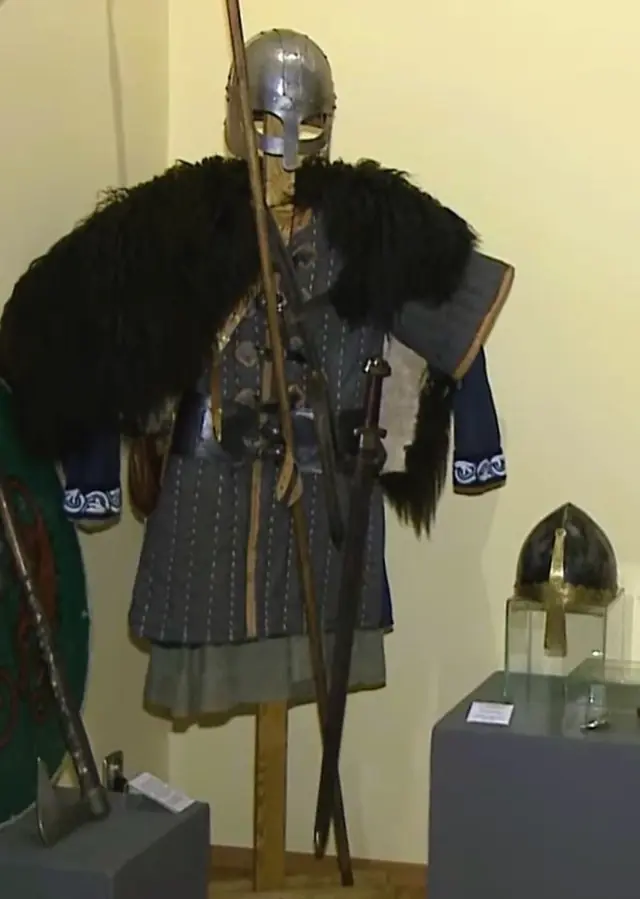
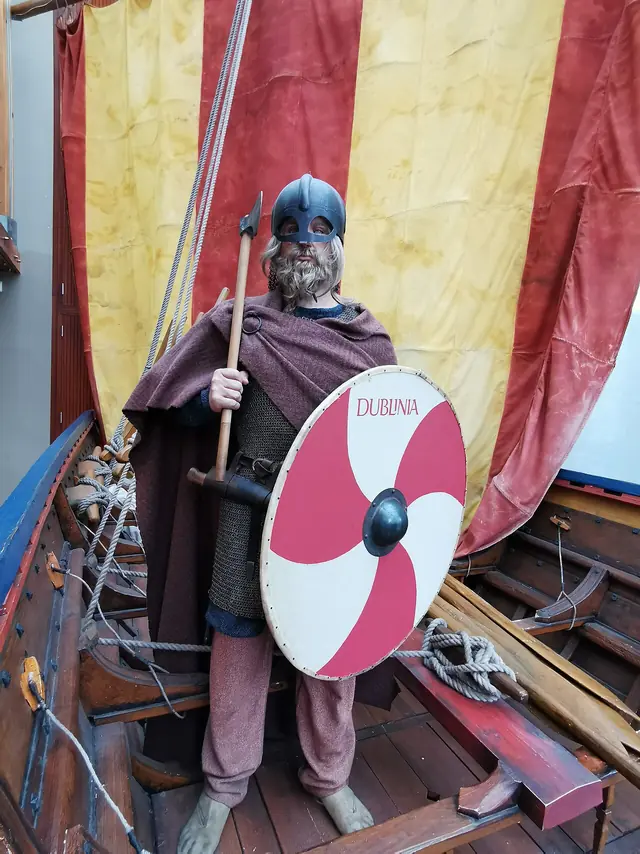
The horned helmet was born in a theatre. Carl Emil Doepler (1824-1905) designed the costumes for the premiere of Wagner's Der Ring des Nibelungen (The Ring of the Nibelung) at Bayreuth in 1876, and crowned his characters with horns and wings to give them an archaic air. From the opera it jumped to illustration, from illustration to the school textbook and from the textbook to everything else. A century and a half of Scandinavian excavation has not turned up a single horned Viking helmet: they were plain iron caps, sometimes with a nasal or a reinforcement around the eyes.
The vegvísir, the eight-armed «Viking compass», is first documented in the Huld manuscript (ÍB 383 4to), copied by Geir Vigfússon in Akureyri in 1860. Eight hundred years after the Viking age ended. It is a late Icelandic magical stave, and a very handsome one, but it comes from neither the Edda nor any ship.
From vellum to the cinema
Cinema comes at this material through three separate doors.
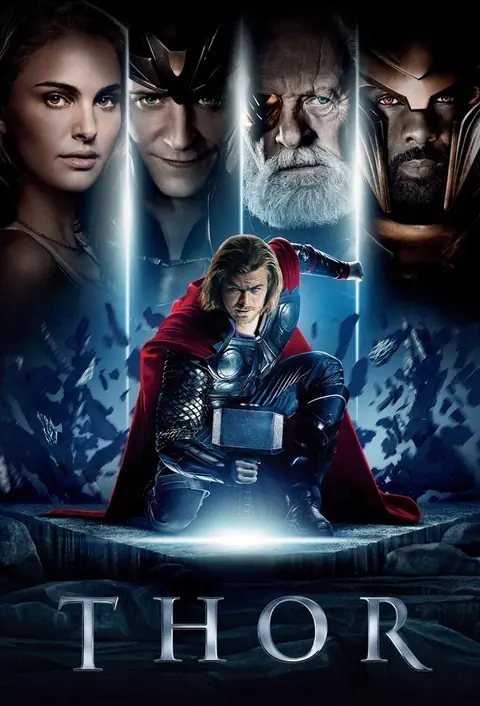
The Marvel door is the widest and the most freewheeling. Thor (2011, Kenneth Branagh) turns Asgard into a science-fiction realm and the Bifröst into a teleport bridge; Thor: The Dark World (2013), Thor: Ragnarok (2017, Taika Waititi) and Thor: Love and Thunder (2022) follow the same route. The third picks up the names —Hela, Fenris, Surtur, the burning of Asgard— and reshuffles the family tree: in Gylfaginning, Hel and Fenrir are Loki's daughter and son, not a boss and her attack dog.
The second door is archaeological. The Northman (2022) pushes it as far as it will go: Robert Eggers wrote the script with the Icelandic poet Sjón, took the plot from the legend of Amleth told by Saxo Grammaticus in the Gesta Danorum (c. 1200) —the same one that centuries later gave us Shakespeare's Hamlet— and shot the visions of the tree of kings and the theft of the sword Draugr inside a burial mound, its occupant rising to defend it. Vikings (2013-2020), created by Michael Hirst, sets off from the Ragnars saga loðbrókar and from Saxo again.
The third is homegrown Scandinavian. Valhalla (2019, Fenar Ahmad) brings back Þjálfi and Röskva, the two children who in Snorri's Edda end up as Thor's servants for breaking a bone of one of his goats. And the Norwegian series Ragnarok (2020-2023) plants the end of the world in a town called, with absolute deliberation, Edda.
Gandalf was on a list of dwarves
The Völuspá, the poem that opens the Codex Regius, contains a passage editors call the Dvergatal: a catalogue of dwarf names, stanzas 10 to 16. There you will find Þorinn, Dvalinn, Bifurr, Bǫfurr, Bǫmburr, Nóri, Dáinn, Durinn, Eikinskjaldi —«oak shield»— and, on the very same list, Gandálfr.
From that passage Tolkien took the names of the thirteen dwarves of The Hobbit, the byname of Thorin Oakenshield and the name of his wizard. Gandalf is a dwarf name out of an Icelandic poem copied in the 13th century by someone we know nothing whatsoever about. The title cards of Peter Jackson's six films come, in a straight line, from seven stanzas of the Poetic Edda.