



A poem with no author's manuscript
The Odyssey was composed around the eighth century BC, in dactylic hexameter and in a dialect nobody ever spoke in the street: Homeric Greek, an artificial blend of Ionic and Aeolic put together to fit the metre. There is no original Homer. What we read comes down from the scholars of Alexandria, who tidied the text and cut it into twenty-four books, one for each letter of the Greek alphabet; the edition by Aristarchus of Samothrace (second century BC) is the one that ended up as the standard version. That much-quoted division isn't Homer's at all: it belongs to librarians.
Nor does the poem begin at the beginning. It opens with Odysseus already held on Calypso's island and his son Telemachus scouring Greece for him. The famous voyage — the Cyclops, the Lotus-Eaters, Circe, the descent into Hades, the Sirens, Scylla and Charybdis — is told by Odysseus himself over dinner, in the past tense, in Books IX to XII. Four books of flashback narrated by a man the poem itself describes as a professional liar.
The Sirens never had fish tails
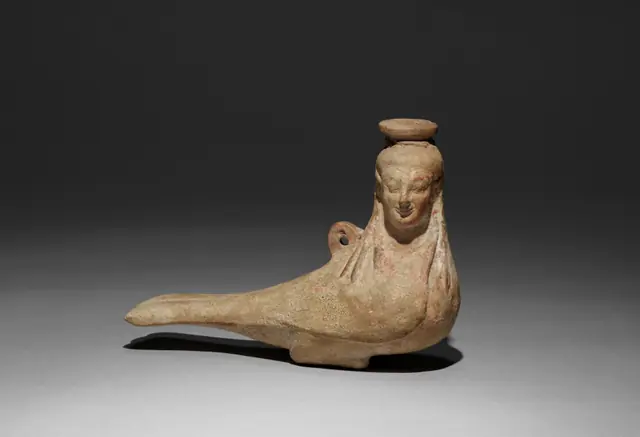
Homer doesn't describe the Sirens. He never says whether they have feathers, scales or legs: he says there are two of them and that they sing. The look came from art. Greek vase painters made them bird-women, a human head on the body and talons of a bird, and that is how they appear on the red-figure stamnos attributed to the so-called Siren Painter (c. 480-470 BC, British Museum), with Odysseus bound to the mast and the feathered creatures hanging above the ship. The fish tail arrives far later, by way of the medieval bestiaries: the Bern Physiologus, from the ninth century, already draws them with a tail even though the text it illustrates still talks about birds. The mermaid everyone carries around in their head doesn't come from Homer, it comes from a copyist's mistake that has been a hit for centuries.
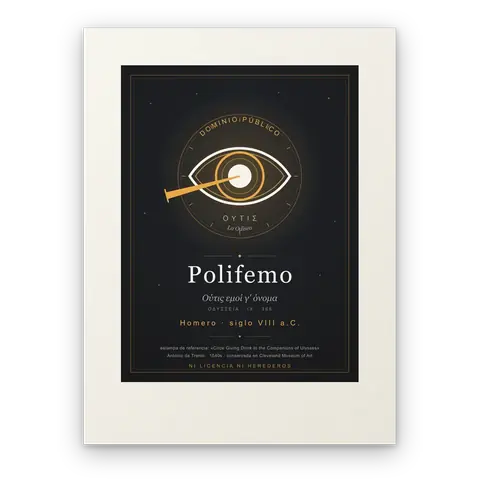
The Cyclops is older still than the text that tells his story. On the Eleusis amphora (c. 650-625 BC, Archaeological Museum of Eleusis) the blinding of Polyphemus is painted on the neck of the vessel: three men driving a stake towards an eye. The piece was used as the funerary urn of a child of ten or twelve.
Ulises, Júpiter and Minerva: how it sounds in Spanish
The first known translation into Spanish is signed by Gonzalo Pérez in 1550, secretary to Charles V and to Philip II. But the one almost everybody in Spain has actually read is by Luis Segalá y Estalella (Barcelona, 21 June 1873 - Barcelona, 17 March 1938), professor of Greek in Seville from 1899 and in Barcelona from 1906: the Iliad in 1908 and the Odyssey in 1910. Literal prose, a deliberately archaic vocabulary, and the names filtered through Latin — Ulises rather than Odysseus, Júpiter rather than Zeus, Minerva rather than Athena — which is precisely why Spanish says «Ulises» where English says «Odysseus».
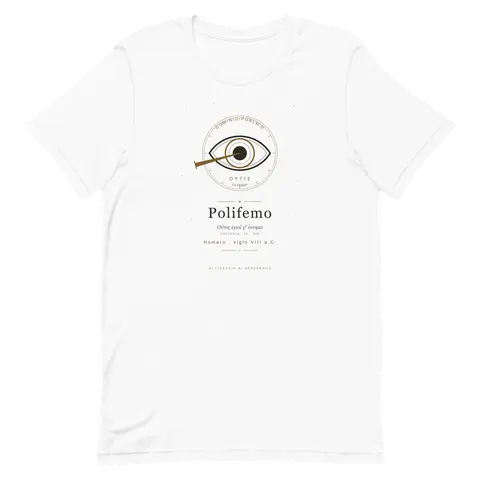
The central joke of Book IX survives that century-old Spanish intact. Odysseus introduces himself to the Cyclops:
«My name is Nobody; and Nobody is what my mother, my father and all my companions call me.»
And when Polyphemus roars that he is being killed, the neighbouring Cyclopes answer from outside the cave: «Well, if nobody is doing you violence, and you are alone, there is no escaping the sickness sent by great Jupiter». Segalá died during the Italian air force's bombing raids on Barcelona, in March 1938.
From an Attic stamnos to an IMAX camera
The cinema has come back here again and again, and nearly always through the same door: the monster and the woman who waits.
- Ulysses (1954), by Mario Camerini, with Kirk Douglas. Silvana Mangano plays Circe and Penelope at once, so temptation and fidelity literally wear the same face. Ben Hecht and Irwin Shaw were among the writers; the Cyclops sequence was directed, uncredited, by Mario Bava.
- Contempt (Le Mépris, 1963), by Jean-Luc Godard. Fritz Lang plays himself shooting an adaptation of the Odyssey while the screenwriter's marriage falls apart alongside it. It is the film about the impossibility of filming this poem.
- The Odyssey (1997), an NBC miniseries directed by Andrei Konchalovsky and produced by Francis Ford Coppola, with Armand Assante and Isabella Rossellini. Forty million dollars, shot in Malta, Turkey and England, 20.6 million viewers on the first night and an Emmy for directing.
- O Brother, Where Art Thou? (2000), by Joel Coen. The credits declare it «based upon The Odyssey by Homer» and the Coens later admitted they hadn't read it; the only person on the shoot who had was Tim Blake Nelson, a classics graduate from Brown. No matter: there they are, Ulysses Everett McGill, his wife Penny, one-eyed Big Dan and the three women singing by the river.
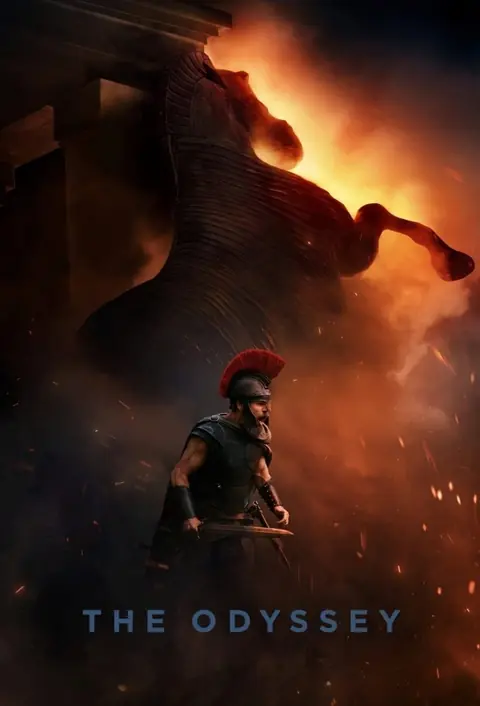
- The Odyssey (released 17 July 2026), by Christopher Nolan. Matt Damon as Odysseus, Anne Hathaway as Penelope, Tom Holland as Telemachus, Zendaya as Athena, Robert Pattinson as Antinous and Charlize Theron as Calypso. A 250 million budget, shooting in Morocco, Western Sahara, Greece, Italy, Iceland and Scotland, and the first film shot in its entirety on IMAX 70mm cameras. The underlying decision is not to show the gods: what you see is people reacting to something that might be nothing more than weather.
The journey doesn't end in Ithaca
What almost nobody remembers is that the poem leaves its ending open on purpose. In Book XI, in the kingdom of the dead, the seer Tiresias sets Odysseus a second journey that begins where the first one finishes: he has to take an oar, shoulder it and walk inland, away from the sea, until he reaches a people who have no idea what a ship is.
«Take a well-balanced oar and walk on until you come to those men who have never seen the sea, who eat no food seasoned with salt, and who know nothing of ships with crimson-painted prows [...]. When you meet another traveller and he tells you that you are carrying a winnowing-fan on your fine shoulder, plant the well-balanced oar in the ground.»
The sign is that somebody mistakes the oar for a winnowing-fan, the wooden blade used to toss grain into the wind. There, where the tool of the sea reads as a tool of the fields, is where he must plant it and make sacrifice to Poseidon. Which is to say: the Odyssey ends with its hero back home and under instructions to leave again. That oar planted inland is one of the strangest and cleanest images in the poem, and practically nobody has ever put it on screen.