
Four roots, each with a god's name
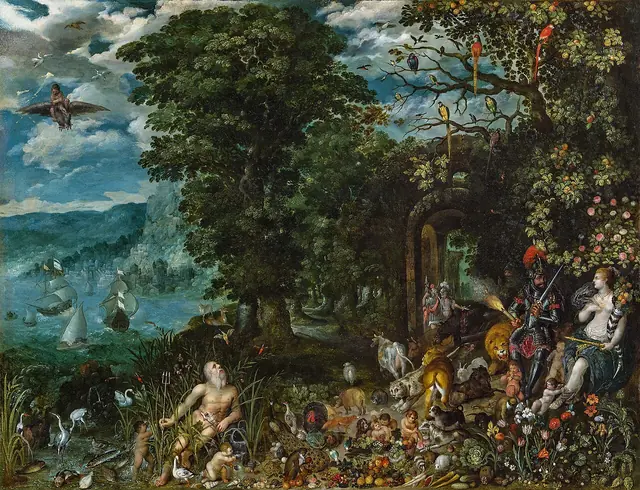
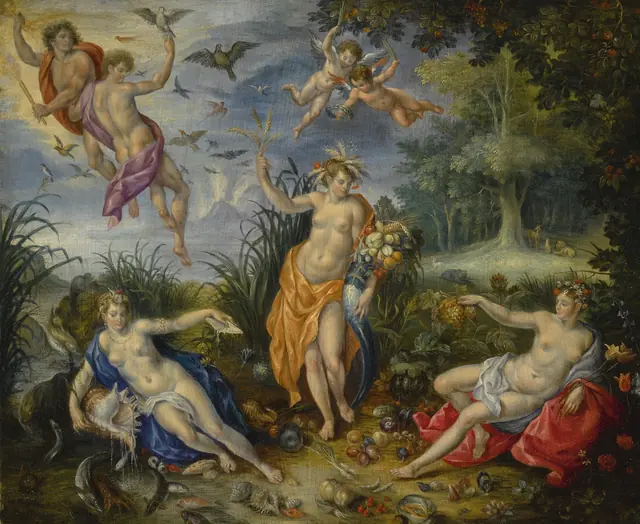
The man who brought them together was Empedocles of Acragas — modern Agrigento — in the fifth century BC. He did not call them elements: he called them rhizomata, roots, and he gave each one a god's name in his poem On Nature.
Hear first the four roots of all things: shining Zeus, and life-bringing Hera; Aidoneus too, and Nestis, who with her tears makes the springs of mortals flow.
That the four roots are fire, earth, air and water is not in dispute; which god is which very much is, and there are rival allocations. The most widely held makes Zeus fire, Hera air, Aidoneus — Hades — earth and Nestis water. Plato gave them geometric bodies in the Timaeus: the tetrahedron for fire, the cube for earth, the octahedron for air and the icosahedron for water, with the dodecahedron for the cosmos as a whole. Aristotle (384-322 BC) arranged them in pairs of qualities — hot, cold, wet, dry — and added a fifth body for the heavens, aether, which his Latin translators called quinta essentia. That is where the word quintessence comes from, and where the title of a 1997 film we will come to comes from too.
In China there are five, and they are not elements
Wuxing (五行) is badly served by the usual translation, ‘the five elements'. The character 行 means to march, to move: these are phases, stages of a cycle. Nor are they the Chinese equivalent of the four Greek ones — Empedocles' roots answer the question of what the world is made of, and these answer how it changes. They are wood, fire, earth, metal and water, and the oldest list of them sits in the ‘Hong Fan', the chapter of the Book of Documents that defines them by what they do rather than by what they are.
The first is water; the second, fire; the third, wood; the fourth, metal; the fifth, earth. Water soaks and descends; fire blazes and rises; wood bends and straightens; metal yields and changes; earth serves for sowing and reaping.
The same chapter gives them tastes: water is salty; fire, bitter; wood, sour; metal, pungent; earth, sweet. Zou Yan (c. 305-240 BC) turned the scheme into political theory, with every dynasty ruling under one phase. The Zhou had reigned under fire, so Qin Shi Huang took water, which defeats it, and with water came black for banners and clothing, the north, winter and the number six. That handover uses only one of the two cycles, the cycle of conquest. The two that are now always drawn the same way — a circle in which each phase generates the next, and a five-pointed star inside it in which each one overcomes another — were not fitted into a single system until the Han dynasty.
A triangle with a line through it and a head made of octopuses
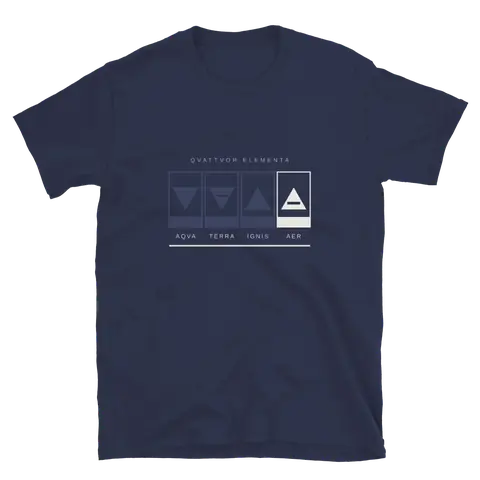
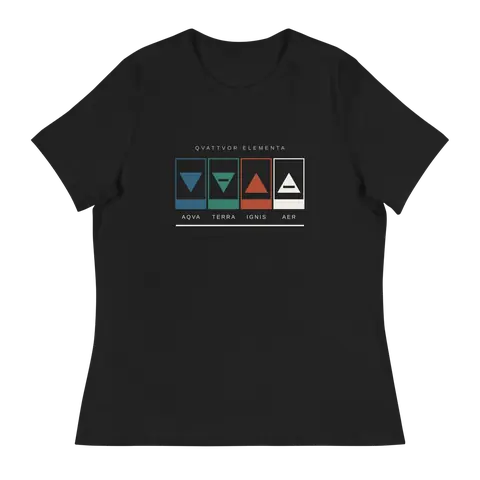
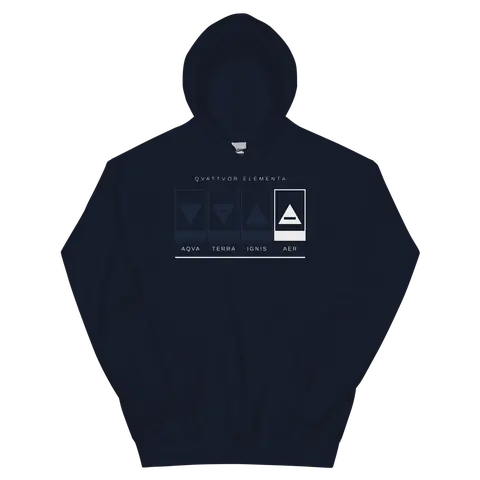
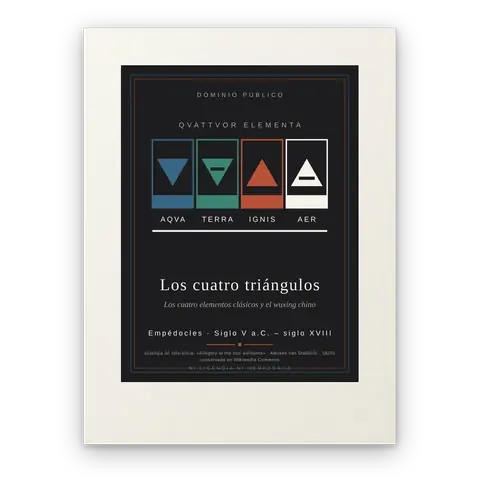
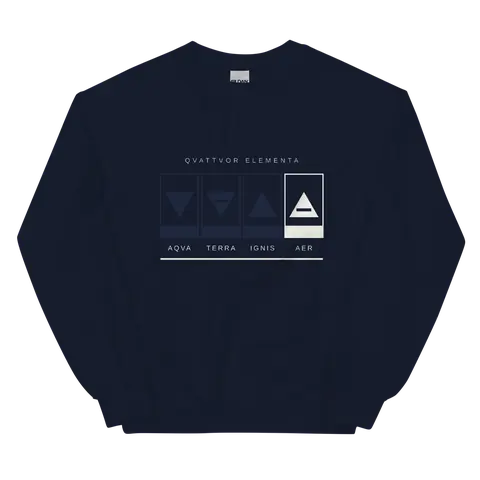
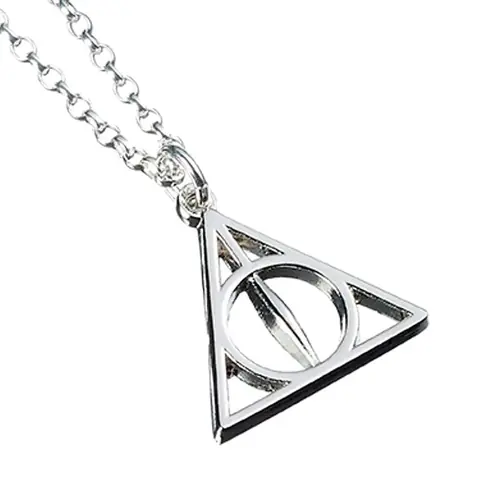
The four triangles everyone recognises come from printed tables, not from medieval manuscripts: fire points up, water points down, air is the upward triangle crossed by a line and earth the downward one crossed by another. Every workshop drew them its own way, and in the table accompanying Torbern Bergman's De attractionibus electivis (1775) they are already in print in exactly that form.
The good illustrated material is in the emblem books. Atalanta fugiens, by Michael Maier (1568-1622), was printed at Oppenheim in 1617 with fifty engravings by Matthäus Merian the Elder, and every emblem carries an epigram, a prose commentary and a fugue for three voices: a book to be looked at, read and sung.
In painting, the series that counts is the one Giuseppe Arcimboldo painted in 1566 for Maximilian II: heads in profile made out of things. Water is a tangle of crabs, turtles, lobsters and octopuses; Fire is flint, striker, burning logs and cannon; Air is birds, with a peacock for a body. Fire and Water hang in the Kunsthistorisches Museum in Vienna; of the original Air nothing survives, and it is known only from a contemporary copy.
Four stones, five ninjas and a salamander
The Fifth Element (Luc Besson, 1997) is the entire system turned into props: four engraved stones, one per element, a sarcophagus holding the fifth, and an Egyptian temple where a priest takes over the watch in 1914. The design was signed by two comics artists, Moebius and Jean-Claude Mézières; the costumes by Jean Paul Gaultier.
Avatar: The Last Airbender (Michael Dante DiMartino and Bryan Konietzko, 2005-2008) did the opposite: rather than invent an elemental magic, it hired a master. Sifu Kisu, of the Harmonious Fist Chinese Athletic Association, assigned each nation a real martial art, which is why the four move differently on screen.
- Water — tai chi: continuity, alignment, breath.
- Earth — hung gar: low stance, short strike.
- Fire — northern Shaolin: long arms and legs, straight attack.
- Air — baguazhang: circles and changes of direction.
- Toph, who is blind, fights southern praying mantis (chu gar).
The calligraphy for the series was by Siu-Leung Lee. Hanging off that same trunk are M. Night Shyamalan's film of 2010, Netflix's live-action series of 2024 and the animated Aang film of 2026.
The rest of the catalogue works from the same picture. Frozen II (2019) shares out the four spirits — Bruni the salamander, Gale the wind, Nokk the water horse and the stone giants — and makes Elsa the fifth. Elemental (2023) raises a whole city with one neighbourhood per element. And on the Chinese side there is the oddity almost nobody has seen: Five Element Ninjas (Chang Cheh, Shaw Brothers, 1982), in which the enemy fields one ninja squad per phase.
The alchemist who never wrote a word
Nicolas Flamel was real: a public scrivener in Paris from about 1330 to 1418, drawing up contracts and letters. He left not one text on alchemy. The Book of Hieroglyphic Figures that made him immortal was published in Paris in 1612, nearly two hundred years after his death, with his name on the cover and P. Arnauld de la Chevalerie behind it. When Harry Potter and the Philosopher's Stone (2001) sets Flamel to making the stone that yields the elixir of life, it is repeating a seventeenth-century publishing fraud, not a medieval legend.
The borrowing runs the other way as well. In Castle in the Sky (Hayao Miyazaki, 1986) the etherium crystal that holds Sheeta up in the air is elemental matter straight out of the books, and the flying island is called Laputa after the one in Gulliver's Travels (Jonathan Swift, 1726); Miyazaki later admitted he slipped the reference in to win the sponsors over, and that he never properly read the novel.