









The manual that came with no pictures
The Malleus Maleficarum was printed in Speyer around 1486-1487 and settled for two centuries what was said about witches, but it never showed one: it is solid text, without a single image. The face came from somewhere else. Ulrich Molitor, a jurist from Constance who died in 1507, published De lamiis et phitonicis mulieribus in 1489, a short dialogue with six woodcuts. It was the first illustrated treatise on witchcraft, and it beat the hammer at its own game: forty-three editions were printed between 1489 and 1669.
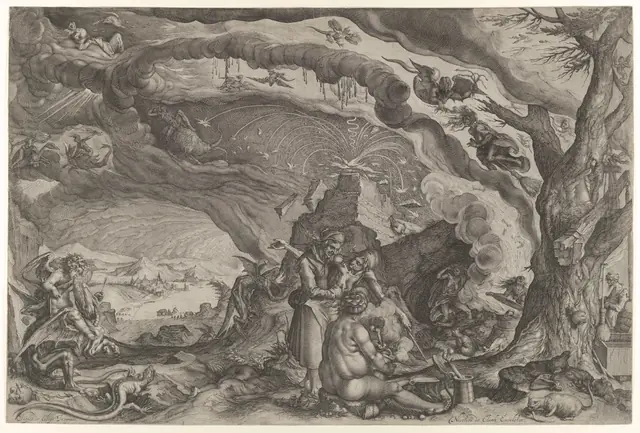
Those six prints are the mould. Two women round a pot, one dropping in a cockerel and the other a snake, the storm boiling up out of the brew. Witches with the heads of an ass, a cockerel and a dog, flying on a farmyard pitchfork rather than a broom. A sorcerer riding a wolf. The witch and the devil arm in arm like a courting couple. The engraver was not illustrating Molitor, who was a sceptic: he was copying prints that were already in circulation. In 1489 the image came loose from the argument, and it was never tied back on.
A witches' sabbath is a meadow in Navarre
The word is not generic: it is a place name. Aquelarre comes from the Basque aker, he-goat, and larre, meadow. That was what they called the little field beside the cave at Zugarramurdi, in the Navarrese Baztan, and the historian Gustav Henningsen dates the first use of the term to between February and May 1609, at the inquisitorial tribunal in Logroño. Half of Europe calls a gathering of witches an aquelarre because the name of a field in Navarre happened to be within an inquisitor's reach.
The Logroño auto-da-fé of November 1610 brought out fifty-three accused and burned six alive and five in effigy, already dead in gaol. The other half of the story almost never gets told: the inquisitor Alonso de Salazar Frías toured the district with an edict of grace, took thousands of statements and concluded that not one case had been proved. In 1614 the Suprema accepted his report, and Spain stopped burning witches almost a century before the rest of Europe.
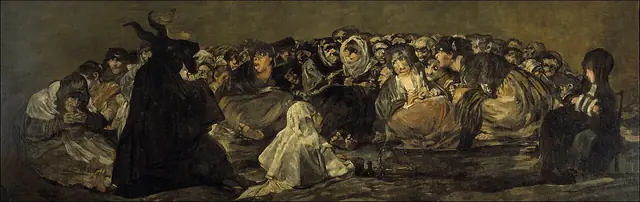
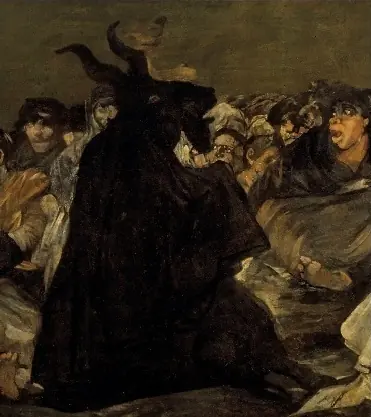
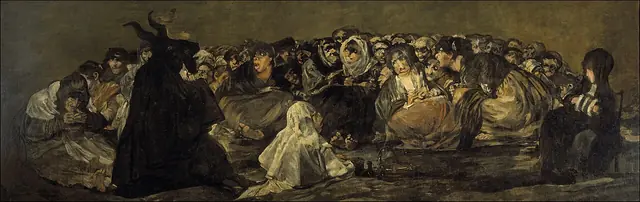
When Goya crowns his he-goat with vine leaves he is painting the etymology: in Witches' Sabbath (El aquelarre) of 1798, for the Duke and Duchess of Osuna, and in the great goat of the Black Paintings, 1821-1823. Two films have gone back to the same meadow: Witching and Bitching (Las brujas de Zugarramurdi, 2013), by Álex de la Iglesia, and Coven of Sisters (Akelarre, 2020), by Pablo Agüero, built on what the judge Pierre de Lancre wrote after his campaign of 1609 in the French Basque Country.
Matthew Hopkins's pocket bestiary
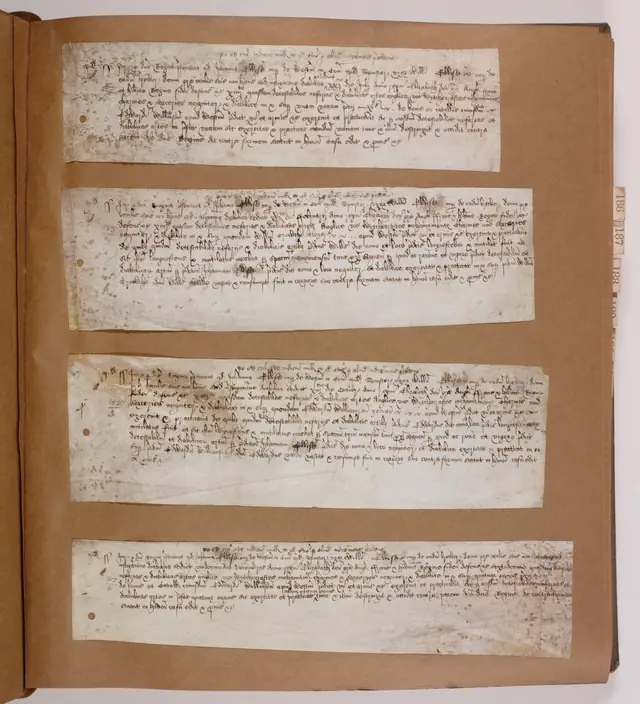
The engraving most looted by witch cinema is small and ugly: the frontispiece of The Discovery of Witches (1647), with which Matthew Hopkins answered the people accusing him of pulling confessions out of prisoners by keeping them awake. He stands between two women of Manningtree, in Essex, and five animals, each with its name lettered beside it.
They come out of Elizabeth Clarke's statement of March 1645 — Hopkins writes «March 1644» because the English year still began on 25 March — and they are a bestiary you could carry in a pocket:
- Holt, «like a white kitling».
- Jarmara, «like a fat spaniel with no legs at all».
- Vinegar Tom, «like a long-legged greyhound with the head of an ox, a long tail and broad eyes».
- Sacke and Sugar, «like a black rabbit».
- Newes, «like a polecat».
Hopkins adds the ones handed to him later — Elemanzer, Pyewackett, Peckin the Crown, Grizzel Greedigut — and finishes:
which no mortall could invent
His proof that the devil existed was that the names were too strange for a countrywoman to have made up.
Pyewacket was never a cat
Pyewacket is now one of the most-used cat names in English. Except that nowhere in Hopkins's text does anyone say Pyewacket is a cat. Of the familiars actually described, the only cat is Holt; the next two are dogs, and after them come a black rabbit and a polecat. Pyewacket stays on a list of names, with no body assigned to it.
The cat was cinema's doing. In Bell, Book and Candle (1958), by Richard Quine, Kim Novak plays a Manhattan witch with a Siamese called Pyewacket, and the name jumps to tens of thousands of real cats. Folklore manufactured backwards: a creature from 1647 given its species by Hollywood in 1958. By 2017, when Adam MacDonald handed the name back to a demon in Pyewacket, it already sounded like something you would call a pet.
The hand that puts the house to sleep
The Hand of Glory is the most concrete thing in any of this. The recipe is in Secrets merveilleux de la magie naturelle et cabalistique du Petit Albert, a French grimoire of 1722 published under a pseudonym: the hand of a hanged man, wrapped in a piece of winding sheet, pressed, cured for fifteen days in an earthenware pot with zimat, saltpetre, salt and long pepper, then dried in the dog-day sun or in an oven with bracken and vervain. There the hand is only the candlestick: it holds a candle of hanged man's fat and leaves everyone in the house unable to move. The other design, the five fingers burning instead of the candle, is older and continental: it turns up in a Flemish print of 1565 engraved by Pieter van der Heyden after Bruegel the Elder, and Francesco Maria Guazzo describes it in his Compendium Maleficarum (1608) as a corpse's hand, smeared with grease, that sends people to sleep while its fingers burn. English folk tales added the arithmetic: one flame per sleeper, and if a finger will not light it means somebody in the house is still awake; the fire cannot be put out with water, only with milk.
A single example is known to survive, in the Whitby Museum in North Yorkshire: it turned up hidden in the wall of a thatched cottage at Castleton and entered the museum in 1935, given by the stonemason and local historian Joseph Ford. It carries no sign of having burned, so in all likelihood it held a candle between its fingers.
From print to frame
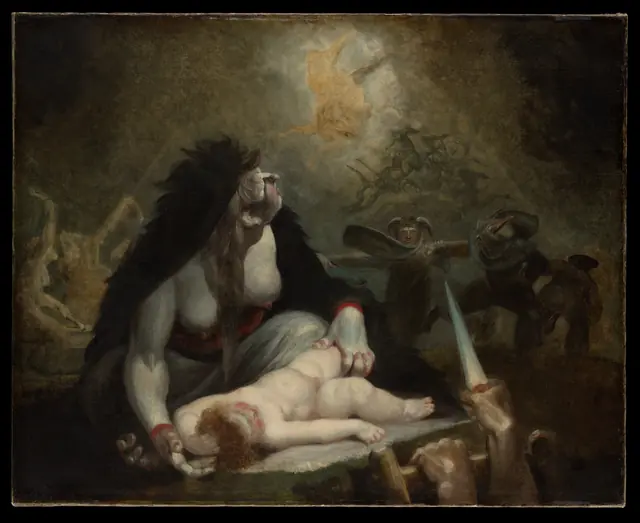
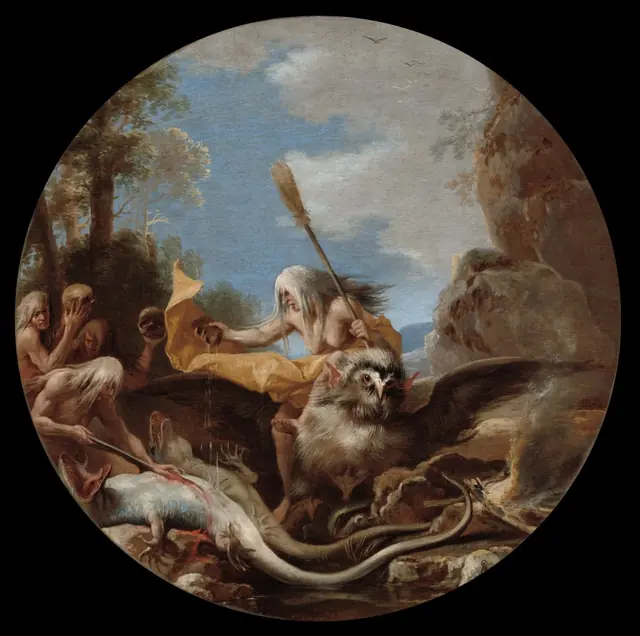
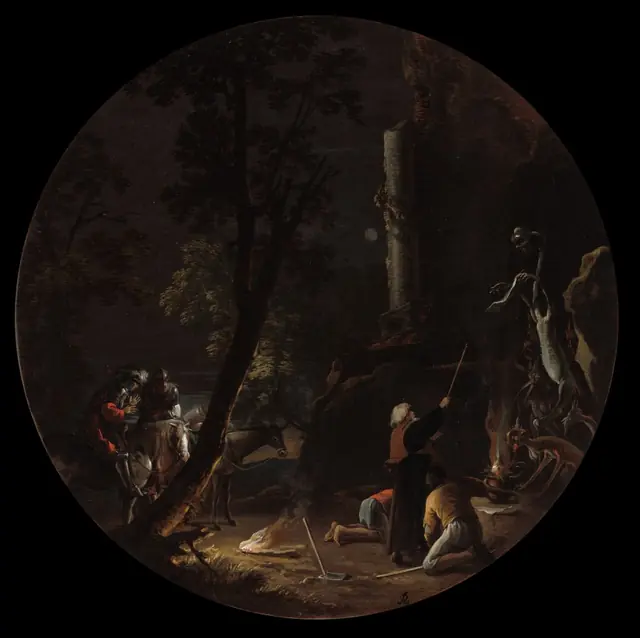
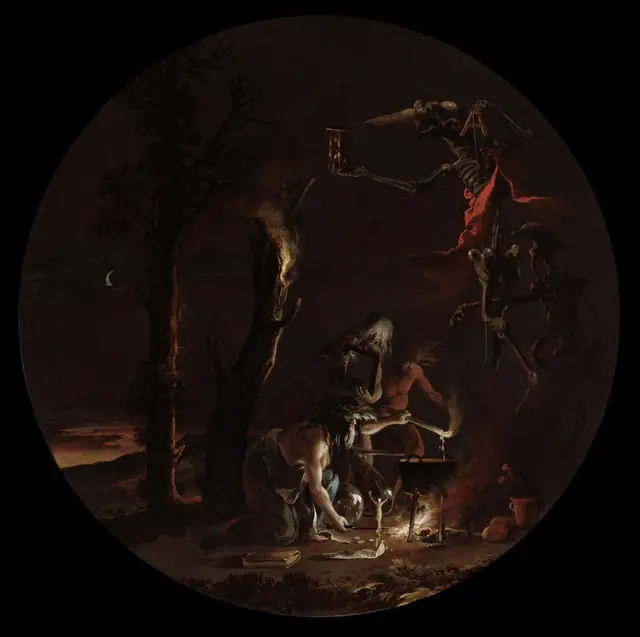
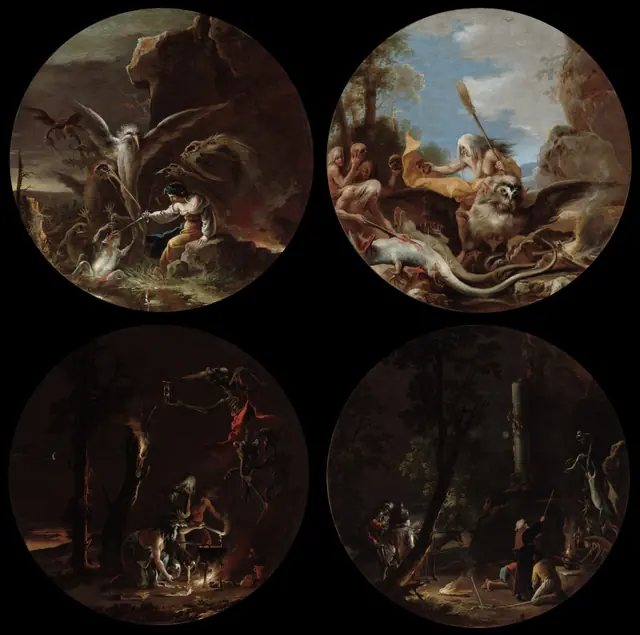
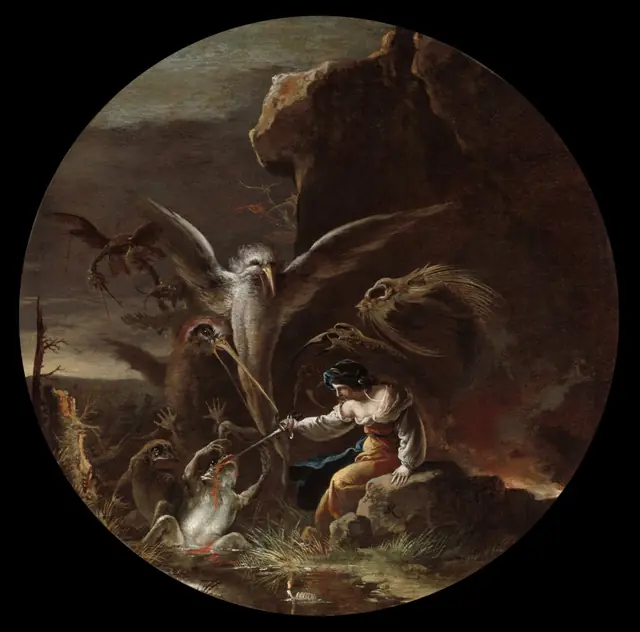
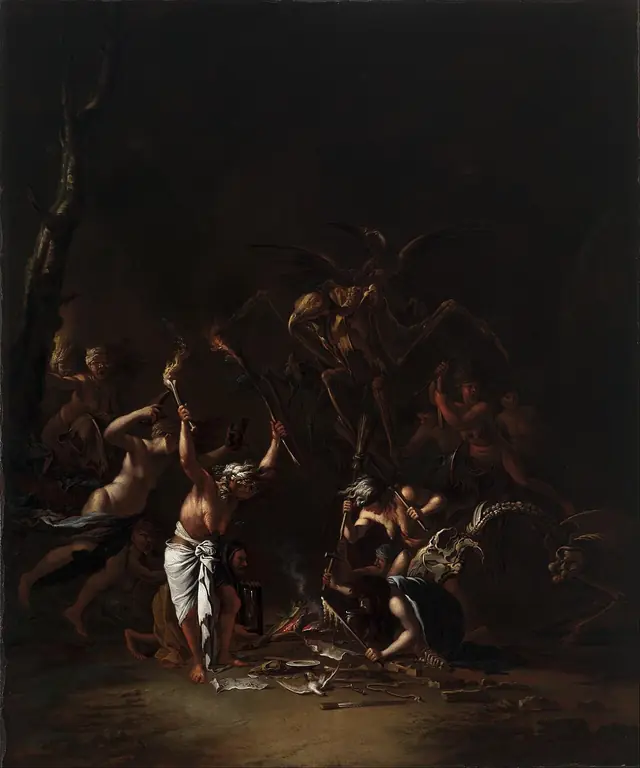
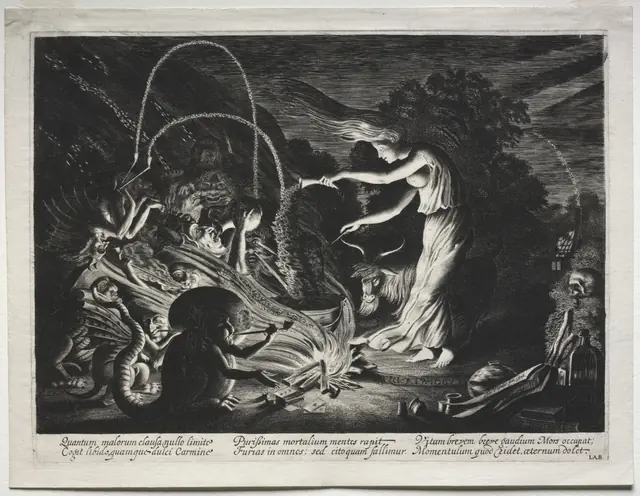
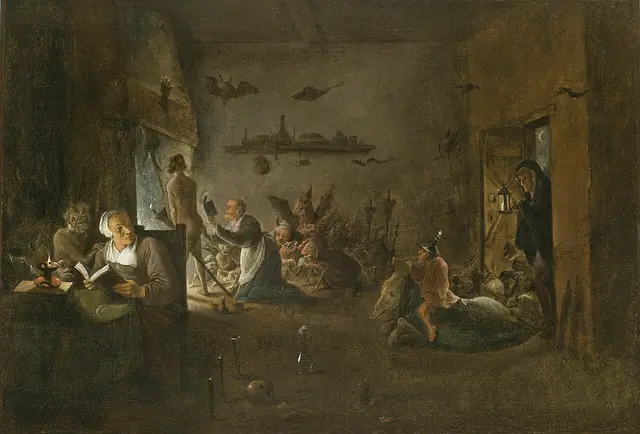
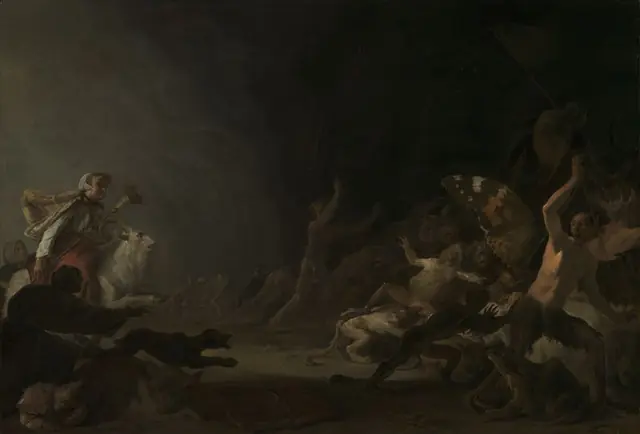
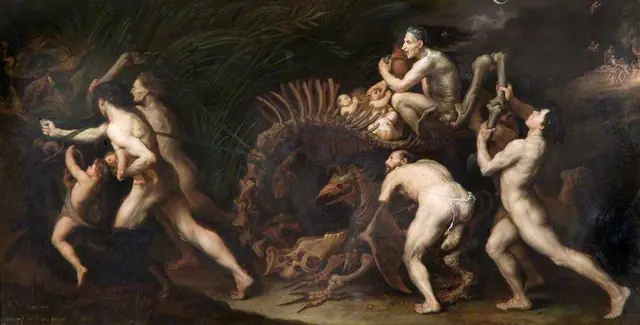
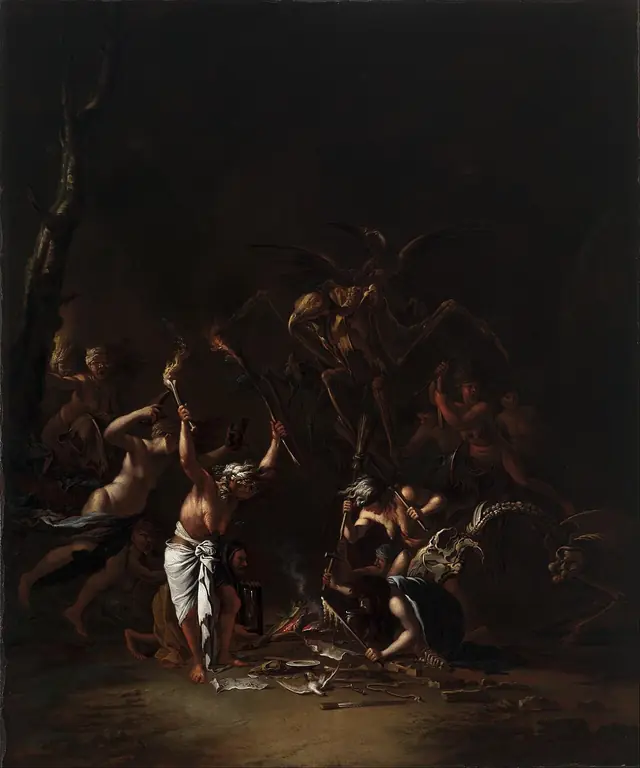
Häxan (1922), by Benjamin Christensen, is the link. Christensen found a Malleus in a Berlin bookshop, spent two years, from 1919 to 1921, working through manuals, plates and treatises on witchcraft, and built the film in seven chapters; before it dramatises anything, the camera tracks across still engravings. Around it sits the painting that cinema copies without crediting: Salvator Rosa's four Scenes of Witchcraft, one for each moment of the day, in the Cleveland Museum of Art, and The Night-Hag Visiting Lapland Witches, which Fuseli painted in 1796 on a passage from Paradise Lost: the night hag comes through the air, drawn by the smell of infant blood.
In 2026 Bullock and Kidman return as the Owens sisters in Practical Magic 2, on 11 September, and on 7 October Mike Flanagan's Carrie arrives on Prime Video: eight episodes, the first time King's novel has been told as a series. Carrie is not witchcraft, it is telekinesis; but it works because a whole town decides that it is, which is precisely what happened at Manningtree in 1645.