Who engraved the sky, and in whose workshop
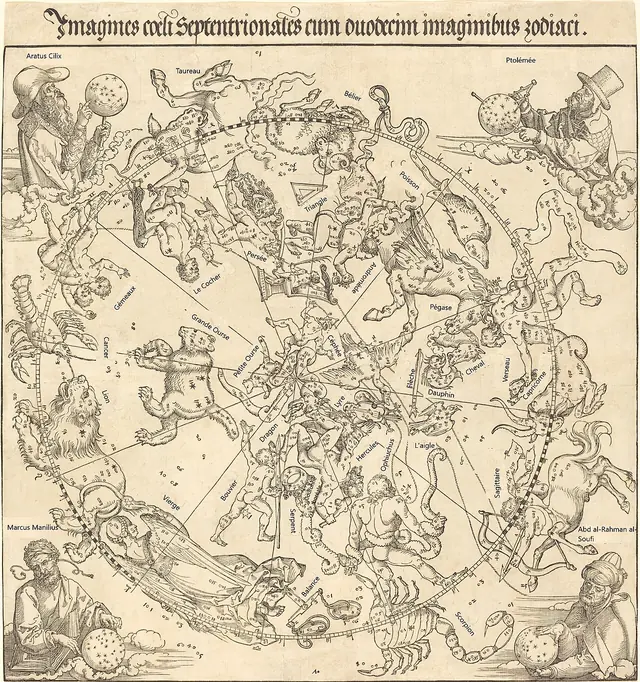
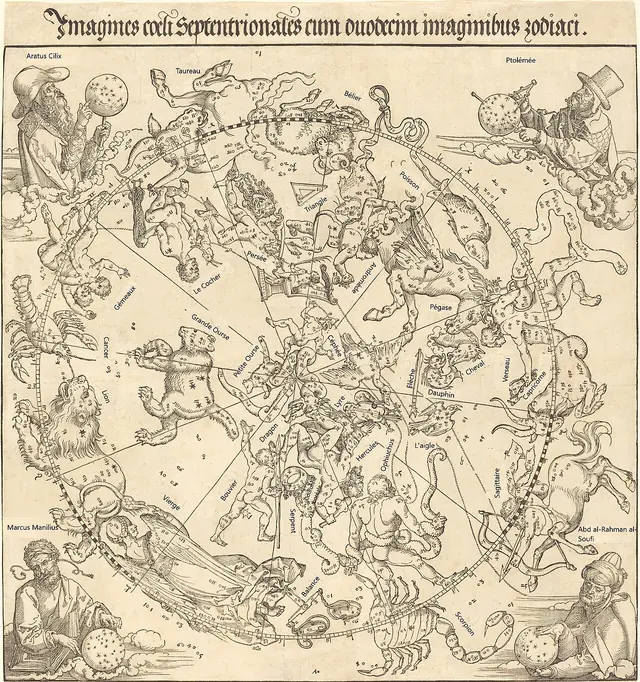
The first star map printed in Europe dates from 1515 and carries three names: Johannes Stabius commissioned it, Konrad Heinfogel placed the stars and Albrecht Dürer drew the figures. The plate's own cartouche says as much, beneath their three coats of arms: Ioann. Stabius ordinavit / Conradus Heinfogel stellas posuit / Albertus Durer imaginibus circumscripsit. Two hemispheres, made in the circle of Maximilian I and Cardinal Matthäus Lang. Around ten copies survive.
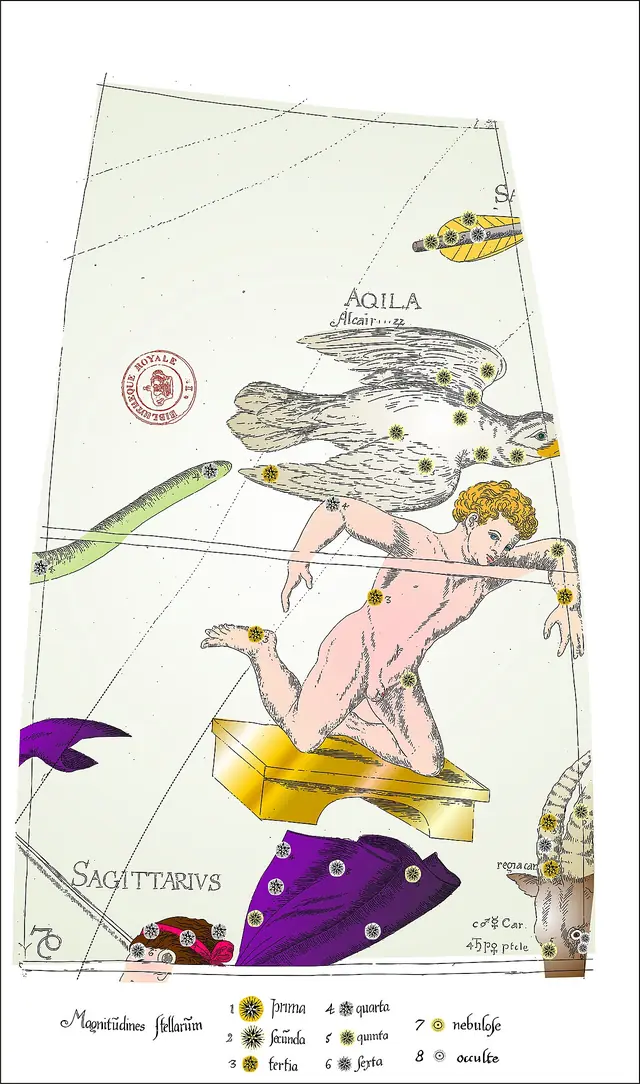
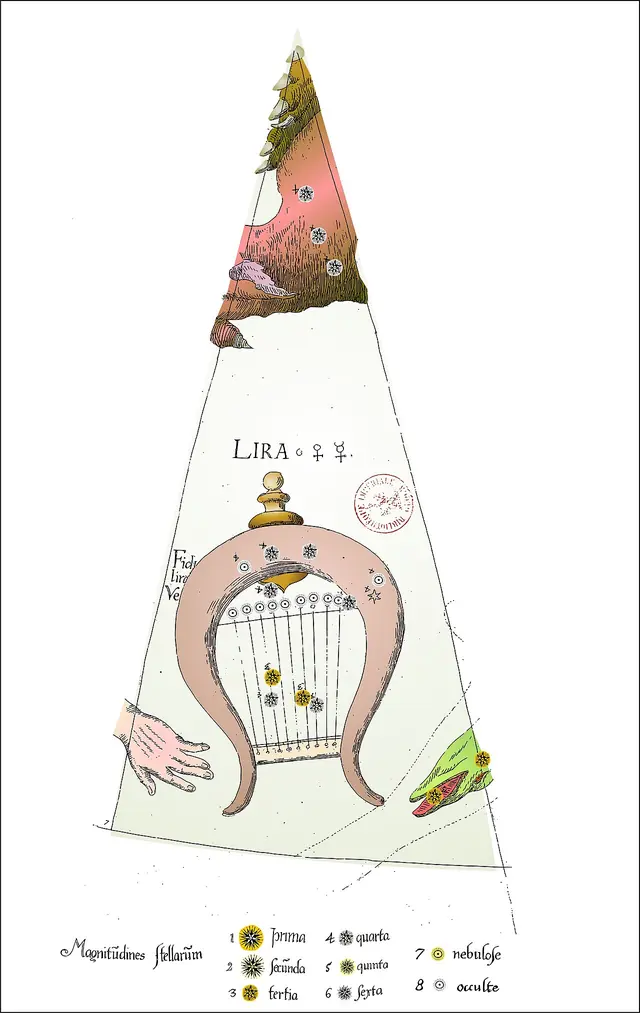
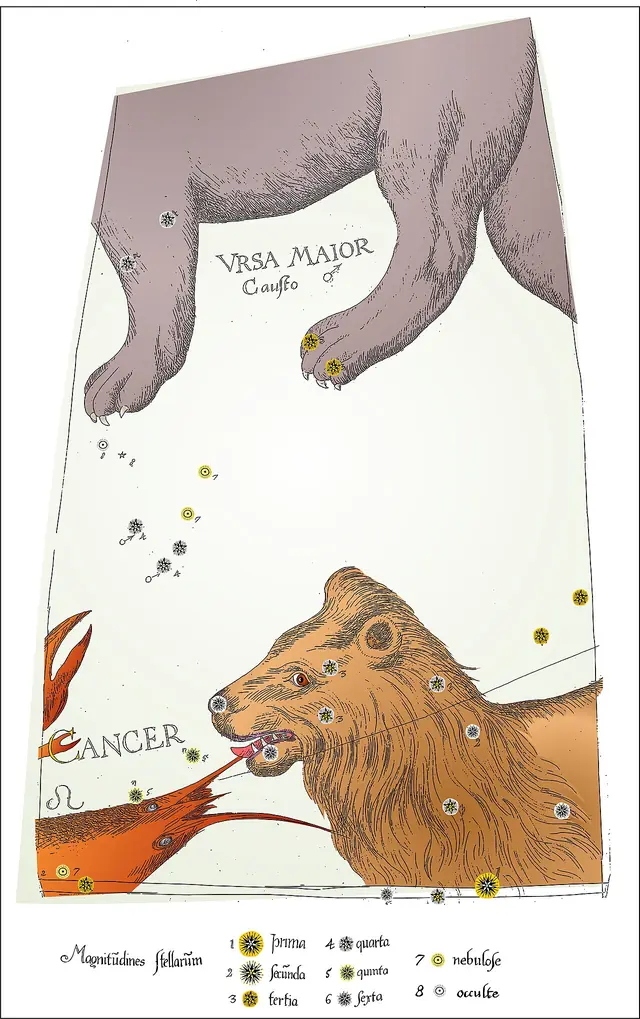
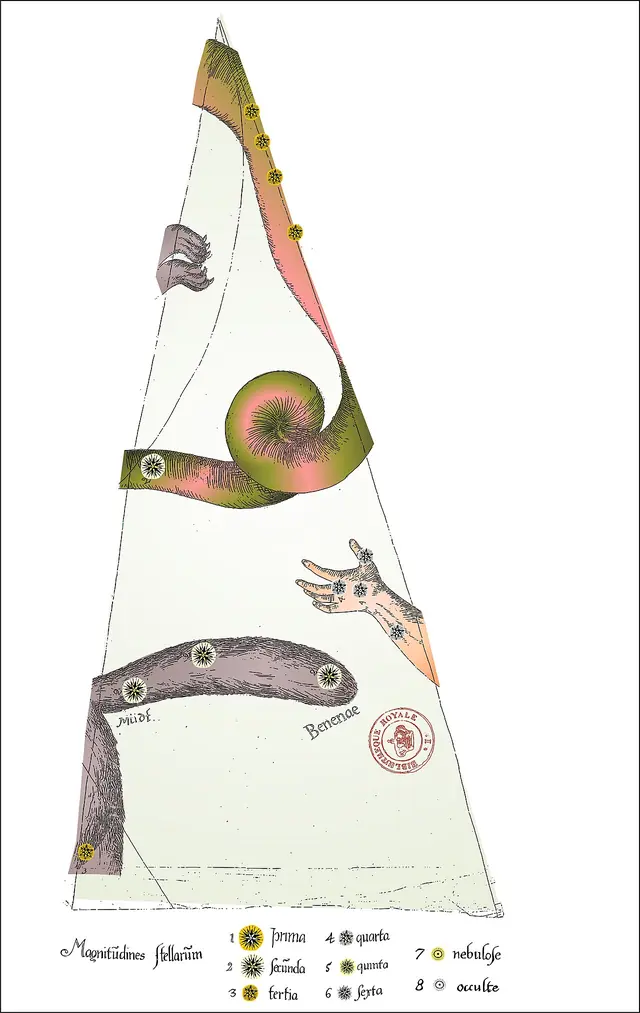
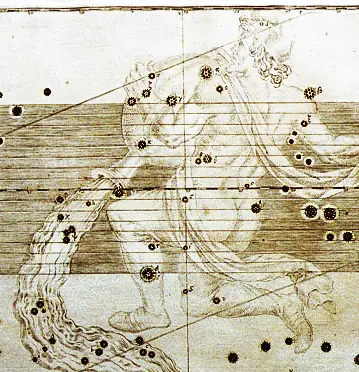
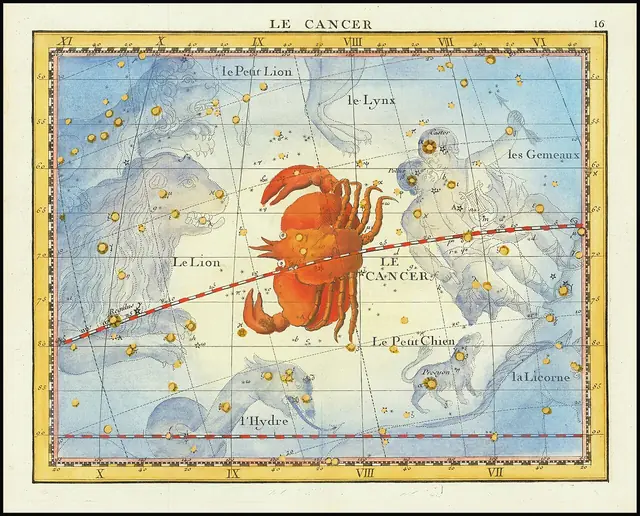
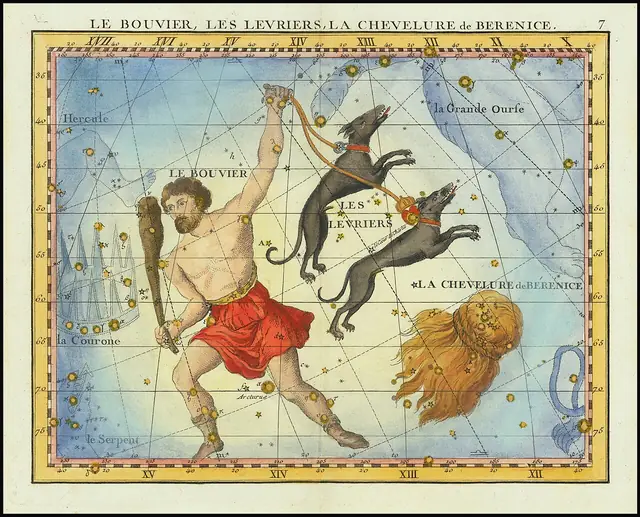
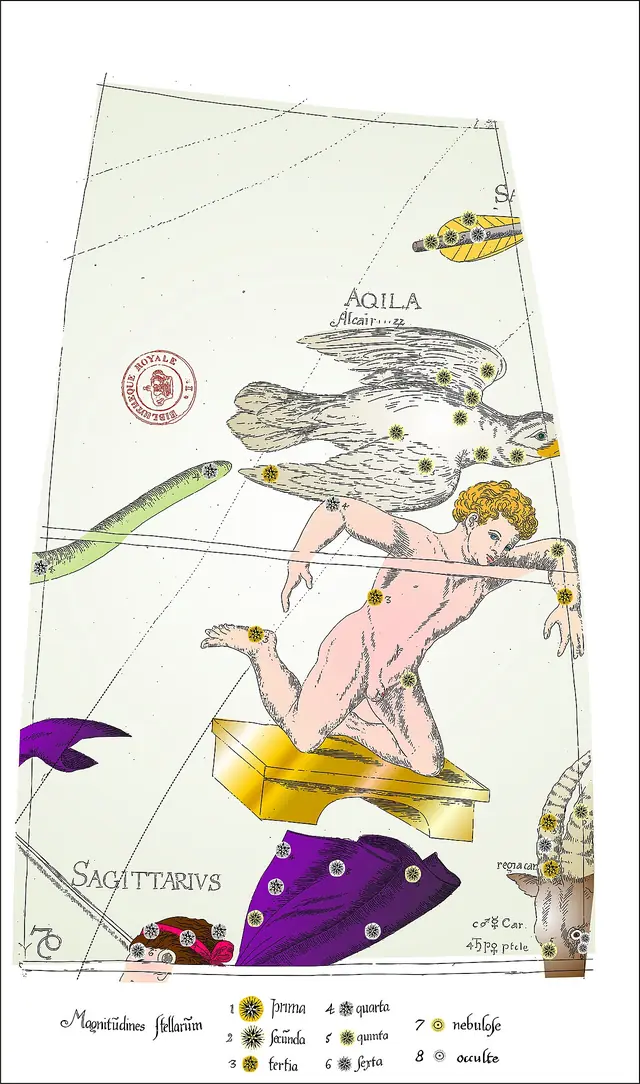
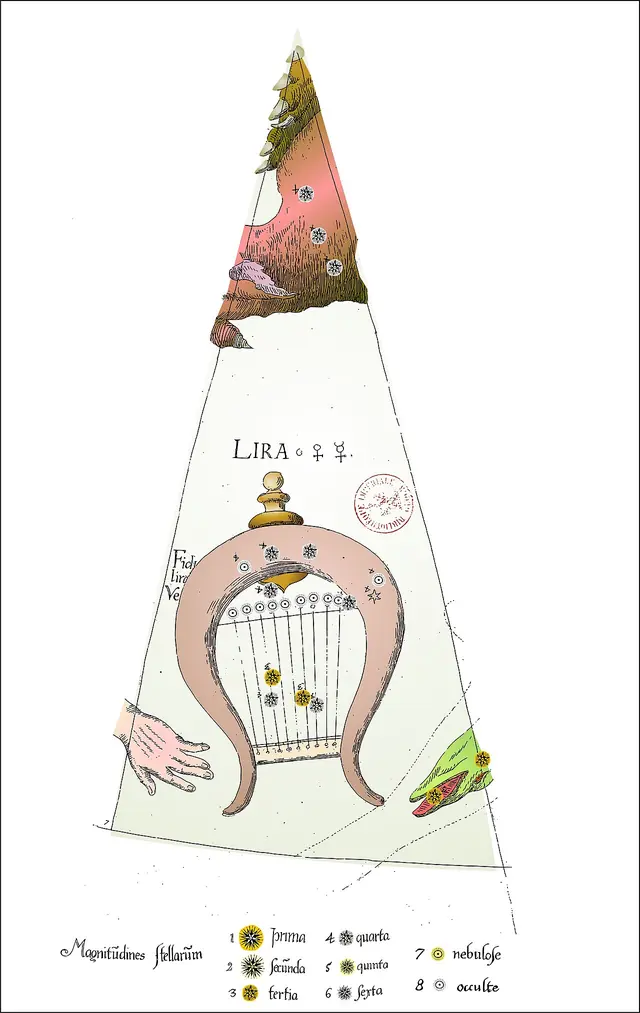
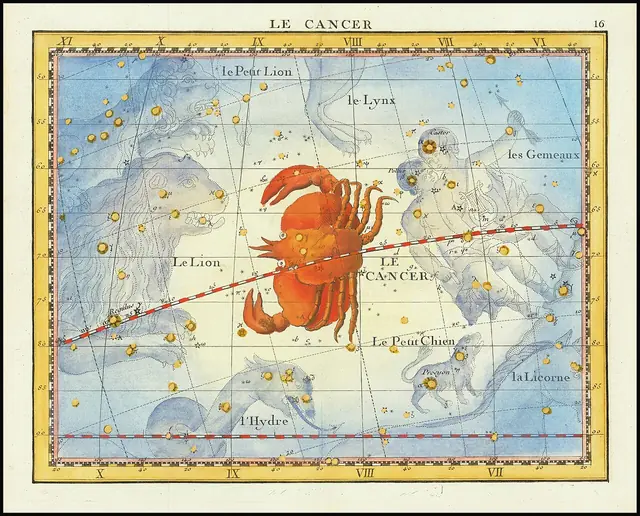
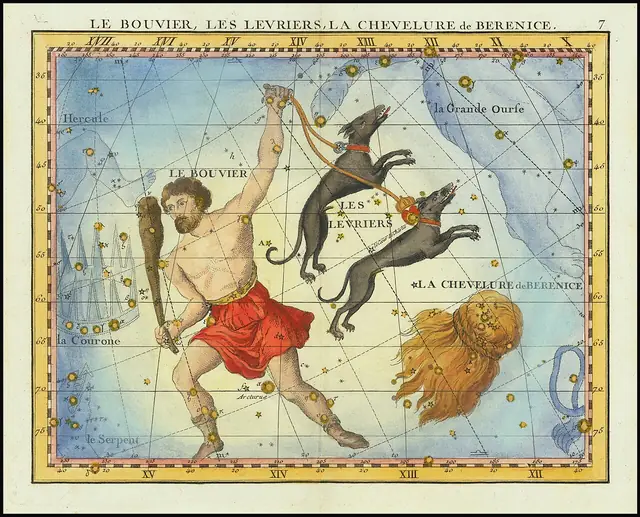
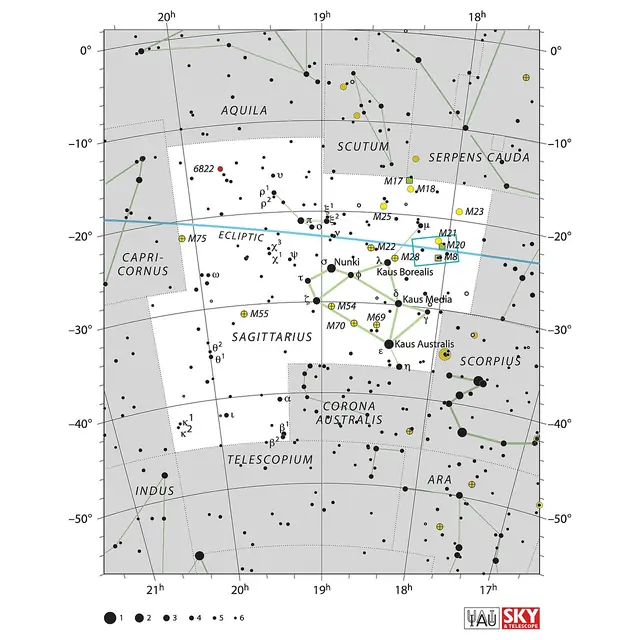
In 1603, in Augsburg, the lawyer Johann Bayer brought out the Uranometria with the printer Christoph Mang: 51 plates engraved in copper by Alexander Mair, every figure overlaid with a coordinate grid and positions taken from Tycho Brahe's catalogue. This is where the habit of naming stars with Greek letters in order of brightness begins, and we are still using it: alpha Orionis is Betelgeuse because Bayer said so.
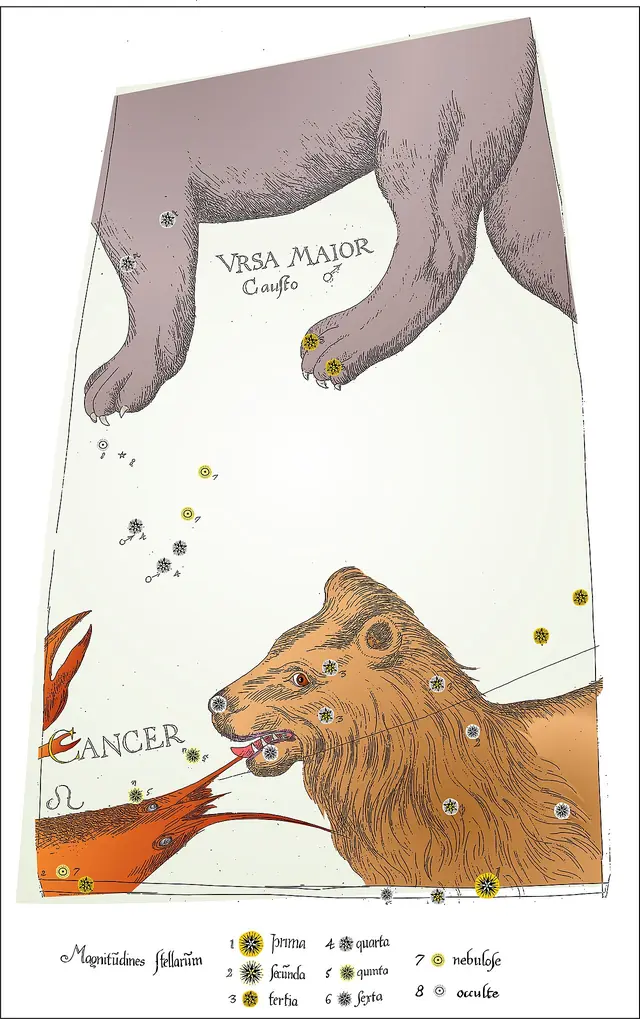
Then come the heavyweights. Andreas Cellarius, Harmonia Macrocosmica (Amsterdam, Johannes Janssonius, 1660), twenty-nine double pages setting the systems of Ptolemy, Copernicus and Tycho side by side with cherubs in the margins; no atlas has been looted harder by interior decorators. And Johannes Hevelius, Firmamentum Sobiescianum sive Uranographia (Gdansk, 1690), 54 double plates covering 73 constellations.
The two atlases that close the sequence were published by two widows. Hevelius died in 1687, and it was Elisabeth Koopman — his wife, and his partner at the great sextant — who got the book out in 1690. John Flamsteed died in 1719 and his Atlas Coelestis was published by Margaret Flamsteed, with James Hodgson, in 1729. In 1776 the Parisian J. Fortin shrank it to a third of the size under the supervision of Lemonnier and Messier: it was that pocket edition that travelled across Europe.
A bestiary brought back from the southern seas
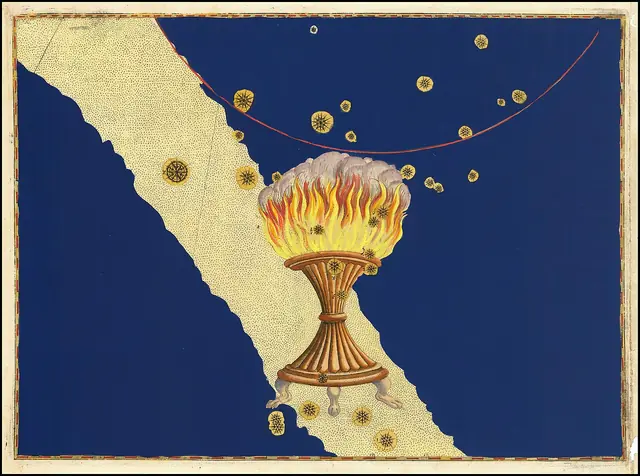
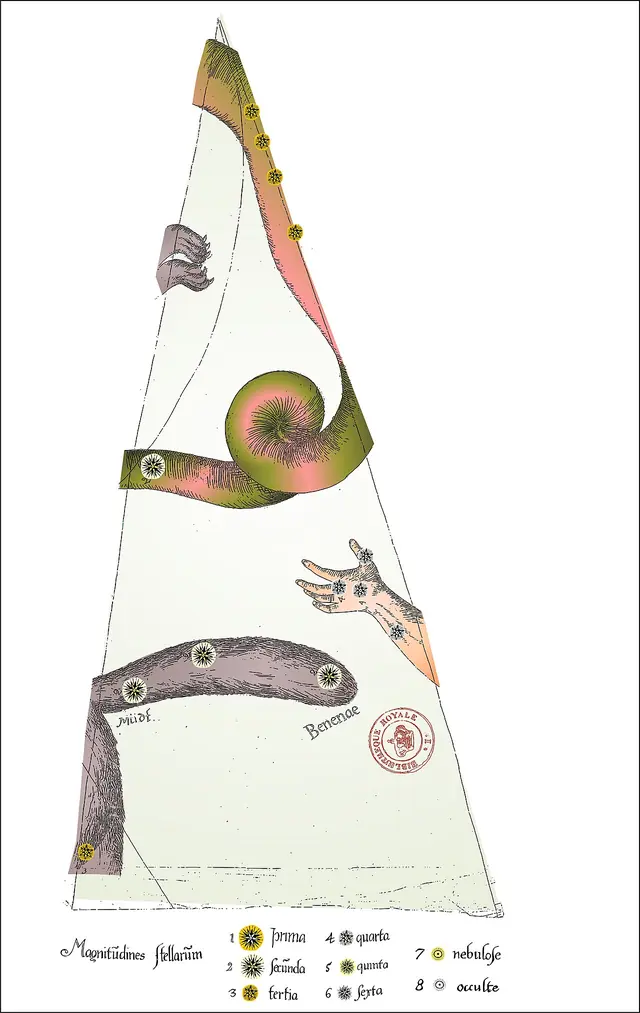
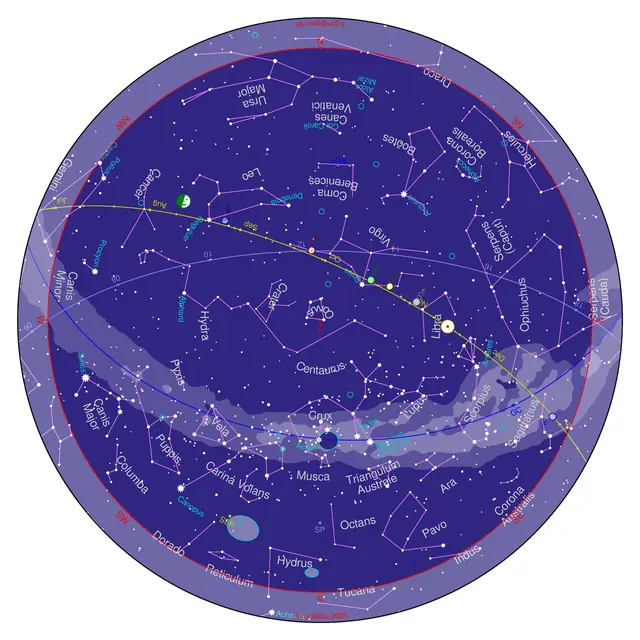
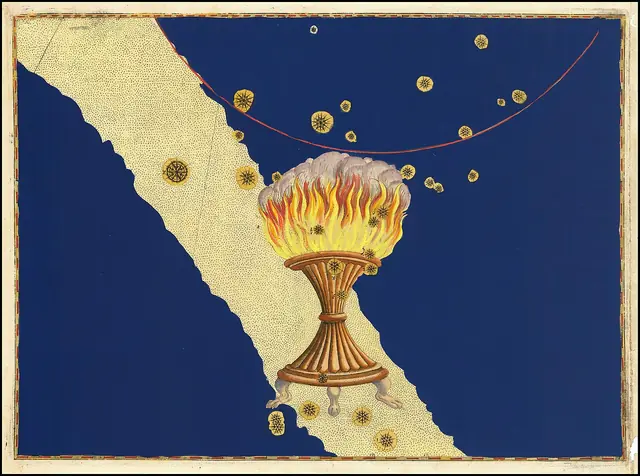
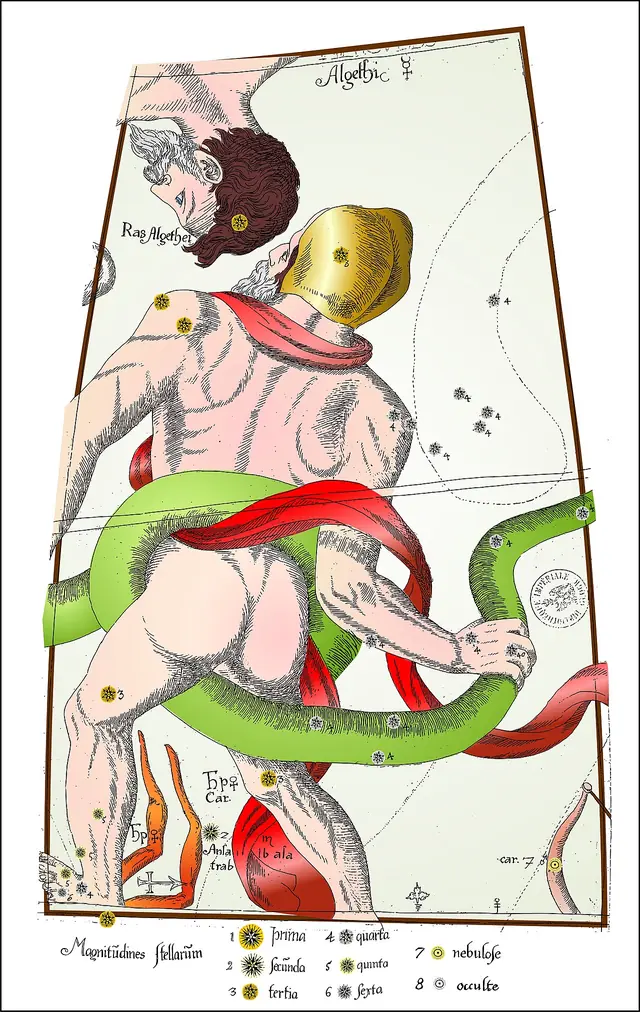
Bayer's plate 49 is the odd one out: twelve constellations Ptolemy could not possibly have known, because they cannot be seen from the Mediterranean. Bayer copied them from the notebook of Pieter Dirkszoon Keyser, who observed them in 1595 and 1596 on the first Dutch expedition to the Indies, alongside Frederick de Houtman. Keyser died in September 1596 in the Sunda Strait and never saw his stars in print: Petrus Plancius mounted them on a celestial globe late in 1597 and Bayer engraved them in 1603. Which is why the southern sky is a menagerie of animals those sailors had only just set eyes on for the first time:
- Apus, the bird of paradise; Pavo, the peacock; Tucana, the toucan.
- Chamaeleon, the chameleon; Musca, the fly — though Bayer engraved it as Apis, the bee, and it was Lacaille who turned it into a fly on his southern planisphere of 1756 —; Volans, the flying fish; Dorado, the swordfish.
- Grus, the crane; Hydrus, the water snake; Indus, the Indian; plus Phoenix and Triangulum Australe.
Hevelius added his own, and his are better still. He named Lynx because, as he wrote, you would need oculos Lynceos, the eyes of a lynx, to make it out: Gassendi had said in 1644 that Hevelius had lynx-like sight, and he turned that into a dare aimed at the reader. He engraved Vulpecula cum Ansere, a fox carrying a goose in its jaws on its way to the three-headed Cerberus, another of his inventions. He called a shield Scutum Sobiescianum, in honour of his patron King John III Sobieski. And he hung a Sextans in the sky in memory of the sextant that burned with his Gdansk observatory on 26 September 1679. The goose was eventually eaten: today only the fox is left, and a star called Anser.
Hevelius drew the sky the wrong way round
Bayer, Cellarius and Flamsteed draw the sky as you see it flat on your back. Hevelius does not: he draws his 73 constellations as though we were looking at a celestial globe from the outside. His figures come out mirrored against what you will see tonight, and to use the plates you have to flip them in your head. It was not carelessness, it was a position: for him the canonical object was the globe, not the ceiling.
That impossible vantage point is exactly the one that opens Game of Thrones (HBO, 2011): an armillary sphere with the sun at its centre and the continents engraved on the inner face of the globe, so that the viewer looks at the world from a spot nobody can stand in. The title sequence is by Elastic; Angus Wall, Robert Feng, Kirk Shintani and Hameed Shaukat won the 2011 Emmy for it.
The 1888 engraving that pretends to be medieval
There is one image that turns up in every documentary about the cosmos: a pilgrim kneels at the edge of the world, pushes his head through a gap in the firmament and sees the wheels and gears behind it. It is almost always presented as a medieval woodcut. It is nothing of the kind.
It first appears in 1888, on page 163 of Camille Flammarion's L'atmosphère: météorologie populaire (Hachette, Paris), and unsigned. The caption is what caused the confusion: it told of a missionary of the Middle Ages who claimed to have found the point where sky and earth touch.
In 1973 Bruno Weber, keeper of rare books at the Zentralbibliothek in Zurich, took it apart: the engraving carries burin strokes, and the burin is not used on wood until the end of the eighteenth century. Weber and the astronomer Joseph Ashbrook also pointed out that the split vault looks a great deal like an illustration in Sebastian Münster's Cosmographia (1544), a book that Flammarion, a bibliophile, could easily have had to hand. It is a nineteenth-century fake antique. The colour versions are newer still: the first to be published was Roberta Weir's, distributed by Print Mint of Berkeley in 1970. And its most widely seen outing was the day before yesterday — on 9 March 2014 the first episode of Cosmos: A Spacetime Odyssey animated it to tell the story of Giordano Bruno.
From the copper plate to the film set
A Trip to the Moon (Le Voyage dans la Lune, Georges Méliès, 1902). Tableau twelve, the dream, does not show stars: it shows faces. Phoebe seated on the horn of the moon (played by Bleuette Bernon), the Great Bear, the twin stars and Saturn leaning out of a window between his rings. Méliès invented nothing: he copied the way the sky was drawn in the atlases and almanacs, where every heavenly body has a body, clothes and a gesture.
Agora (Alejandro Amenábar, 2009). The armillary sphere, the quadrants, the astrolabe and the model of the Ptolemaic system that Hypatia handles were built as genuine working replicas: blacksmiths, carpenters, model-makers and painters spent three months between Rome and Malta, working from designs pulled out of museums and libraries. Once the shoot wrapped, the pieces went on display at the Museo de la Ciencia y el Cosmos in Tenerife until 19 July 2009.
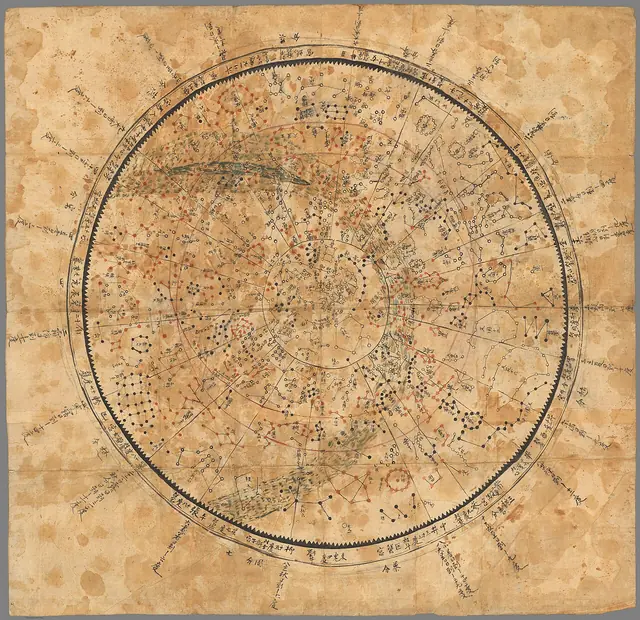
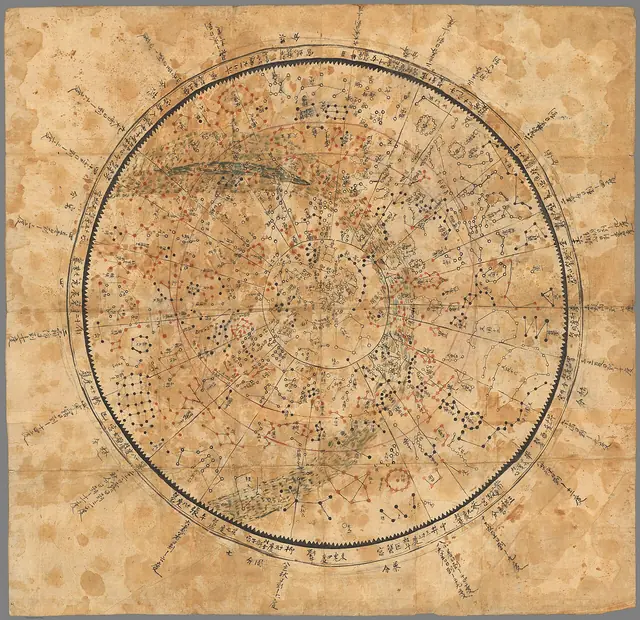
Forbidden Dream (Hur Jin-ho, 2019). Choi Min-sik and Han Suk-kyu as Jang Yeong-sil and King Sejong, building celestial globes and water clocks. Behind it all sits the Cheonsang Yeolcha Bunyajido, the chart Taejo had carved into black stone in December 1395 with 1,467 stars and 264 constellations: Korea's National Treasure no. 228, and the backdrop of the 10,000-won note since 2007.