




A Welsh bishop invents a king
Around 1136 Geoffrey of Monmouth finished the Historia Regum Britanniae, a book sold as history and almost entirely invented. Uther Pendragon, Guinevere, Tintagel, Merlin and a sword called Caliburnus are all assembled there already — the name a Latinisation of the Welsh Caledfwlch, «hard breach», which two centuries of copyists turned into Excalibur. It worked: by 1929, 186 surviving manuscripts had been catalogued, bestseller numbers for the twelfth century. Geoffrey died around 1155 as Bishop of St Asaph, a diocese he probably never set foot in.
Everything else was added in layers, and we know who laid each one. The Norman Wace put Geoffrey into French in the Roman de Brut (c. 1155) and slipped in the Round Table, which had existed nowhere before. Chrétien de Troyes wrote five romances between 1170 and 1190 —Erec and Enide, Cligès, Lancelot, Yvain, Perceval— and invented three things that now sound impossibly ancient: Camelot, Lancelot's affair with Guinevere, and the Grail. Robert de Boron closed the package around 1200: he made the grail the chalice of the Last Supper, made Merlin the son of a demon and a virgin, and drove a sword into a stone.
The grail was not a cup
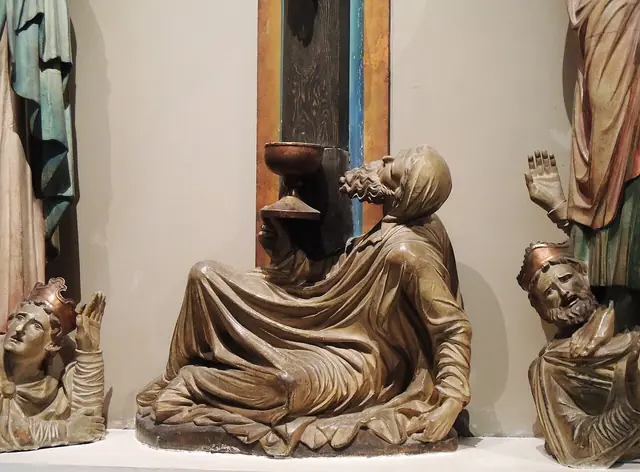
In Perceval, the Story of the Grail (1182-1190, some 9,000 lines that Chrétien left unfinished) the object is not a chalice, and not once does the text call it holy. It is a graal: a wide, heavily decorated serving dish. It shares the scene with a lance dripping blood, a silver tailleor and a set of candlesticks. Perceval watches the procession pass in the Fisher King's castle and, out of good manners, fails to ask who is being served. The whole literature of the Grail comes out of that unasked question. The four later continuations added roughly 54,000 lines and christianised everything Chrétien had left ambiguous.
The Welsh branch is stranger still. In Culhwch ac Olwen —the oldest Arthurian tale in Welsh, preserved in the White Book of Rhydderch (c. 1350) and the Red Book of Hergest (1382-1410)— the giant Ysbaddaden sets some forty impossible tasks before he will hand over his daughter. One of them is to hunt Twrch Trwyth, a prince turned into a boar as divine punishment, his bristles dripping venom and a comb, a pair of shears and a razor lodged between his ears. The hunt crosses Ireland and Wales and ends with the animal driven off a Cornish cliff. That same boar had already appeared, as Troynt, in the ninth-century Historia Brittonum.
The manuscript asleep in a school library
Thomas Malory wrote Le Morte d'Arthur around 1469-70, in «the ninth year of the reign of Edward IV», and described himself like this:
knyght presoner Thomas Malleorre
Knight prisoner. William Caxton printed it in 1485 and imposed a division into books and chapters that Malory had never written. Two copies of that print run survive: one in the Morgan Library in New York, the other in the John Rylands in Manchester. For four and a half centuries, Caxton was the only version there was.
In June 1934, Walter Oakeshott was cataloguing the library of Winchester College when he came across a Malory manuscript older than the printed book, its names in red ink and free of Caxton's divisions. The newspapers summed it up well: what Caxton published was not exactly what Malory wrote. But the clincher came in 1976. Microscopic examination showed that certain smudges on the manuscript are offsets from pages freshly printed in Caxton's own type. Which means the codex was physically in his workshop while the book was being set. The printer had it in front of him, read it, and decided to change it. Today it is Add MS 59678 at the British Library.
From parchment to screen
Excalibur (John Boorman, 1981) adapts Malory without apology, and it is the film that fixed the look: mirrored armour, dripping forest, Orff's Carmina Burana bolted onto Wagner (Parsifal, Tristan, Siegfried's funeral march). It cost $11 million and took $35 million in the United States and Canada alone. It was shot entirely in Ireland —Wicklow, Tipperary, Kerry and Ardmore Studios— and buried in the cast, young and nowhere near the top of the poster, are Liam Neeson, Gabriel Byrne, Patrick Stewart and Ciarán Hinds.
The Green Knight (David Lowery, 2021) goes back to the fourteenth-century poem and treats it as material rather than as a script: it keeps the beheading pact and the green girdle, and adds Morgan le Fay as Gawain's mother, the ghost of St Winifred and a fox. A24, a $15 million budget, $20 million at the box office, 89% favourable reviews and a C+ from audiences: it delighted the critics and baffled the room. It was shot in Ireland, at Cahir Castle and at Ardmore, the same stages as Excalibur forty years earlier.
King Arthur (Antoine Fuqua, 2004) tries the «historical» route: Arthur as a fifth-century Roman officer and his knights as Sarmatian cavalry. They built a kilometre of Hadrian's Wall in County Kildare and it took four and a half months; the film took $203.6 million against a $120 million budget, and Fuqua came away unhappy because the studio cut it down to a PG-13. And then there is the rest of the cycle: Monty Python and the Holy Grail (1975), bankrolled by Led Zeppelin (£31,500) and Pink Floyd (£21,000) because it was a tax write-off, with actors banging coconut shells together because there was no money for horses; Merlin (BBC, 2008-2012, 65 episodes shot in Wales and at the Château de Pierrefonds, sold to 183 countries); and Guy Ritchie's King Arthur: Legend of the Sword (2017), the first instalment of a planned six that cost Warner $153 million in losses and died right there.
Who gave him a face
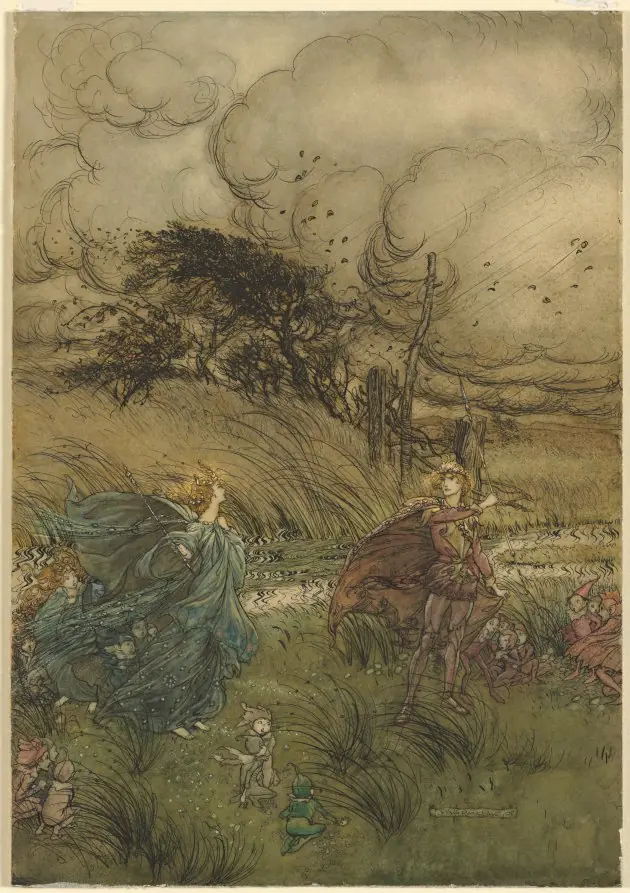
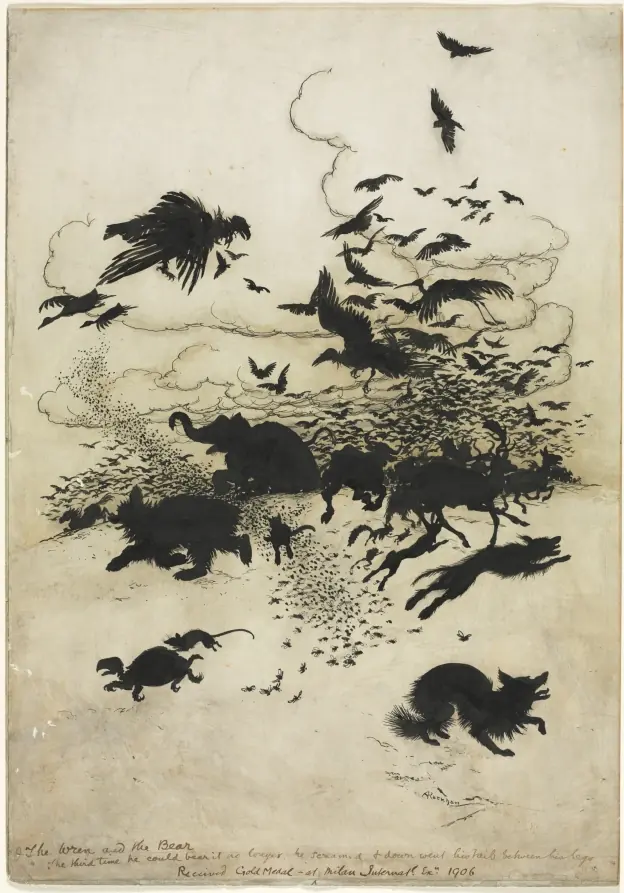
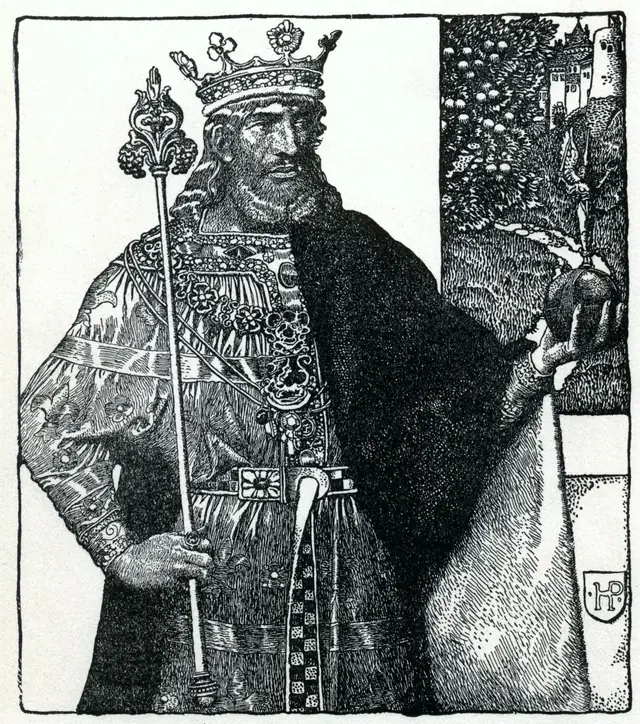
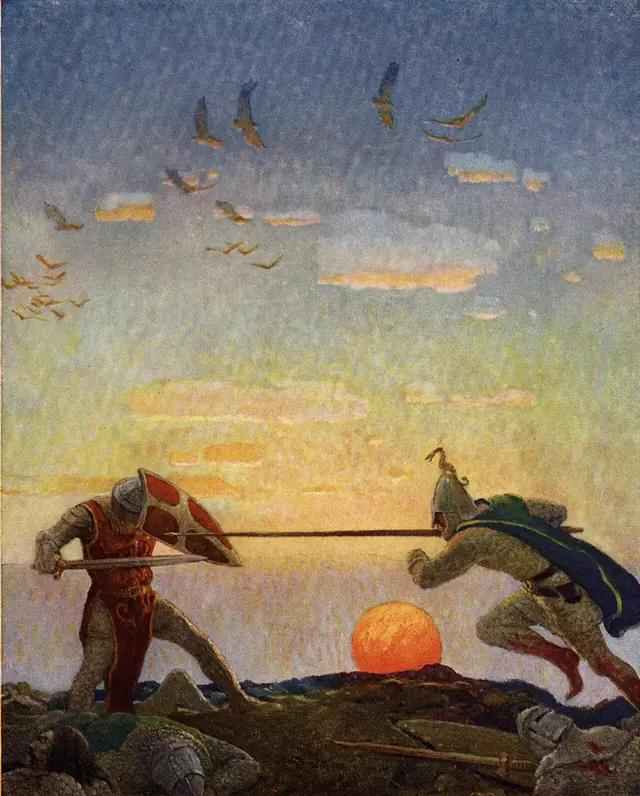
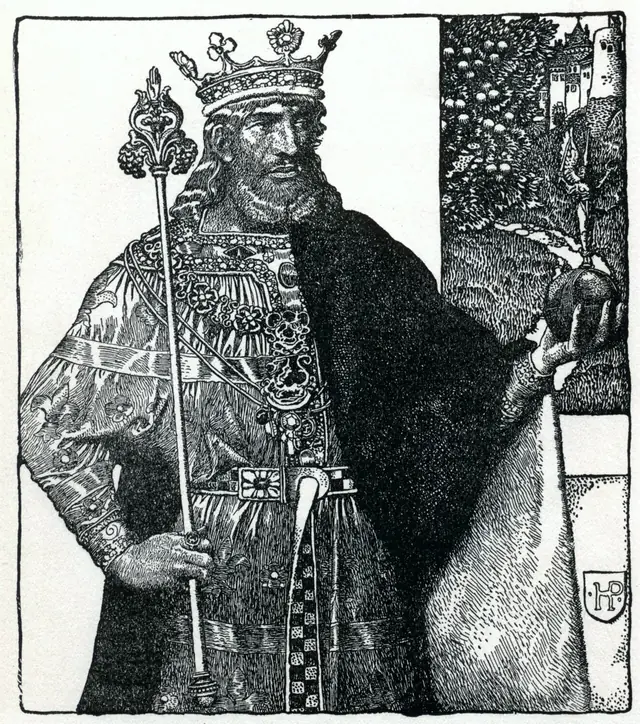
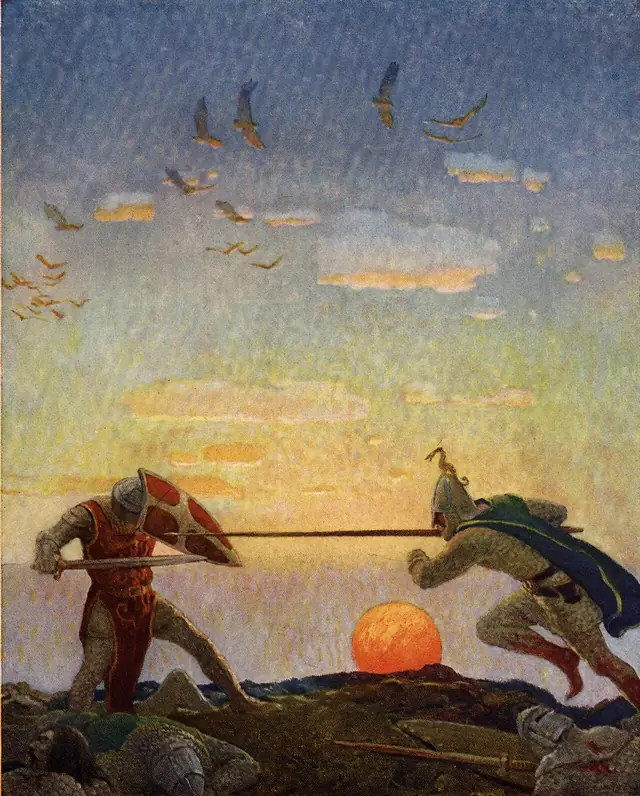
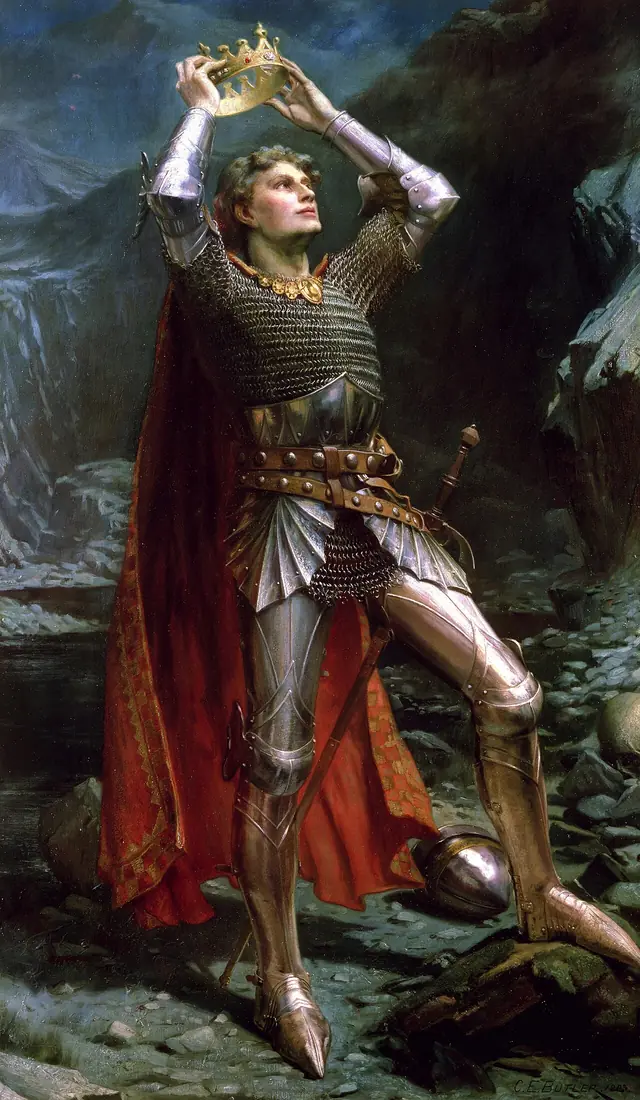
Almost everything that comes to mind at the word «Arthur» comes from four illustrators of the nineteenth and early twentieth centuries, not from the manuscripts. Gustave Doré engraved Tennyson's Idylls of the King, twelve poems published between 1859 and 1885. Aubrey Beardsley was handed his first professional commission in 1893: illustrating Le Morte Darthur for J. M. Dent. He was twenty, and he was dead at twenty-five, in 1898; that line of his —black, flat and ornamental— is the one that holds up best in screen print. Howard Pyle (1853-1911) wrote and illustrated four volumes himself between 1903 and 1910. Arthur Rackham (1867-1939) supplied 23 plates and 16 line drawings for Pollard's The Romance of King Arthur (Macmillan, 1917).
One real object is worth remembering. Hanging in the Great Hall at Winchester is a round table 5.5 metres across and weighing 1.2 tonnes, with twenty-four knights' names spread over the boards. Dendrochronology dates it to between 1250 and 1280: it is not Arthur's, it is Edward I's, a king so taken with the whole business that he staged at least five tournaments called «round tables». The paintwork you see today, with the Tudor rose at the centre, was commissioned by Henry VIII. Three layers of manufacture, one on top of another, and it still works.