




Cinema's most famous alchemist was a scrivener
Nicolas Flamel was born in Pontoise around 1330 and died in Paris on 22 March 1418. His trade was public scrivener: he drew up contracts, letters and petitions to order. He married Perenelle, already twice widowed, who brought with her more than enough money to account for the fortune the legend would later credit to the stone.
What he left behind can still be visited. The house he had built in 1407 still stands at 51 rue de Montmorency and is the oldest stone house in Paris; there is a restaurant on the ground floor. The tombstone he designed himself in 1410, carved with Christ, Saint Peter and Saint Paul, is in the Musée de Cluny.
The book that turned him into an alchemist, the Book of Hieroglyphic Figures, was published in Paris in 1612: nearly two hundred years after his death, and edited by one P. Arnauld de la Chevalerie. As early as 1761 Étienne Villain argued that the whole thing was the publisher's invention. The manufacturer of immortality the movies keep reaching for was, on paper, a paperwork man with a posthumous CV.
Four books supply almost every image
Alchemy did not leave behind one image; it left a catalogue, and nearly everything we now recognise as “alchemical” comes out of a handful of titles.
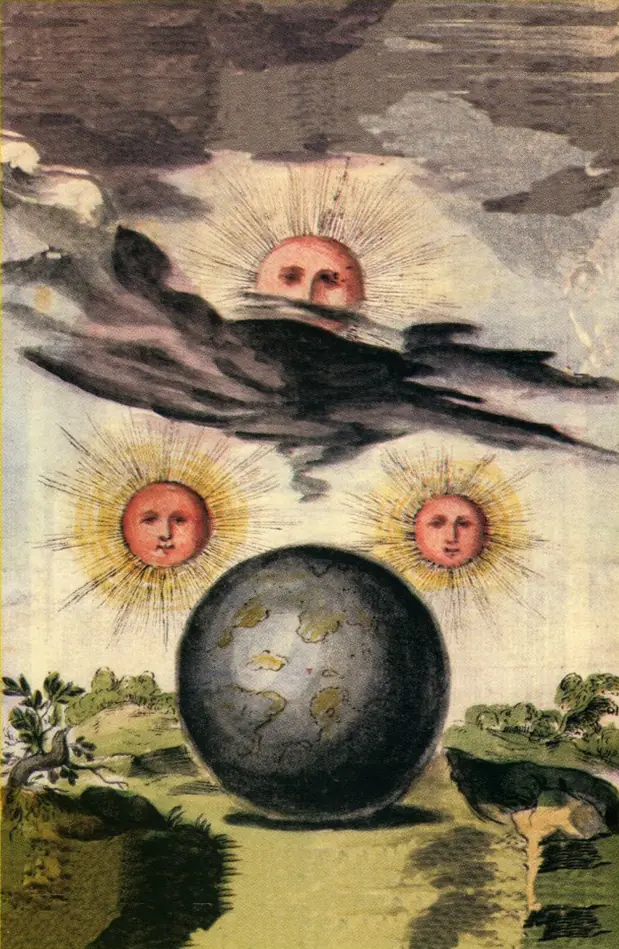
- Splendor Solis. German manuscript of 1532-1535 in the Kupferstichkabinett in Berlin; the most widely reproduced copy is the one from 1582, Harley MS 3469, in the British Library. Twenty-two miniatures mounted in book-of-hours frames: seven flasks, one per planet, each showing what is going on inside; a king drowning; a human-faced sun setting over a city; naked children playing in a room; armed knights beneath celestial chariots.
- Rosarium philosophorum. Frankfurt, 1550. Twenty woodcuts in sequence: the king and queen meet, climb into the bath together, rot, watch their soul slip out through the top and come back, and out of the last plate steps the rebis, a single body with two heads. Jung spent years reading these blocks as though they were a map of the mind.
- Mutus Liber. La Rochelle, printed by Pierre Savouret, 1677. Fifteen plates and not one word: the entire book is drawing. It is signed by an “Altus” whom later research identified as Isaac Baulot, an apothecary born in La Rochelle in 1612, and the first edition ran to only a few dozen copies; twelve survive today.
- Amphitheatrum sapientiae aeternae, by Heinrich Khunrath. Hamburg, 1595; expanded edition in Hanau, 1609, four years after the author's death. The four plates of the first edition were engraved by Paullus van der Doort after Khunrath's own designs, and the most famous of them splits a single room down the middle: the furnace on one side, the prie-dieu on the other.
Above all of them stands the ouroboros, the snake biting its own tail. The version carrying the Greek phrase hen to pan — “the all is one” — is in Marcianus graecus 299 at the Biblioteca Marciana in Venice, a tenth-century codex copying recipes attributed to Cleopatra the Alchemist.
The emblem you were also meant to sing
In 1617, in Oppenheim and at the press of Johann Theodor de Bry, the physician Michael Maier published Atalanta fugiens. Fifty emblems engraved by Matthäus Merian the Elder (1593-1650), each one built out of five parts: a motto, the print, an epigram, a three-voice fugue and a prose discourse explaining it. You look, read and sing all at once. A multimedia book from four centuries ago, sheet music included.
Emblem 21 is the one that has outlived everything else. A philosopher with a pair of compasses draws a circle on a wall; inside it, a square; inside that, a triangle; and inside the triangle, another circle holding a man and a woman.
Make of the man and the woman a circle, from that a square, from that a triangle; make it round again, and you will have the stone.
It is one of the most copied alchemical drawings there is. If you have seen it on a book cover, a poster or a tattoo, it comes from this page of 1617.
Where all this turns up on screen
Alejandro Jodorowsky kept the part of the Alchemist for himself in The Holy Mountain (1973), and with the thief he does exactly what the trade promises: he gathers up the man's excrement, feeds it into a machine and takes out gold. “You are excrement; you can change yourself into gold,” he tells him. The whole programme in a single line.
Harry Potter and the Philosopher's Stone (2001, Chris Columbus) put Flamel back into commercial circulation: Hermione discovers in the library that the stone is his work. Fullmetal Alchemist got there by the opposite route. Hiromu Arakawa began serialising it in 2001 after reading about the philosopher's stone, did the research properly, and ended up keeping only the philosophical side because the books kept contradicting one another; out of that came the 2003 and 2009 anime series and the 2017 live-action film.
A Cure for Wellness (2016, Gore Verbinski) is the Great Work with the spiritual half amputated: a baron filtering toxic water through human bodies to distil an essence that prolongs life. And A Discovery of Witches (Sky, 2018-2022) opens on a real shelfmark: Ashmole 782, from Elias Ashmole's collection at the Bodleian in Oxford, a manuscript that is listed in the catalogue but has been missing for more than a century.
One series is left in which transmutation actually pays. The Gold (BBC One, 2023; second series in June 2025) tells the story of the robbery of 26 November 1983 next to Heathrow: 6,800 bars, three tonnes of gold, £26 million at the time. Kenneth Noye melted the haul down and mixed copper coins into it so that it would stop being that gold. It is the closest anyone has come to turning one metal into another and getting paid for it.
Newton and the million words nobody wanted to print
In 1936 Sotheby's auctioned 329 lots of Isaac Newton's papers from the Portsmouth collection. More than a third of them were alchemy: his heirs had spent two centuries treating them as unpublishable. Newton is reckoned to have written and copied around a million words on the Great Work.
The man who ended up with the bulk of those alchemical papers was the economist John Maynard Keynes, who bid against the scholar Abraham Yahuda and who summed the find up in a phrase that is still the best headline anyone has written on the subject: Newton was not the first of the age of reason, but the last of the magicians.