





A Tuesday in June, 1284
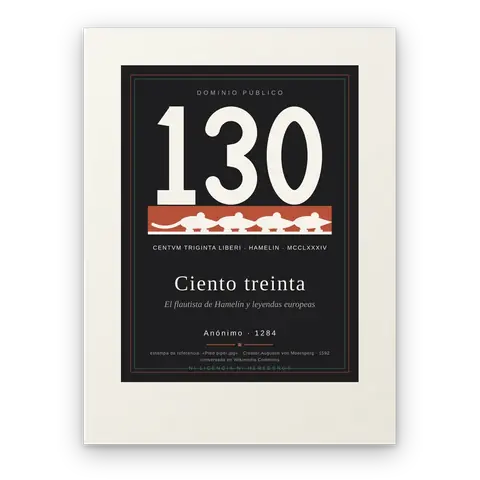
The oldest surviving account of this is not a children's story: it is a jotting. It was written by hand on the last page of a Latin chronicle copied out in Lüneburg around 1430-1450, and it says that in 1284, on the day of Saints John and Paul — 26 June — a well-dressed young man of thirty walked into Hamelin playing a silver flute, drew 130 children after him and lost them outside the walls, at the execution ground they call the calvary. It does not mention a single rat.
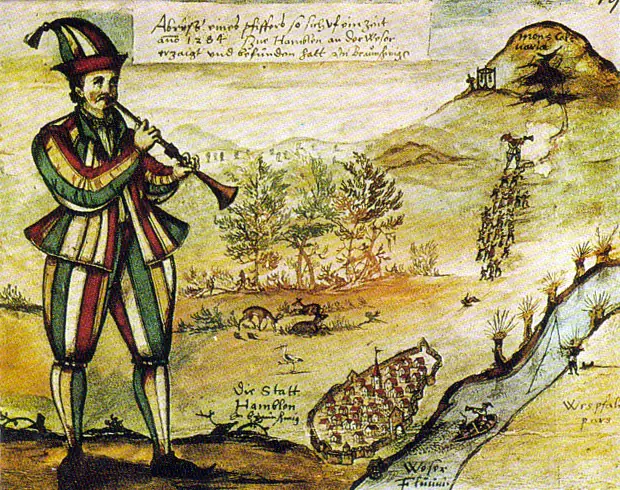
The earlier testimony has all been lost. Around 1300 the Marktkirche in Hamelin had a stained-glass window showing the piper and the children; mayor Friedrich Poppendieck had it renewed in 1572 and it disappeared around 1660. But we do not know it only from the descriptions that circulate between the fourteenth and seventeenth centuries: in 1592 the Alsatian Augustin von Mörsperg copied it by hand into his travel chronicle, and that is the oldest surviving portrait of the piper — who is blowing not a flute but a shawm. Around 1384 Decan Lude kept a choir book containing Latin verses presented as an eyewitness account; that has not survived either. What has survived is an entry in the town's own records, from that same year of 1384: it is a hundred years since our children left.
And one house has survived. On the corner of Osterstraße and Bungelosenstraße, the Rattenfängerhaus — put up in 1602-1603 for the councillor Hermann Arendes, at the height of the Weser Renaissance — carries the date carved into a beam:
anno 1284 am dage johannis et pauli war der 26. juni dorch einen piper mit allerley farve bekledet gewesen cxxx kinder verledet binnen hameln geboren to calvarie bi den koppen verloren
A stone from the New Gate, dated 1556 and now in the town museum, tells it the other way round: 272 years ago the magician took away 130 children.
The rats arrive nearly three centuries late
There are no rats in the original story. They turn up between 1559 and 1565, in the Zimmerische Chronik of Count Froben Christoph von Zimmern, and after that they never leave. The first telling in English is by Richard Verstegan — a Catholic antiquary exiled in Antwerp — in A Restitution of Decayed Intelligence (1605), pages 85 to 87: the rats are there, the children reappearing in Transylvania are there, and so is a new and wrong date, 22 July 1376.
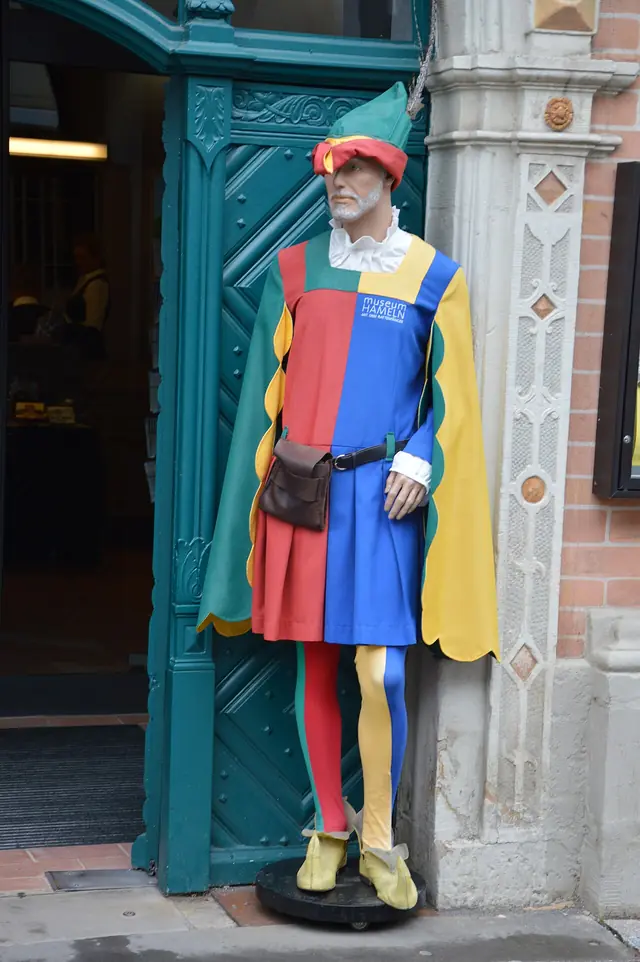
The Grimms pinned it down in Deutsche Sagen (1816), where it is legend number 244 — 245 in later editions — 'Die Kinder zu Hameln'. Theirs is the version almost everybody remembers without knowing where it came from. They call the man Bundting, after his coat of many-coloured cloth. He plays no golden flute but a Pfeifchen, a little pipe. The rats and mice drown in the Weser. He comes back disguised as a huntsman, with a terrible face and a strange red hat. He takes the children aged four and upwards. And three are saved by accident: one blind, one dumb, and one who had gone out in his shirt and turned back for his jacket.
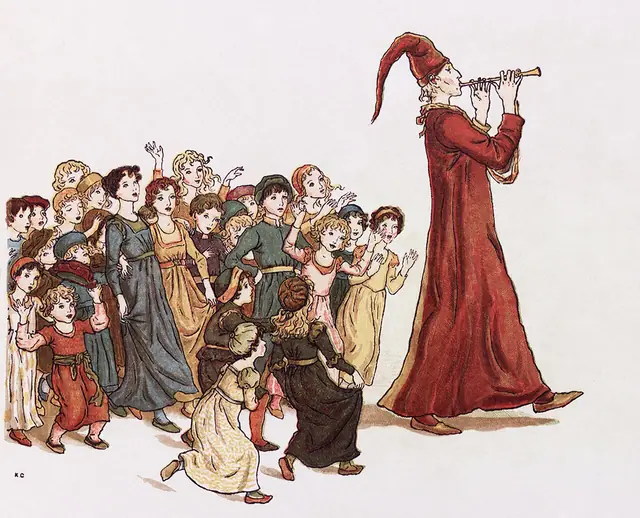
Robert Browning wrote his poem in May 1842 as a domestic commission: Willie, the son of the actor William Macready, was ill in bed and had asked him for something to illustrate. Browning worked from Verstegan, kept the wrong date of 1376, and gave the piper the garment that has been drawn ever since, a long coat half yellow and half red. It appeared in Dramatic Lyrics that same year.
A patchwork coat and a hill with two crossed stones
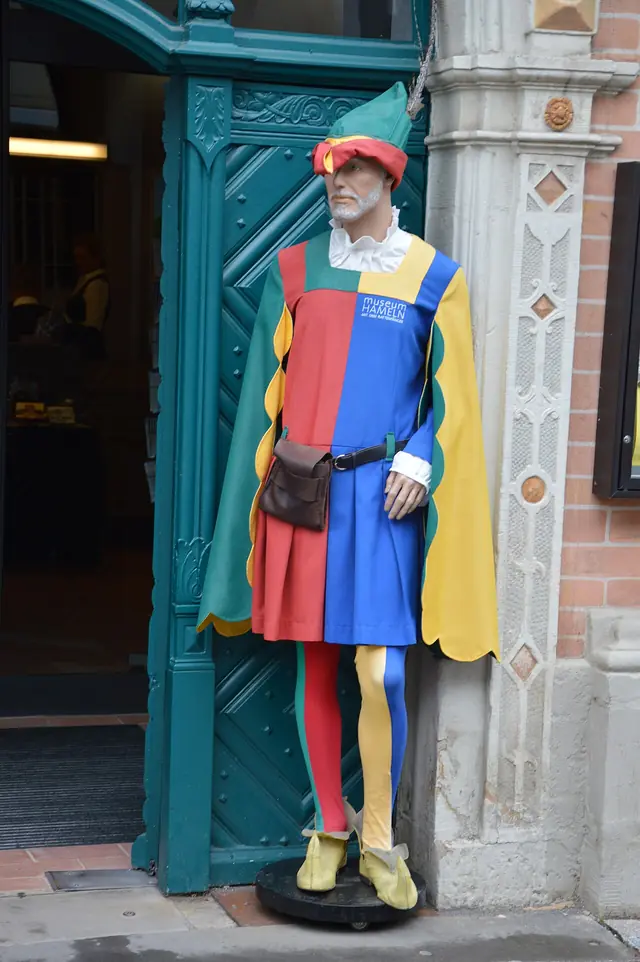
The repertoire is short and highly recognisable: the parti-coloured cloth coat, the stubby little pipe of the Grimms and Browning, the Weser full of drowned rats, the stepped-gable façades of the Weser Renaissance, and the hill where the rock closes up. The Grimms call it the Poppenberg and mark it with two stones planted in the shape of a cross.
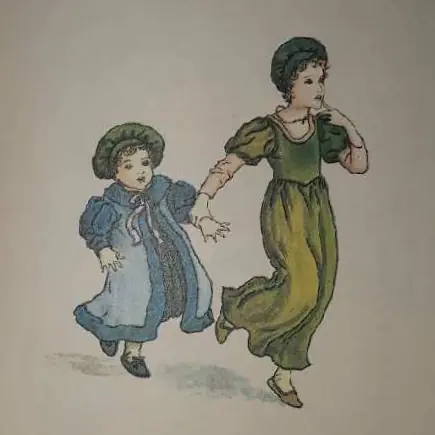
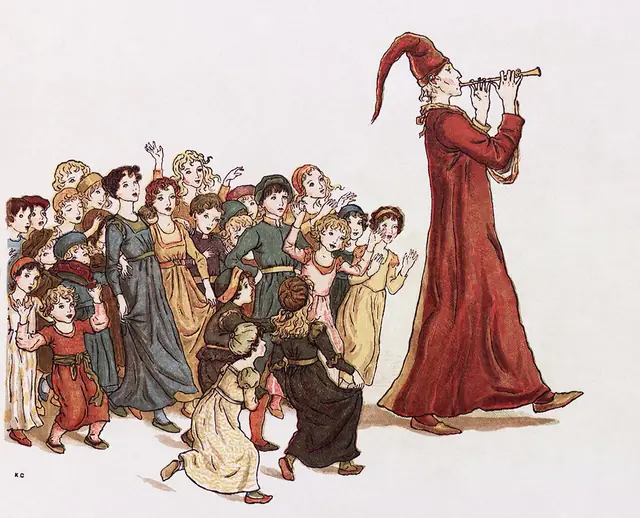
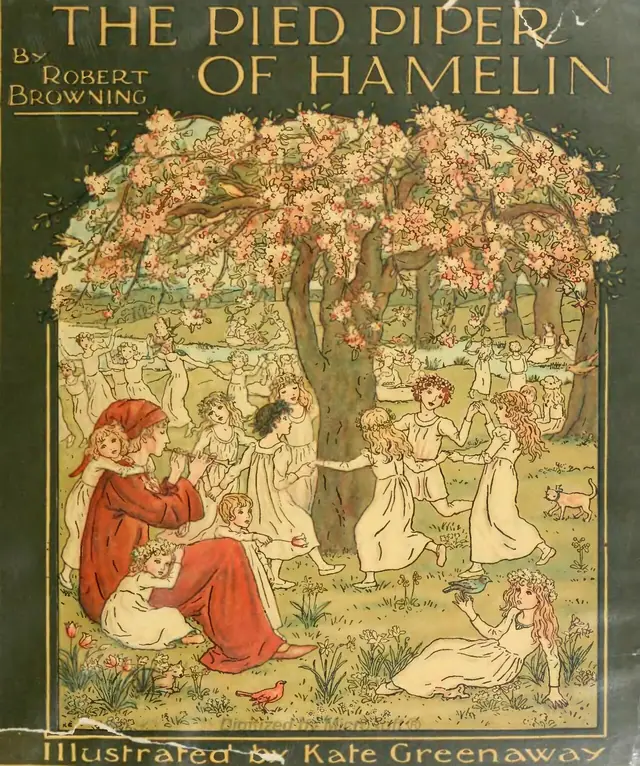
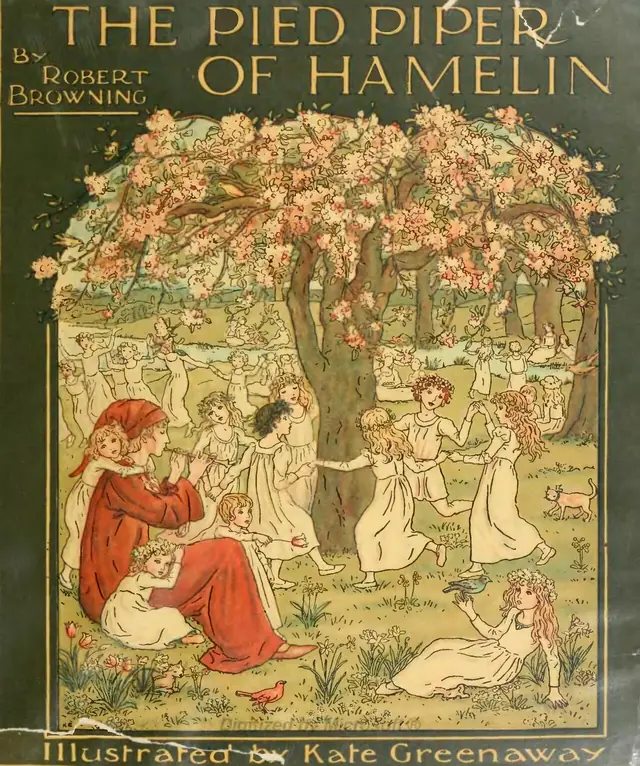
Two editions fixed the image. Kate Greenaway illustrated Browning's poem in 1888 for Routledge: 35 drawings engraved and colour-printed by Edmund Evans, with those high-waisted children in bonnets that were her signature. Ruskin thought them the best thing she ever did. Arthur Rackham illustrated it in 1934 for Harrap, in a signed limited edition of 410 copies, and got the opposite effect: crooked roofs, rats with rather too much in their eyes, and a piper who frightens you before he has done anything at all.
From the engraving to the frame
The piper reached the cinema early: there are earlier shorts, a British one from 1907 and an American one from 1911. But the first feature-length Hamelin is German, and it opened on 19 December 1918 at the U.T. on Nollendorfplatz in Berlin, a month after the armistice. Der Rattenfänger (The Pied Piper), by Paul Wegener, closed his trilogy of German legends — Rübezahls Hochzeit (1916) and Hans Trutz im Schlaraffenland (1917) — and pointed towards the Golem of 1920. The rats were not rats: since there was no way of working with trained animals, they were carved in wood and animated frame by frame. Only fragments of the film survive.
Disney released The Pied Piper as a Technicolor Silly Symphony on 16 September 1933, directed by Wilfred Jackson. Jacques Demy moved the story to 1349, with the plague coming on, in The Pied Piper (1972), with Donovan as the piper and Donald Pleasence, John Hurt and Jack Wild around him. Jiří Barta shot Krysař (The Pied Piper, 1986) in Czechoslovakia: carved puppets from one to sixty centimetres tall, an expressionist city built in wood, an invented language with a German ring to it and music by Michael Kocáb, all from Viktor Dyk's 1915 novel.
The strangest adaptation does not have Hamelin in the title at all. In The Sweet Hereafter (Atom Egoyan, 1997) Browning's poem is the skeleton: Nicole reads it to the children she looks after, a whole school bus is lost, and the only one left is the girl who could not follow the piper. Korea moved it to a post-war village in The Piper (Kim Kwang-tae, 2015), and in Shrek (2001) the piper passes through in the crowd of evicted fairy-tale characters.
The street where the musicians fall silent
The piper's house faces onto Bungelosenstraße, and the name is not decoration: bunge meant 'drum' in the Low German of the region. That is the way the children went out, and no music is played there. The Grimms were already noting it in 1816: nobody danced, nobody touched a string, and when a wedding procession came past with music the players fell silent while they crossed that stretch. The custom holds to this day.
There is a second detail, this one from the cinema. The silhouettes on the intertitles of Wegener's film were cut out by Lotte Reiniger, who in 1918 was nineteen and nobody at all. Eight years later she released The Adventures of Prince Achmed (1926), the oldest surviving animated feature.
There is no settled explanation for 1284, and it is worth keeping what is documented apart from what is guessed. All that is documented is that Hamelin spent centuries recording the loss — the date, the 130, the habit of counting the years from it; no early source says what actually happened. Everything else is hypothesis. The best worked-out one was published in 1997 by the onomastics professor Jürgen Udolph: place names from the Hamelin district reappear, oddly, to the north of Berlin — Hamelspringe yields Hammelspring in the Uckermark; the county of Spiegelberg gives Groß Spiegelberg near Pasewalk — which points to organised emigration eastwards during the German colonisation of the east. The dancing mania has also been proposed — in 1237 a group of children danced the twenty kilometres from Erfurt to Arnstadt — and a children's crusade in imitation of the one in 1212, but both of these run into the dates: the crusade was seventy-two years earlier, and the plague, which has also been invoked, does not reach Europe until 1347. None of them accounts for the 130.