






Nobody called it that while it was being fought
The men who fought it never used the name. David Hume writes in his History of England (1762) of the wars of the two roses, and Walter Scott made it stick in Anne of Geierstein (1829) with his reference to “the wars of the White and Red Roses”: three and a half centuries after Bosworth.
Before that there was Shakespeare. In Henry VI, Part 1 (Act II, scene 4) the nobles plant themselves in the Temple garden and each plucks a rose, white or red, to declare his side. No fifteenth-century chronicle records the scene. He invented it.
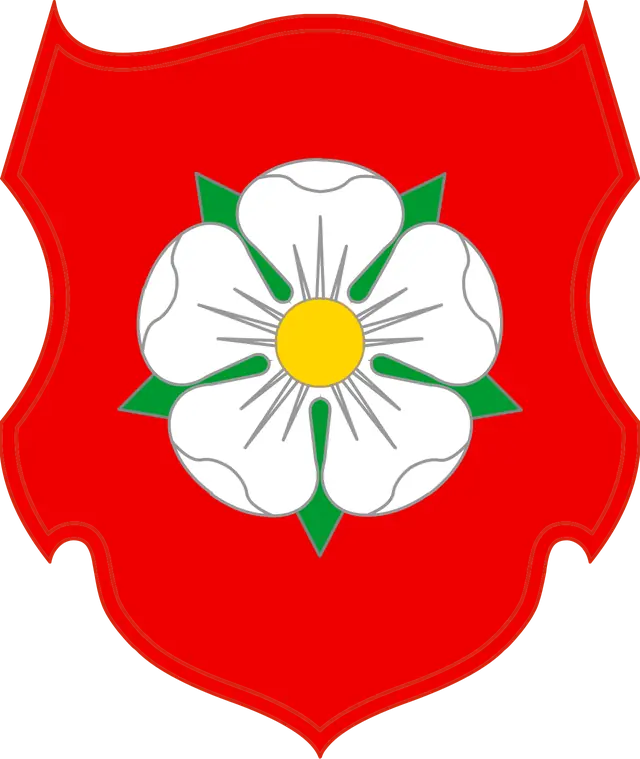
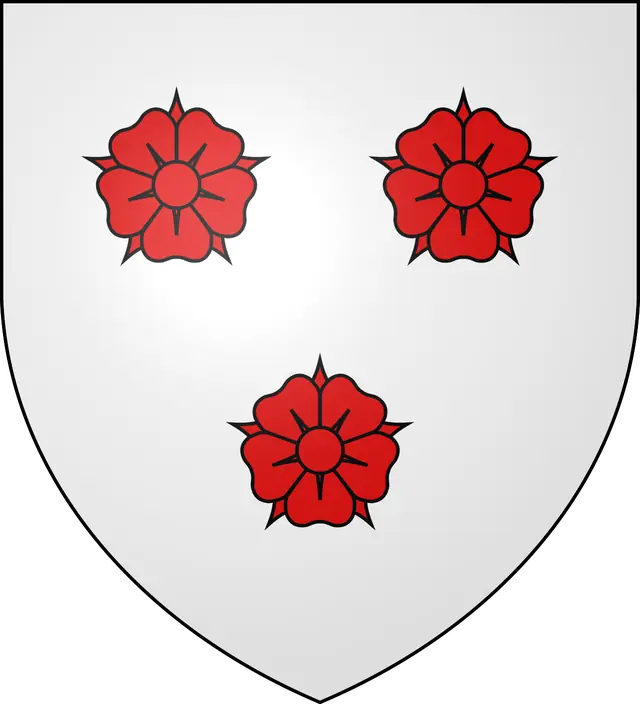
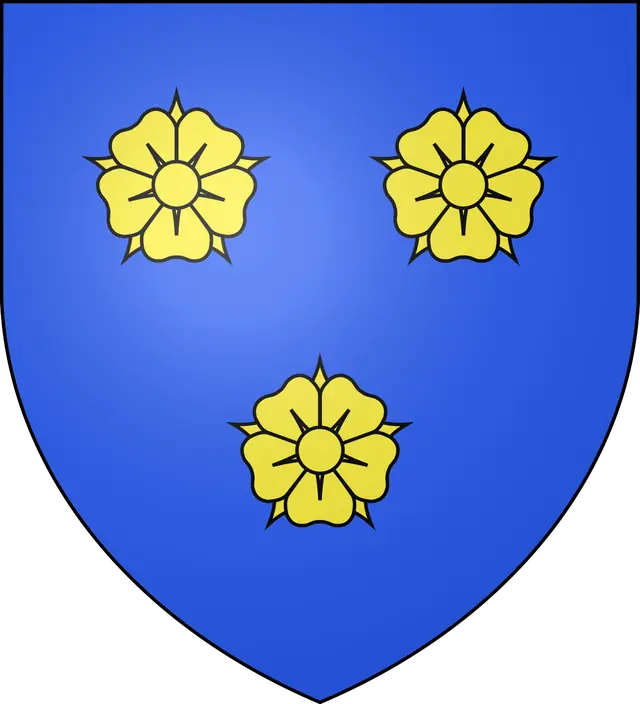
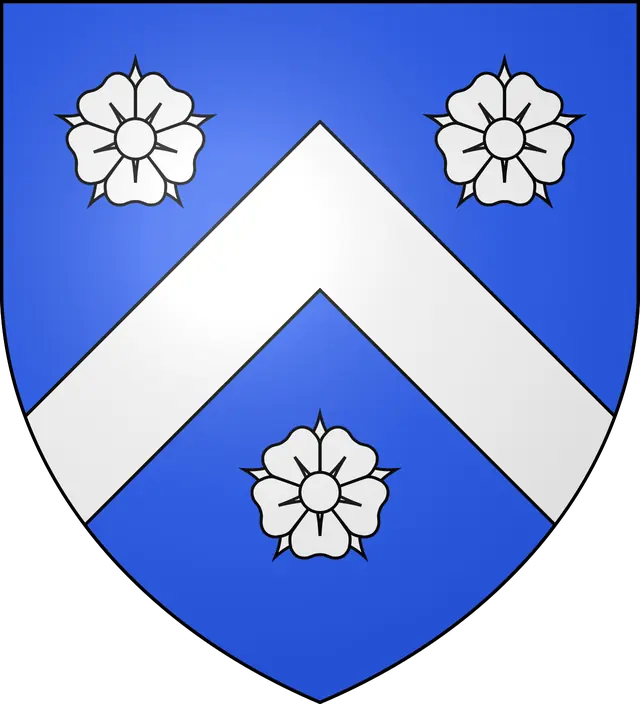
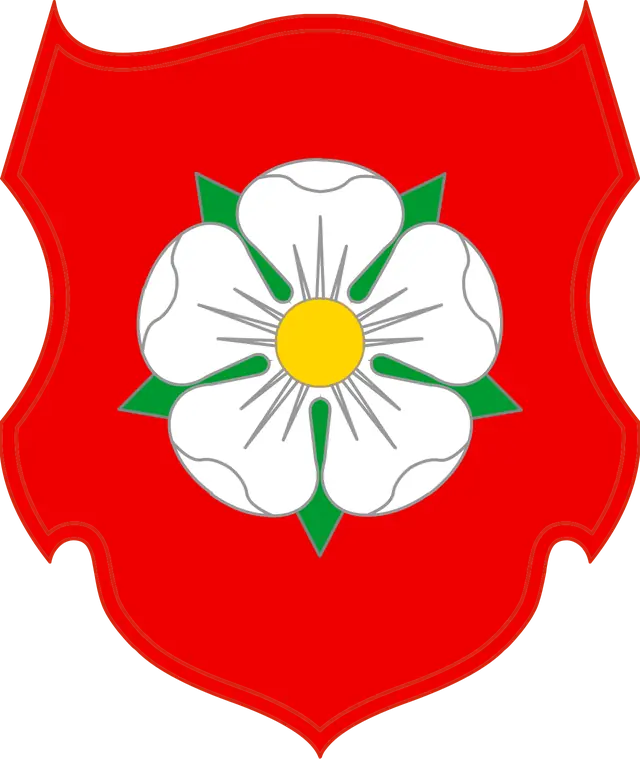
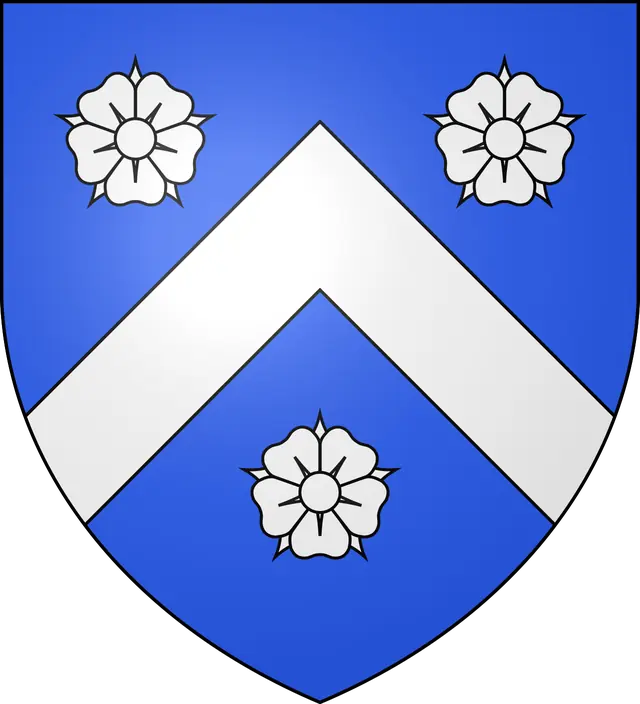
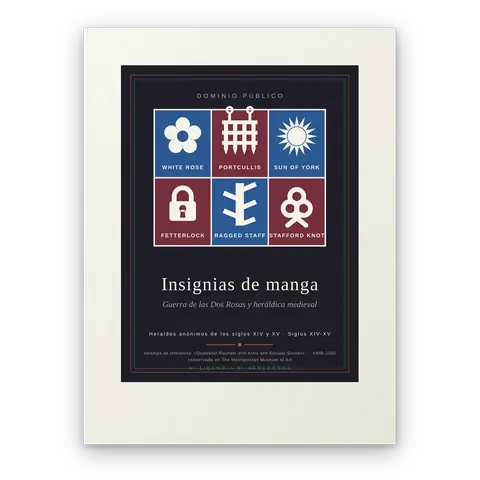
The red rose does not survive scrutiny either. The Lancastrians used it rarely and often in gold; Henry VI, the king under whom the country came apart, was far keener on his chained antelope. The historian Adrian Ailes argues that the red rose owes its popularity to Henry VII, who answered the Yorkist white rose in a hurry. The Tudor rose — red without, white within — was put together after his marriage to Elizabeth of York in January 1486. The emblem of the war was designed once the war was already over.
The bestiary they really did wear
What actually went on the sleeve was stranger, and a great deal more specific.
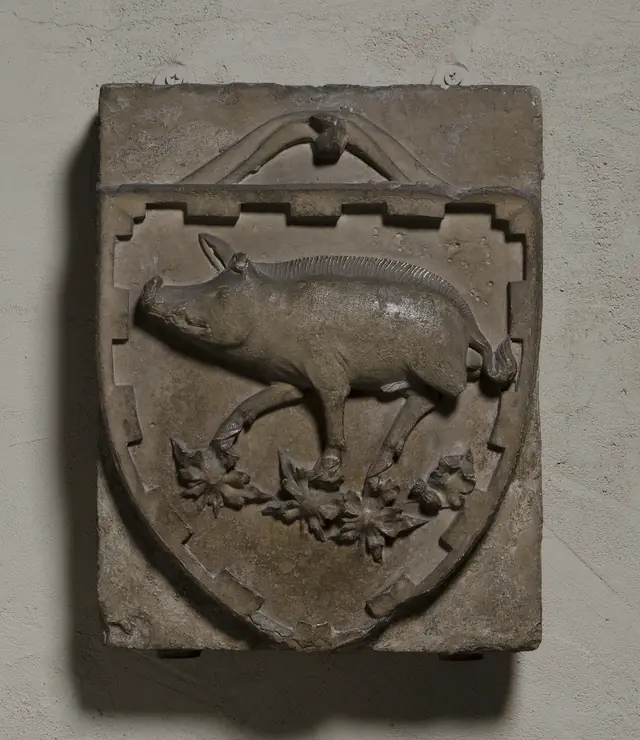
- The white boar of Richard III, tusked and hoofed in gold, taken up while he was still Duke of Gloucester.
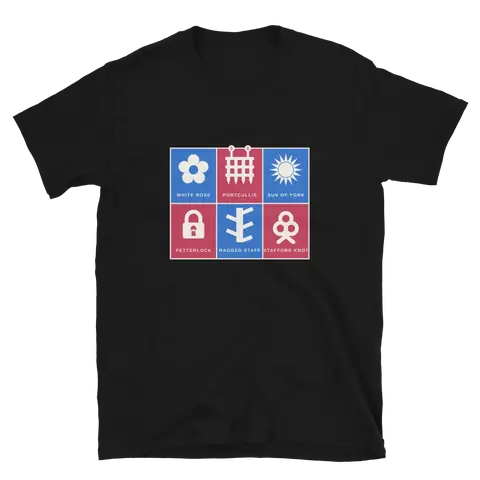
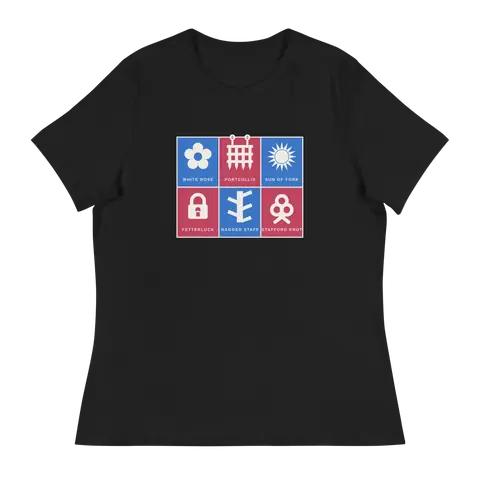
- The falcon and fetterlock of York: a falcon shut inside a horse's fetterlock. Edmund of Langley, the first duke, used it; his grandson Richard began to draw the lock open.
- The bear and ragged staff of the earls of Warwick. The two first appear together in 1387, on a bed of Thomas Beauchamp's embroidered with a gold bear and a silver staff.
- The swan of the Bohuns, crowned at the neck and chained in gold. The portcullis of the Beauforts. The rope knot of the Staffords.
- The sun in splendour of Edward IV, which comes with an exact date: on 2 February 1461, before the battle of Mortimer's Cross, a parhelion put three suns in the sky. Edward convinced his men it was the Trinity and kept it for himself.
Thirteen thousand boars in cloth
The livery badge was propaganda you could wear, and it was made in bulk. The royal wardrobe accounts record an order in 1483 for 13,000 fustian badges of the white boar, split between Richard III's coronation and the investiture of his son Edward of Middleham as Prince of Wales at York.
They survive in lead, in silver and in gilt copper. A silver-gilt one turned up at Chiddingly, Sussex, in 1999 and is now in the British Museum. Another, 29 millimetres across, was found by Carl Dawson in 2009 beside Fenn Lane, and it shifted the Bosworth battlefield some three kilometres south-west of the traditional site at Ambion Hill: it came out of the edge of the marsh where the chronicles put the king's death, and the quality of the metal points to someone of his own household.
For how they were worn, the best document is the Wilton Diptych (c. 1395-1399, National Gallery): all eleven angels wear Richard II's white hart. A whole court in the same badge.
And one tradition worth telling as a tradition: the Leicester inn where Richard slept his last night was called the White Boar, and woke up repainted blue after Bosworth, the colour of Oxford's boar. The University of Leicester warns that the name is only recorded from the sixteenth century.
Barnet, or the day a design lost a battle
14 April 1471, Easter Sunday, Barnet, north of London. Thick fog. The Earl of Oxford comes back round the enemy flank behind his banner: a star with streaming rays. Warwick's men see it loom out of the murk and take it for Edward IV's sun in splendour. The archers shoot at their own side. Oxford's men conclude that Warwick has gone over to the enemy, the cry of treason goes up and the Lancastrian army falls apart on its own. Warwick, the Kingmaker, dies that same day.
Two badges that looked too much alike and a hundred metres of fog. The battle that broke his power was settled, in good part, by a problem of graphic design.
The sketchbooks all of this is copied from
The first-hand material sits in two manuscripts. The Rous Roll was painted around 1483-1485 by John Rous, chaplain of Guy's Cliffe: a parchment roll with pen figures of the earls of Warwick and their badges beside them. Rous made two versions: in the English one Richard III is a good lord who rules commendably; the Latin one he redid after Bosworth, under the Tudors by then, and there the same king becomes a criminal. He died in 1492.
The other is the Beauchamp Pageant (British Library, Cotton Julius E IV): 53 pen drawings from the end of the fifteenth century (c. 1483-1492), attributed to the so-called Caxton Master, and the only illustrated biography of a lay figure to come down whole from the late Middle Ages.
Then comes the Victorian engraving that almost everyone has copied ever since: Charles Boutell and his heraldry manual of 1863, and above all A Complete Guide to Heraldry (1909) by Arthur Charles Fox-Davies, with nearly 800 figures by Graham Johnston, herald painter to the Lyon Court.
How it reached the screen
Laurence Olivier's Richard III (1955) opens with a coronation Shakespeare never put there: Edward IV's, lifted from the end of Henry VI, Part 3. Production design by Roger Furse, art direction by Carmen Dillon.
Richard Loncraine's version (1995), with Ian McKellen, does the opposite, and that is exactly why it works: it moves the play to a fascist England of the 1930s and turns the boar into a party emblem, a badge on a uniform, a red banner at a rally. Medieval heraldry reads at once as totalitarian propaganda, which is what it always was. Tony Burrough and Shuna Harwood won the BAFTAs for production design and costume, and both were nominated for the Oscar.
The Hollow Crown: The Wars of the Roses (BBC, 2016), with Benedict Cumberbatch, Tom Sturridge and Sophie Okonedo, does stage the Temple garden, and the nobles plucking roses is one of its signature images. The White Queen (BBC, 2013), drawn from Philippa Gregory's The Cousins' War novels, tells the war from the Yorkist side, with Elizabeth Woodville at the centre.
And then there is the version that goes by another name. George R. R. Martin has said again and again that the Wars of the Roses is one of his main sources and that his Lannisters and Starks are traced, broadly, from the Lancasters and the Yorks. The sigils in Game of Thrones are livery badges under a different name: you sew them to your clothes and they say whose man you are.