
An afternoon on the river and a withdrawn first edition
On 4 July 1862 Charles Lutwidge Dodgson, a mathematics lecturer at Christ Church, Oxford, rowed up the Thames with the Reverend Robinson Duckworth and the three Liddell sisters: Lorina, Alice and Edith. To keep them amused he made up a story about the middle one. Two years later, in November 1864, he gave Alice Liddell the manuscript he had written out and illustrated by hand, titled Alice's Adventures Under Ground.
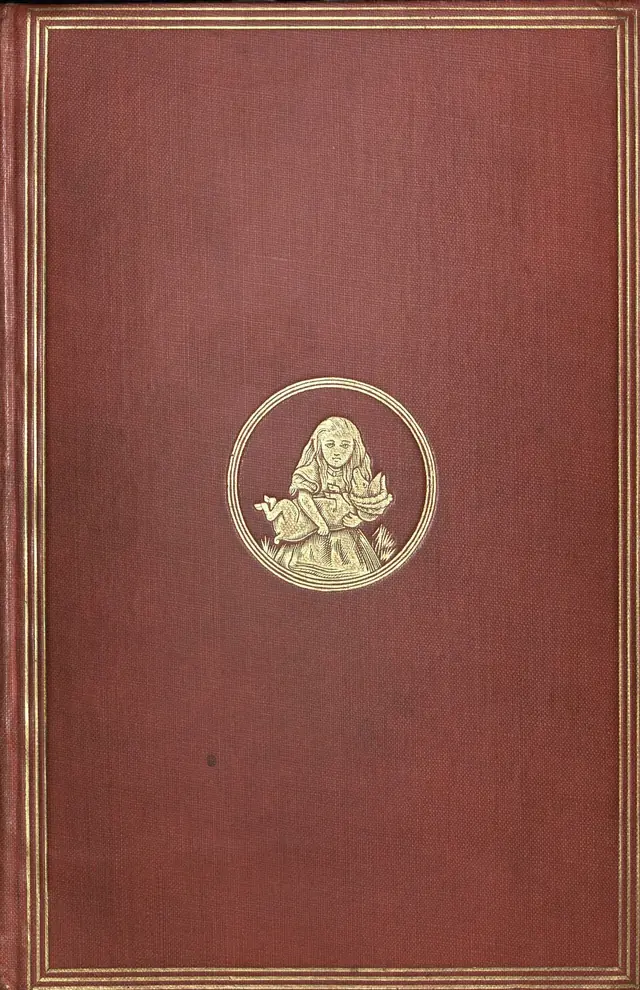
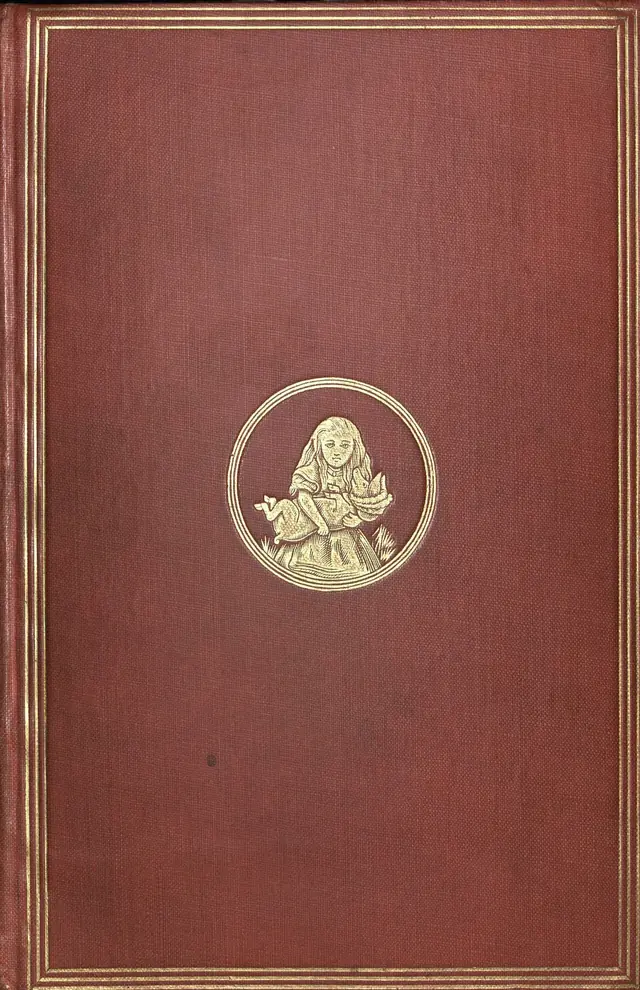
The expanded version appeared on 26 November 1865 from Macmillan, signed Lewis Carroll: a pen name cooked up by latinising Charles Lutwidge into Carolus Ludovicus and turning it back into English the other way round. Almost nothing survives of that first run of 2,000 copies, because Tenniel objected to the printing quality and Carroll withdrew it; the sheets were sold off to an American publisher and the good edition went on sale that December. Twenty-two copies of the first are known to survive. The original manuscript was auctioned at Sotheby's in 1928 for £15,400 and now sits in the British Library.
Tenniel gave them the faces we all picture
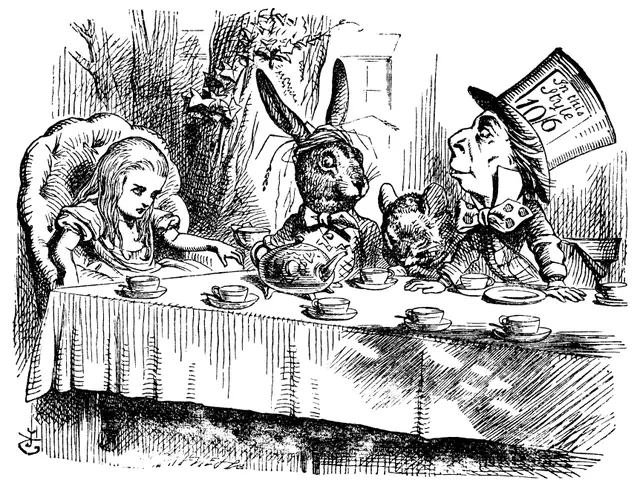
Carroll was a keen amateur draughtsman, but for the book he hired John Tenniel (1820-1914), chief cartoonist at Punch from 1864 and the author of some 2,165 drawings. He produced 42 engravings for Alice, and 92 in all counting Through the Looking-Glass. The Dalziel brothers cut them into woodblocks; those original blocks are now in the Bodleian Library in Oxford.
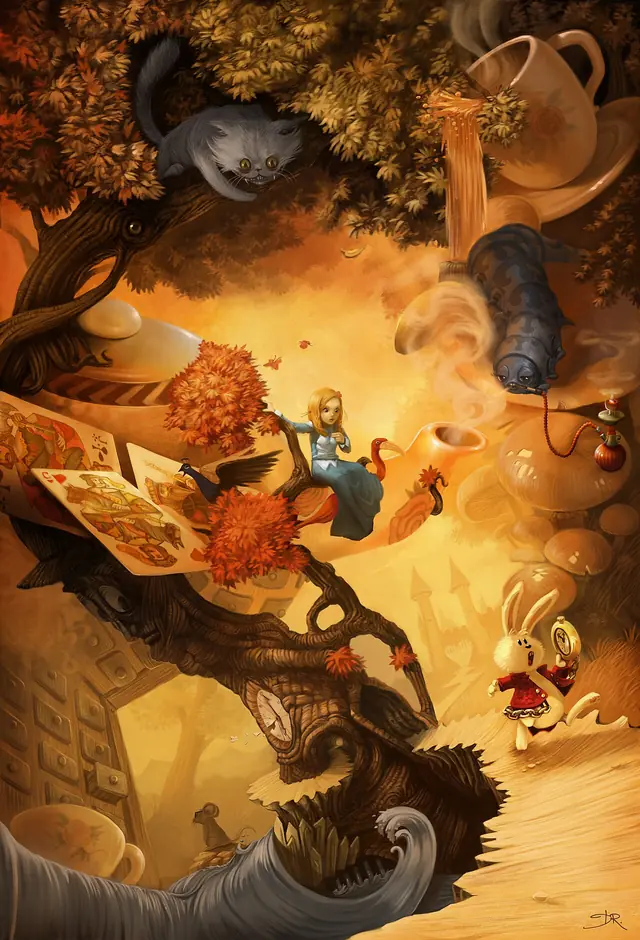
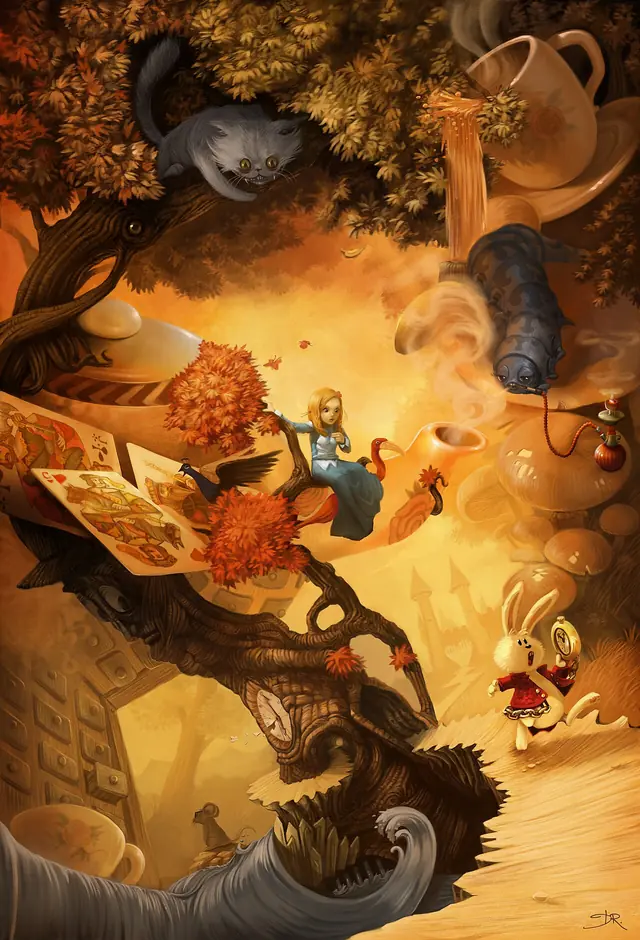
The upshot is that the iconography comes not from the text but from the drawings. Carroll never once describes the Hatter physically: the top hat with its price ticket, the bow tie, the nose — all of it is Tenniel's invention. Nor does he ever call him the «Mad Hatter» —in the books he is simply «the Hatter»—; the Mad Hatter was the adaptations' doing, built on the English saying mad as a hatter, which came from the mercury used to treat felt. Any film hoping to look like Alice is negotiating with Tenniel, not with Carroll.
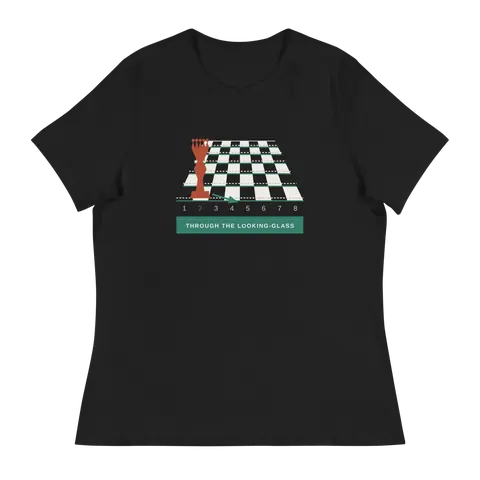
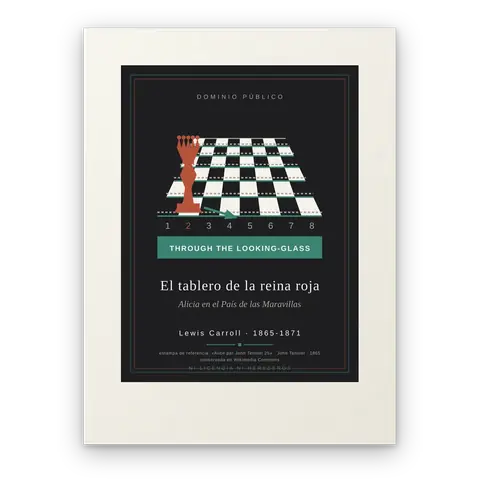
Through the Looking-Glass reached the bookshops in December 1871 with 1872 printed on the title page, and sold 15,000 copies within weeks. There the chessboard takes over from the pack of cards: the countryside is a set of squares divided by brooks, and Alice advances like a pawn.
Words that did not exist and are now in the dictionary
The poem Jabberwocky opens Through the Looking-Glass with a stanza that means nothing and is understood anyway: brillig, slithy toves, borogoves, mome raths. It is Humpty Dumpty who, several chapters later, explains the mechanism and names the concept: slithy is lithe plus slimy, two meanings packed into one word, «like a portmanteau». That is where the linguistic term we still use today comes from.
Some of them really stuck. Chortle (from chuckle and snort) and galumphing (from gallop and triumphant) are in the Oxford English Dictionary. Others drifted off into genre fantasy and no longer credit the source: the vorpal sword, whose meaning Carroll himself admitted he could not explain, and the Bandersnatch. A good part of fantasy cinema's stock of swords and strange beasts is drawn from a nonsense poem of 1871.
A hundred and twenty years of Alices on screen
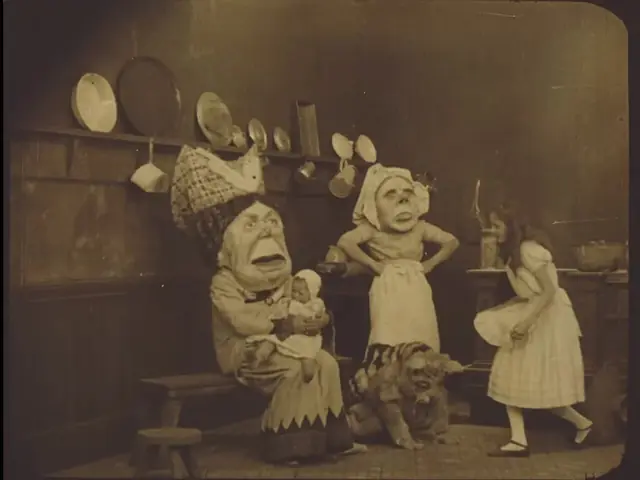
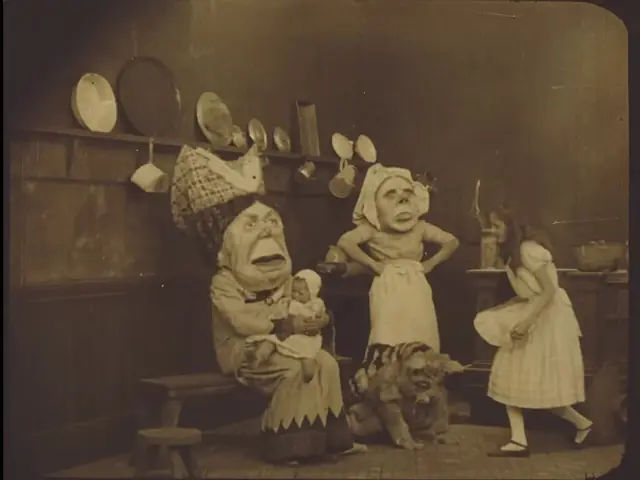
The first is British and dates from 1903: Alice in Wonderland, by Cecil Hepworth and Percy Stow, shot largely at Port Meadow in Oxford, with May Clark as Alice and Mrs Margaret Hepworth doubling as the White Rabbit and the Queen of Hearts. It ran about 12 minutes —the longest film made in Britain up to that point— and showed off its trick photography: Alice shrinking in the hall of doors and then trapped by her own size inside the rabbit's house. A single copy survives; the BFI restored it with its original tinting and released it in 2010, by then down to 9 minutes and 35 seconds.
The interesting leap is 1966. Jonathan Miller shot an Alice for the BBC, broadcast on 28 December, without a single animal head in it: actors in Victorian dress, a real cat as the Cheshire Cat, Peter Cook as the Hatter, John Gielgud as the Mock Turtle, Michael Redgrave as the Caterpillar, Peter Sellers as the King of Hearts and a score by Ravi Shankar. His reasoning was simple: «once you take the animal heads off, you begin to see what it is about».
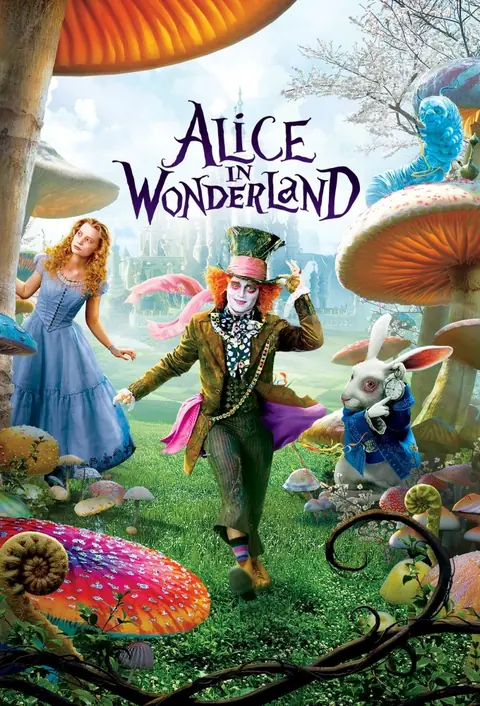
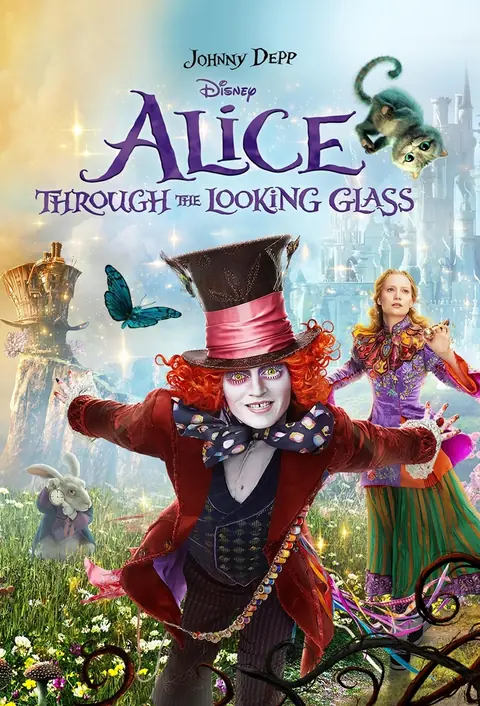
In 1988 Jan Švankmajer made Něco z Alenky (Alice) and went to the opposite extreme: stop motion with real objects, a stuffed white rabbit leaking sawdust and a caterpillar made out of a sock. It won the feature award at Annecy in 1989. And in 2010 Tim Burton turned the material into pure box office: Alice at 19, the place is called Underland, the Jabberwocky is the final villain and Helena Bonham Carter's head is digitally enlarged to three times its size. It took $1.025 billion. The 2016 sequel, this time directed by James Bobin, lost some $70 million.
The Alice screenplay Aldous Huxley wrote
Disney bought the rights in May 1938 and took thirteen years to release anything. Along the way it dropped David Hall's designs for looking too much like Tenniel and being hard to animate, and in the autumn of 1945 hired Aldous Huxley —the author of Brave New World— for a live-action-and-animation hybrid to be called Alice and the Mysterious Mr. Carroll. Huxley delivered a fourteen-page treatment on 23 November 1945 and a first script on 5 December. Disney turned it down as «too literal» an adaptation.
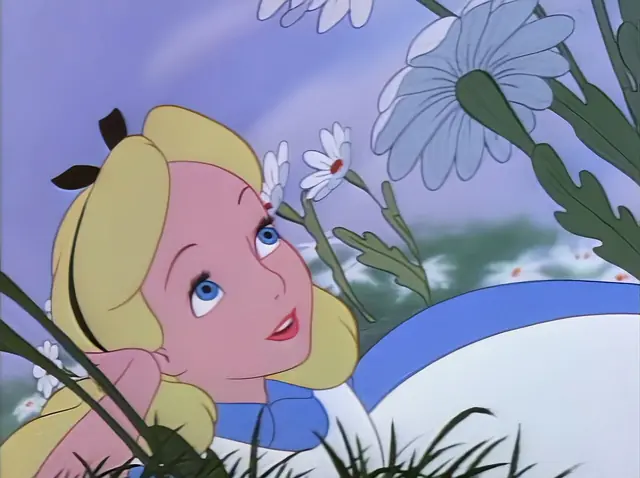
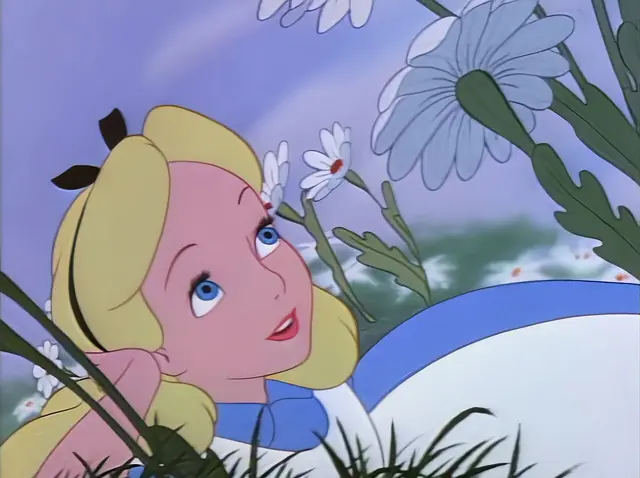
The film that did come out, in July 1951, flopped: $2.4 million taken against a $3 million budget, with the British critics accusing Disney of Americanising Carroll. University campuses rescued it from 1971 onwards, where it became the most-rented film in some cities, and Disney reissued it in 1974 leaning shamelessly on the psychedelic reading, with radio spots quoting Jefferson Airplane's White Rabbit.
Micropsia: the syndrome that carries her name
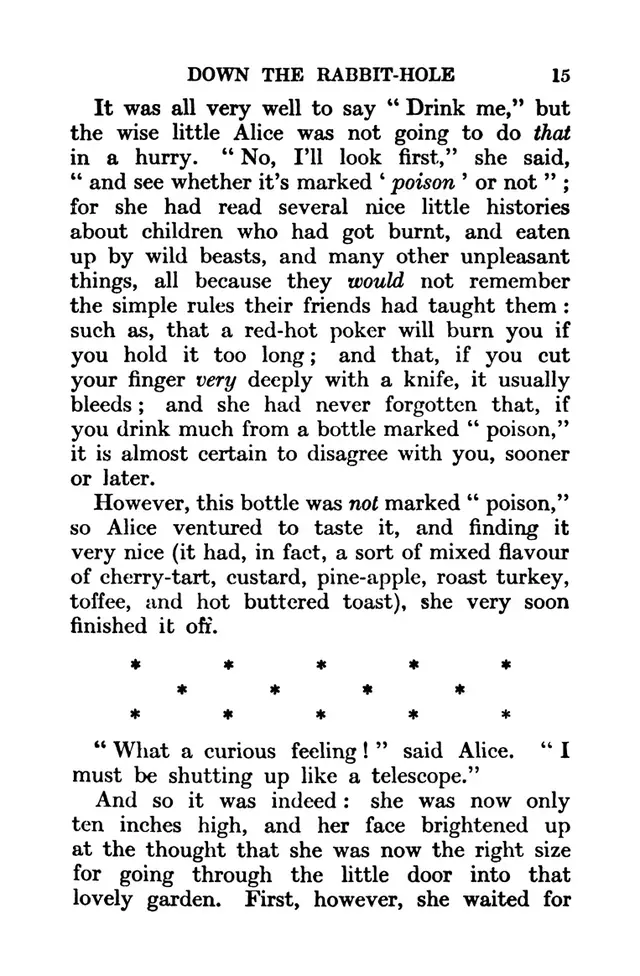
Shrinking and growing is not merely a plot device. In 1955 the British psychiatrist John Todd described a pattern of perceptual distortion in the Canadian Medical Association Journal and called it Alice in Wonderland syndrome: micropsia (seeing objects as smaller than they are), macropsia (larger) and a distorted sense of one's own body. It tends to go with migraine; around one in ten people who suffer migraines experience it.
Todd pointed out that Carroll was writing from inside his own head: his diary records those «moving fortifications» followed by a headache, and he consulted an ophthalmologist about them. Every shot of Alice stretching up to the ceiling has a symptom with a clinical name behind it.