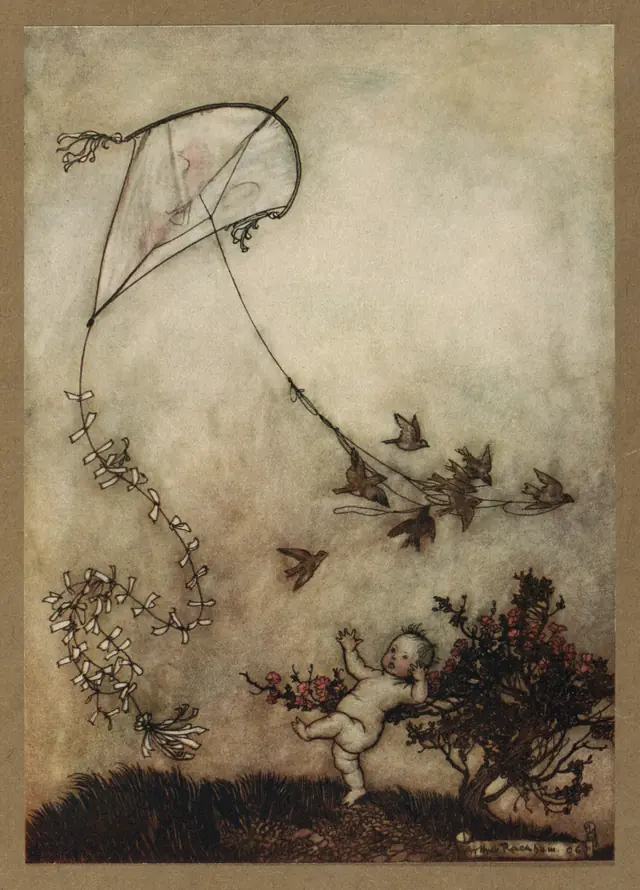
A seven-day-old baby escapes through the window
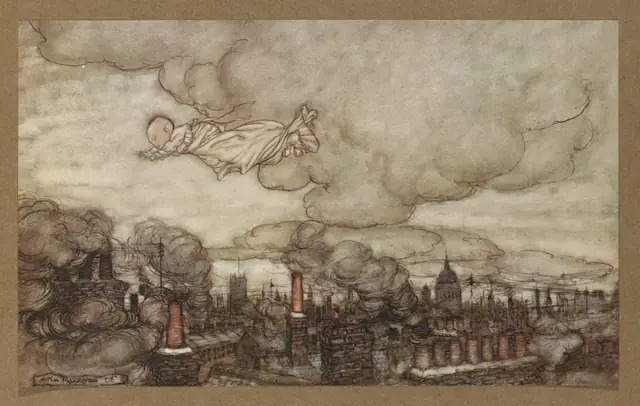
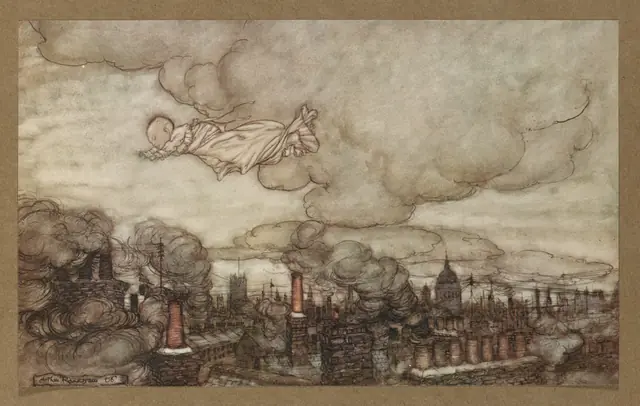
Peter Pan was not born in Neverland. He turned up in November 1902, in chapters 13 to 18 of The Little White Bird, a novel J. M. Barrie wrote for adults and Hodder & Stoughton published. There Peter is a seven-day-old newborn who slips out of the nursery window and ends up in Kensington Gardens, living among birds and fairies on the banks of the Serpentine. His playmate is Maimie Mannering; Wendy does not exist yet.
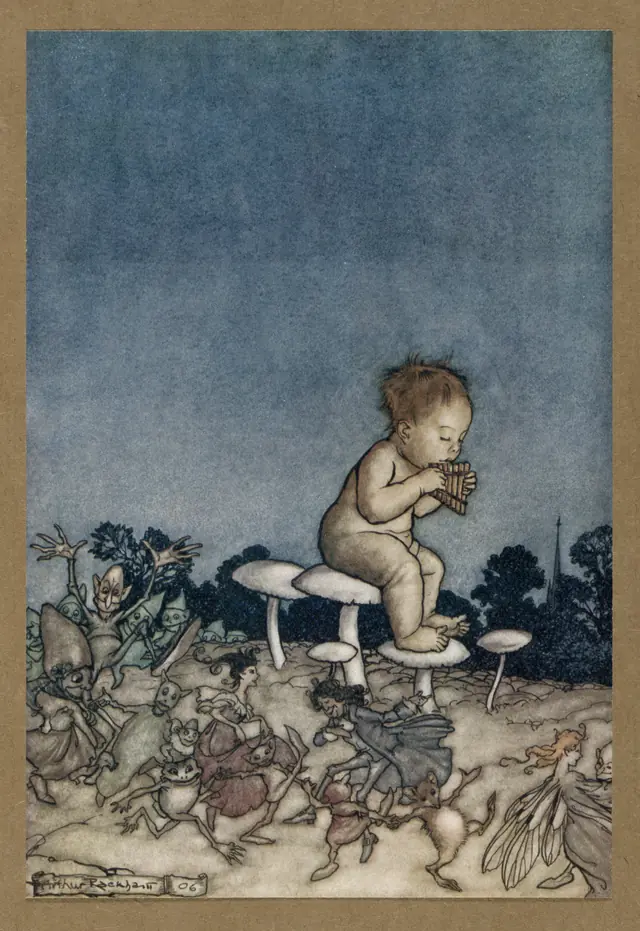
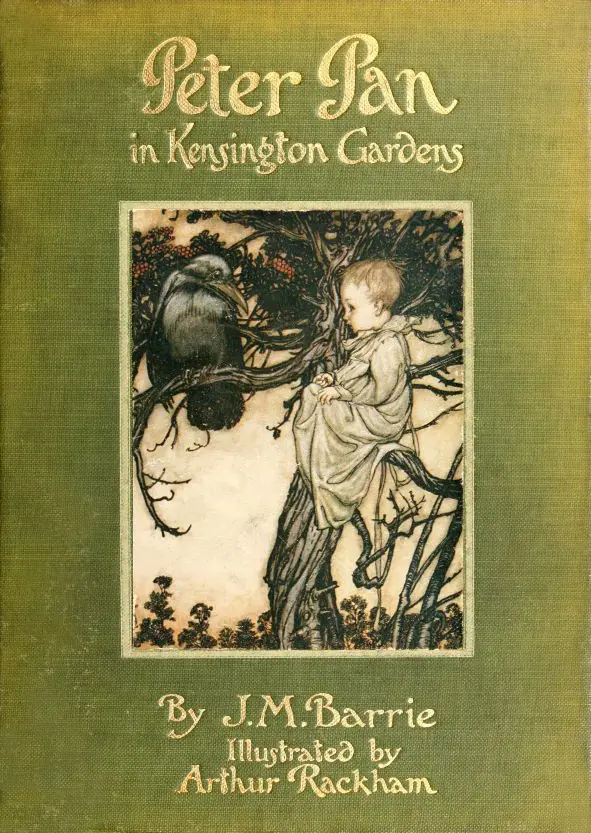
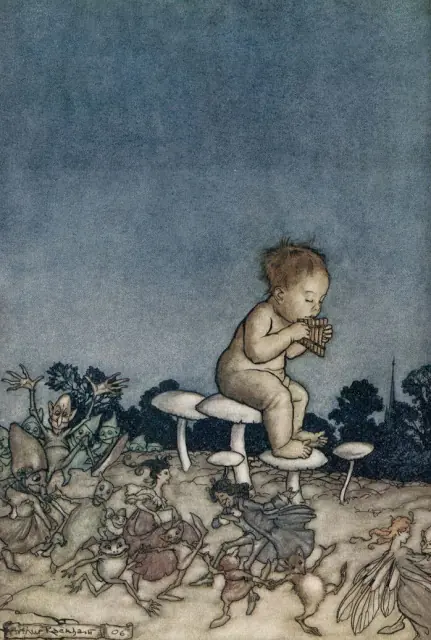
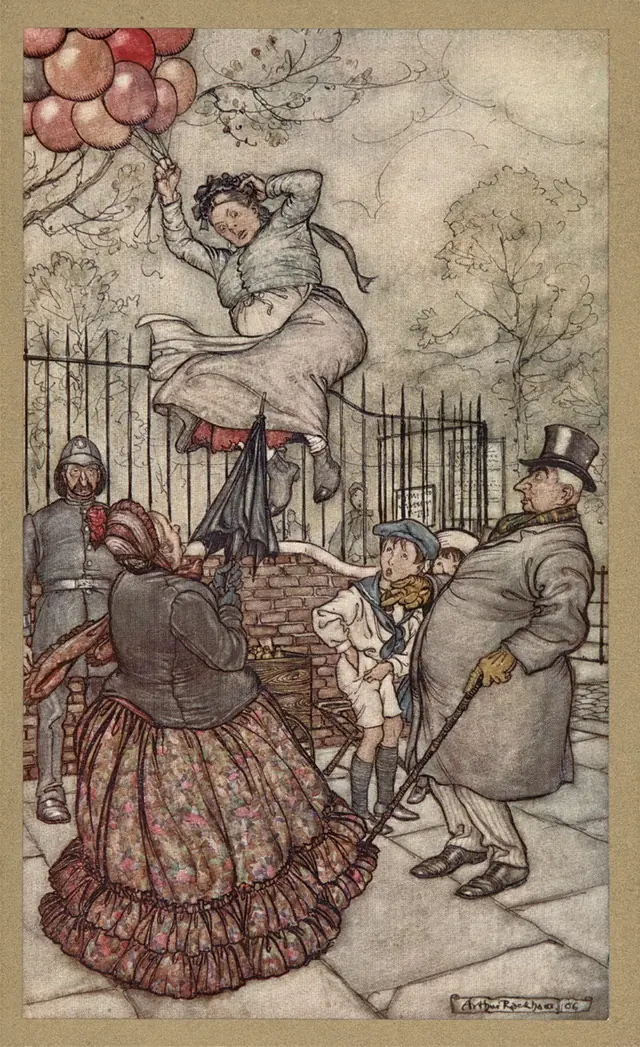
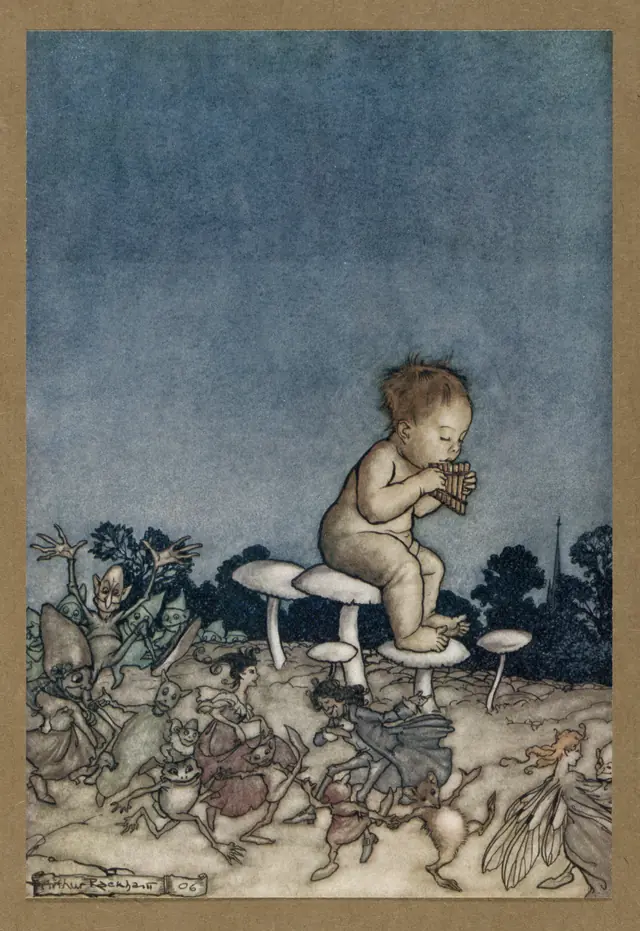
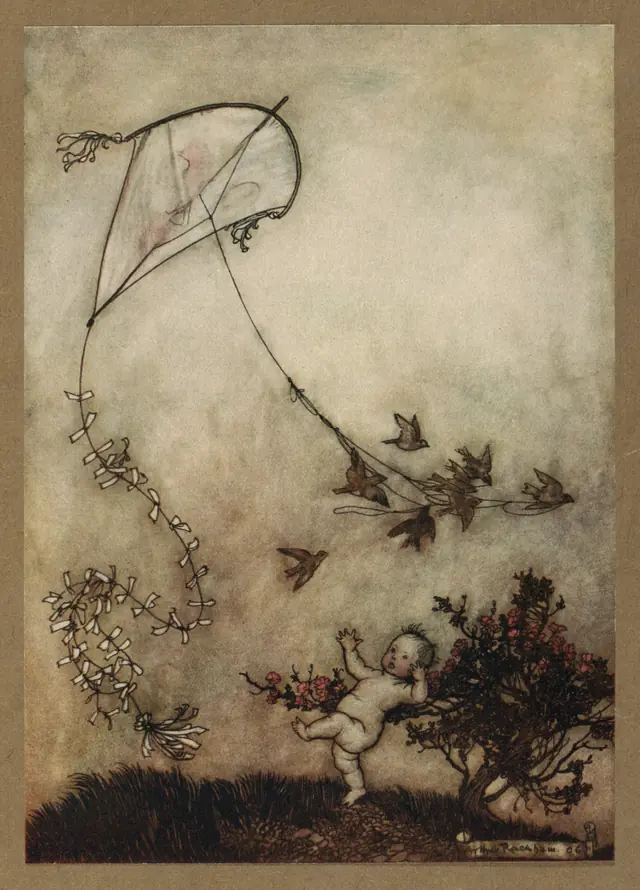
Those six chapters stood up so well on their own that in 1906 they were reissued separately as Peter Pan in Kensington Gardens, illustrated by Arthur Rackham: the plates that fixed how the character looked before any studio had drawn him.
27 December 1904, the Duke of York's Theatre
The play opened on 27 December 1904 at the Duke of York's Theatre in London, produced by Charles Frohman, under the title Peter Pan; or, The Boy Who Wouldn't Grow Up. Peter was played by Nina Boucicault: the rules of the day kept a child out of the part, so the production fell back on the English pantomime habit of handing the principal boy to a young actress. The tradition held for half a century.
Gerald du Maurier doubled as Captain Hook and Mr Darling, the father. This was not a way of trimming the cast: the same actor playing the grey father and the pirate is still the rule. Hans Conried supplied both voices in Disney's 1953 film; Jason Isaacs both faces in 2003.
Tinker Bell was not an actress either: a point of light, a hand mirror offstage bouncing a spotlight beam around, and a set of bells for her voice. When Peter turns to the stalls and asks everyone who believes in fairies to clap, he is asking them to save a lamp. Barrie kept rewriting the text, and the script was not published until 1928.
Skeleton leaves, a hook and a clock inside a crocodile
The novel came afterwards: Peter and Wendy, 18 October 1911 from Hodder & Stoughton, 21 October from Scribner's, with eleven plates by F. D. Bedford. Almost everything that gets drawn today is written down in there.
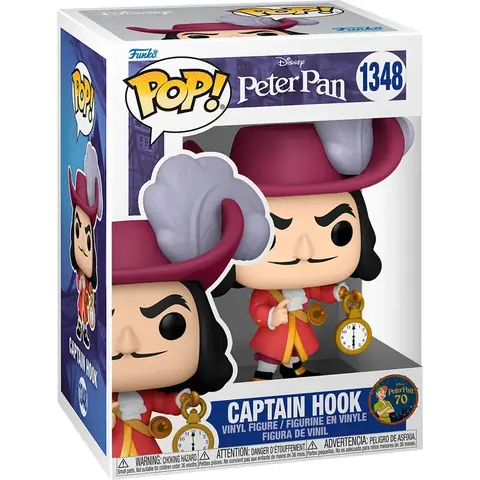
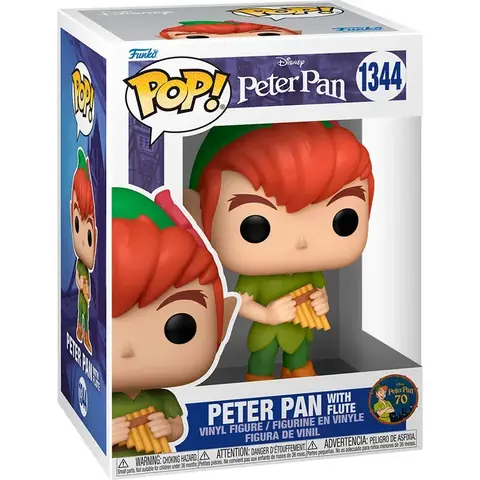
Peter is dressed in skeleton leaves and the juices that ooze out of trees, and he plays the pan pipes, which is where the surname comes from. Hook wears his hair in long curls that look like black candles from a distance, has eyes of forget-me-not blue, the iron on his right arm and a cigar holder of his own design that lets him smoke two cigars at once. The crocodile has swallowed a clock and goes tick-tock. The rest comes from here as well: the Jolly Roger, Smee and Starkey, the Lost Boys (Tootles, Nibs, Slightly, Curly and the Twins), the house under the ground you enter through hollow trees, the mermaids' lagoon, Marooners' Rock, Nana the dog, the shadow Wendy sews back on with a needle and thread, the thimble Peter accepts believing it is a kiss, and the acorn that stops an arrow.
In 1912 Barrie commissioned George Frampton to make the bronze statue in Kensington Gardens: Peter playing his pipes. Six further casts were made, from Brussels to Perth.
The star Barrie never wrote
In the book, the way to Neverland is this:
Second to the right, and straight on till morning.
Second to the right — and not a star anywhere in it. The star arrives with Disney in 1953, in the song The Second Star to the Right, by Sammy Fain and Sammy Cahn, which had itself been recycled from Alice in Wonderland, where it was called Beyond the Laughing Sky. Everybody remembers a star Barrie never wrote.
From Betty Bronson to Hugh Jackman
The first film is Paramount's, 29 December 1924, directed by Herbert Brenon. Peter is played by Betty Bronson, chosen by Barrie himself, and Ernest Torrence is Hook. It was presumed lost until a print surfaced at the Eastman School of Music in the fifties; restored in 1994, it entered the National Film Registry in 2000.
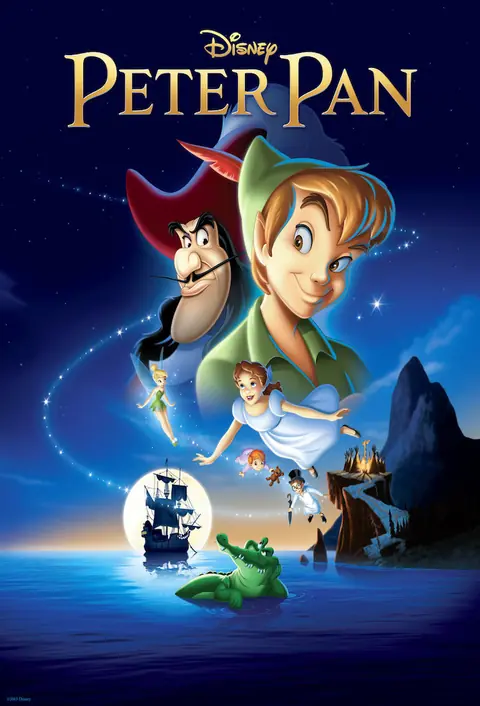
Disney bought the animation rights from Paramount in 1938 and in January 1939 signed a contract worth £5,000 with Great Ormond Street Hospital. Its Peter Pan opened on 5 February 1953 with Bobby Driscoll, the first male in the part.
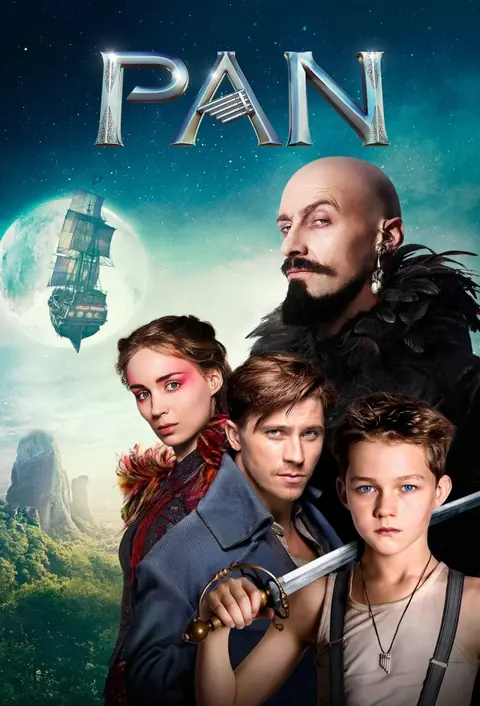
After that, three quite different ways of handling it. Hook (1991) is Spielberg asking what happens if Peter grows up: Robin Williams as a lawyer who has forgotten everything, Dustin Hoffman as Hook, Julia Roberts as Tinker Bell and Dante Basco as Rufio; nine sound stages in Culver City, a full-size Jolly Roger on stage 27, $70 million spent and $301 million taken. Peter Pan (2003), by P. J. Hogan, is the faithful adaptation: cinema's first live-action boy Peter, Jeremy Sumpter, and Jason Isaacs doubling Hook and Mr Darling, the exact nod to 1904. Pan (2015), by Joe Wright, tried to be a prequel with Hugh Jackman as Blackbeard and came apart: $129 million against a $150 million budget, 27% on Rotten Tomatoes and a row over whitewashing Tiger Lily by giving the part to Rooney Mara, who later said she hated being on that side of the conversation.
Off to one side, Finding Neverland (2004) has Johnny Depp playing Barrie as he writes the thing.
The arithmetic: 1937 plus eighty
Barrie died on 19 June 1937 in London. In Spain, a transitional provision of the consolidated text of the Spanish Intellectual Property Act keeps the term set by the Spanish law of 1879 — eighty years after death — for authors who died before 7 December 1987; for those who died later it is seventy. The count starts on 1 January of the year following the death: 1 January 1938 plus eighty years runs out on 31 December 2017. Peter Pan has been in the public domain in Spain since 1 January 2018.
The United Kingdom is another story, and it is the part almost nobody knows. In April 1929 Barrie gave the rights in Peter Pan to Great Ormond Street Hospital, the London children's hospital, asking that the sums involved never be made public. The copyright ran out at the end of 1987, fifty years after his death, and Parliament wrote a clause into the Copyright, Designs and Patents Act 1988 giving the hospital a perpetual right to be paid for performances and editions of Peter Pan within the United Kingdom. The European directive of 1995 handed the full copyright back until 2007, and the clause has governed again ever since: a law written for one single work, which allows nothing to be forbidden, only charged for, and only there.