



Universal Added the Full Moon in 1943
The European werewolf begins in court records, not in fairy tales. Peter Stumpp was executed near Cologne on 31 October 1589: the wheel, red-hot pincers applied at ten points of his body, arms and legs broken. He had confessed that the devil made him a gift of a belt that turned him into a wolf. The case travelled as far as London in an illustrated pamphlet carrying Lukas Mayer's woodcut, and the entire iconography is already there: the wheel, the belt, the wolf at a throat.
From the Beast of Gévaudan, shot dead by Jean Chastel in June 1767, comes the silver bullet cast from a medal of the Virgin; but that detail was added afterwards and appears nowhere in the papers from the hunt. The first serious survey of the whole business is The Book of Were-Wolves, published by the Reverend Sabine Baring-Gould in 1865.
The full moon, on the other hand, is Hollywood's. The verse the Gypsy woman recites in The Wolf Man (1941) was written by the screenwriter Curt Siodmak, and it speaks of wolfsbane in bloom and the autumn moon. The rule we all take for folklore was laid down by Frankenstein Meets the Wolf Man (1943), directed by Roy William Neill. Forty years later, the transformation in An American Werewolf in London (1981) won Rick Baker the first Academy Award for make-up ever given.
Ourense, 1852: Spain's Only Lycanthropy Trial
Manuel Blanco Romasanta (1809-1863), a pedlar from Allariz, confessed to thirteen killings and was convicted of nine. His defence was that a curse turned him into a wolf. The jury sentenced him to the garrotte on 6 April 1853, and in 1854 Isabella II commuted the sentence after a report from a French hypnotist who signed himself Mr Phillips. It is the only lycanthropy prosecution Spain has ever seen.
The other Galician creature does not bite: it warns. The earliest printed definition of the Santa Compaña is in Juan Cuveiro Piñol's Diccionario gallego, 1876:
Compaña: among the common people, a procession of witches who walk by night lighting their way with the bones of the dead.
Cinema has gone after Romasanta twice: The Ancines Woods (El bosque del lobo, 1970), by Pedro Olea, from Carlos Martínez-Barbeito's 1947 novel El bosque de Ancines, and Romasanta: The Werewolf Hunt (2004), by Paco Plaza. One detail from the first: one of its screenwriters, Juan Antonio Porto, was the great-great-grandson of the lawyer who handled the real case.
The Board Named Itself
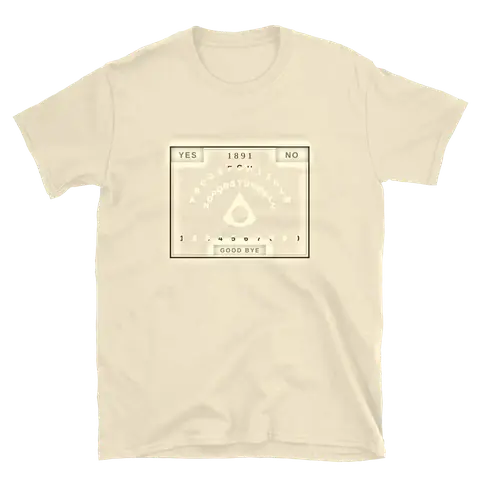
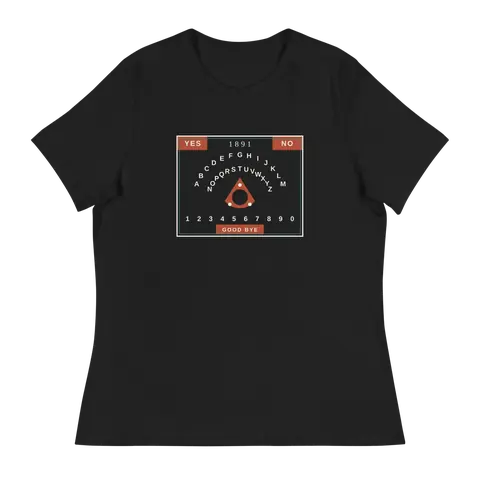
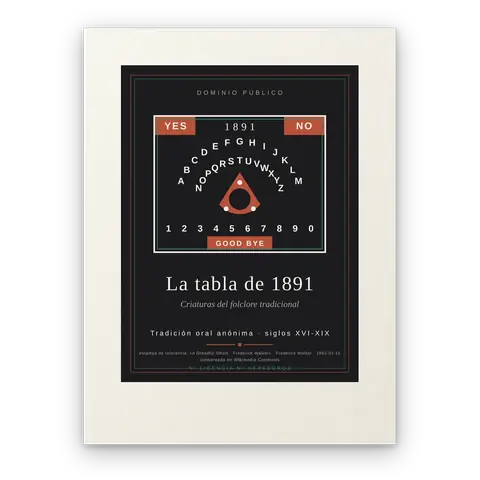
The ouija comes out of no grimoire at all: it is a novelty-shop product. The Kennard Novelty Company was set up in Baltimore in 1890, and patent 446,054 was granted on 10 February 1891 in the name of the lawyer Elijah Bond. The name was chosen by the board itself: Helen Peters, Bond's sister-in-law, asked it what it wanted to be called and it spelled out O-U-I-J-A; asked what that meant, it answered «good luck».
What almost nobody knows is how the patent came to be approved. As Linda Rodríguez McRobbie told it in Smithsonian Magazine on 27 October 2013, working from the researcher Robert Murch's documents, the chief examiner set one condition: if the board spelled out his name, which he had not said aloud, he would sign. It spelled it. He signed, white as a sheet.
The money was made by William Fuld (1870-1927), who died falling from the roof of his Baltimore factory while supervising the fitting of a flagpole. His heirs sold to Parker Brothers in 1966. On screen: the board Regan uses to call Captain Howdy in The Exorcist (1973), Witchboard (1986) and Ouija: Origin of Evil (2016), by Mike Flanagan.
Birch Rods, Chains and Christmas Greetings
Krampus comes from Krampen, claw, and the creature is a cousin of the Alpine Perchten who ran through the villages between the solstice and 6 January. Its present face was settled by the printing press: once chromolithographs and postcards became cheap in the 1890s, Austria and Germany filled up with Krampuskarten bearing the greeting «Gruss vom Krampus», and that is where the catalogue was fixed: an enormously long red tongue, goat's horns, a bundle of birch rods, chains, cowbells and the wicker basket on his back with a child inside it.
He has a political file, too. Dollfuss's Austrofascist regime went after him, and in December 1934 the New York Times ran the headline «Krampus Disliked in Fascist Austria». In the 1950s the Austrian government was still handing out leaflets titled Krampus ist ein böser Mann. The version the public knows today comes from Krampus (2015), by Michael Dougherty, which gave him back the basket and the chains almost exactly as the postcards had them.
The Wendigo Never Had Antlers
The wendigo of the Algonquian cultures — Ojibwe, Cree, Innu — is not a deer. The traditional descriptions speak of a gaunt giant, grey skin stretched over the ribs, lips chewed away and a heart of ice: it is what becomes of anyone who lets hunger and greed win. The deer skull with antlers is a recent design, out of cinema and video games, and Antlers (2021), by Scott Cooper, nailed it into everybody's head for good.
Best said without decoration: this is not a dead myth, it is living belief in communities that are still here. Which is why the documented description belongs here rather than the antlered caricature — a caricature that has modern authors behind it, besides.
The Sheet, the Chain and the Etching
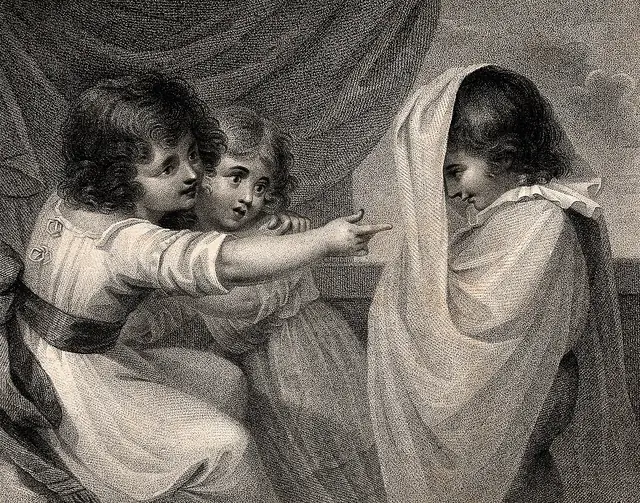
The sheet is not laziness about the costume: it is the raw linen shroud people were buried in, and by the nineteenth century it already worked as a uniform. The Hammersmith case proves the point. On the night of 3 January 1804 the bricklayer Thomas Millwood was walking home in his work clothes — white linen trousers, waistcoat and apron — and Francis Smith, out patrolling for the local ghost, shot him. The Old Bailey tried him on 11 January; the death sentence came down to a year's hard labour.
The chain was Dickens's doing: Jacob Marley in A Christmas Carol (1843) drags cash-boxes, padlocks and ledgers behind him, and ever since then ghosts have clanked. The two eyeholes are the last arrival of all, and A Ghost Story (2017), by David Lowery, turned them into an entire film.
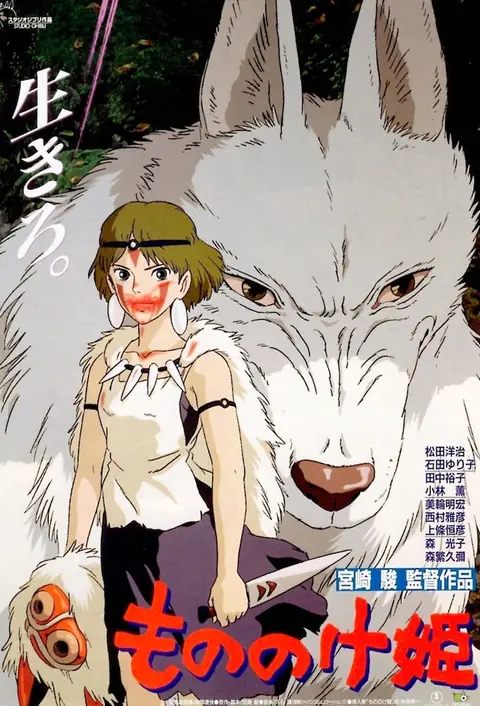
The rest of the visual vocabulary comes out of prints. Goya's eighty Caprichos went on sale on 6 February 1799, advertised in the Diario de Madrid and sold from a perfume shop to dodge the booksellers. Half of Spain's iconography of dread comes from there, and so does the Pale Man in Pan's Labyrinth (El laberinto del fauno, 2006), built from two parts: Goya's Saturn and the tenome, the yōkai with eyes in its palms that Toriyama Sekien drew in the Gazu Hyakki Yagyō (1776). From that same book come the kodama that Miyazaki sets nodding in Princess Mononoke (1997).