The general who did not trust fists
Qi Jiguang (1528-1588) spent his life driving wokou pirates off the coast of Zhejiang, and in 1560 he wrote the manual he trained his recruits with: the Jixiao Xinshu, the "New Treatise on Military Efficiency". Chapter fourteen, "The Essentials of the Fist", sets out thirty-two empty-hand postures, each with its own woodcut and its own four-line verse. It is the oldest surviving illustrated manual of unarmed combat in China, and it opens with a warning his heirs would rather not quote: boxing, says Qi, is of little use in a battle. It is there to toughen up the recruit, not to save him in a charge.
Along the way he leaves us a catalogue of what was actually being practised in 1560: the thirty-two postures of Song Taizu, the seventy-two hands of the Wen family, monkey fist, the Shaolin staff. Sixty years later Mao Yuanyi (1594-1640) copied the whole thing into the Wubei Zhi (1621), two hundred and forty volumes of weaponry drawn piece by piece.
Shaolin made its name with a stick
Cheng Zongyou (1561-1636), the son of a well-off family from Xiuning, planted himself at the Shaolin monastery for a decade. What he brought back, written around 1610 and printed in 1621, is called Exposition of the Original Shaolin Staff Method, and it is the oldest Shaolin manual to survive. It has nothing to do with fists: it is fifty-three long-staff positions. The monastery's martial reputation under the Ming was built on the pole; the empty hand came later, as the sinologist Meir Shahar documented in The Shaolin Monastery (2008).
The other pillar of the myth, the Yijin Jing or "Classic of Changing the Muscles and Tendons", is attributed to Bodhidharma but dated to 1624, and it carries two forged prefaces signed in the names of the generals Li Jing and Niu Gao; the afterword is by a Daoist from Mount Tiantai, Zining Daoren. In 1930 the historian Tang Hao proved the entire chain was an invention, and it earned him threats from the schools that were living off the story.
The ninja manual that does exist
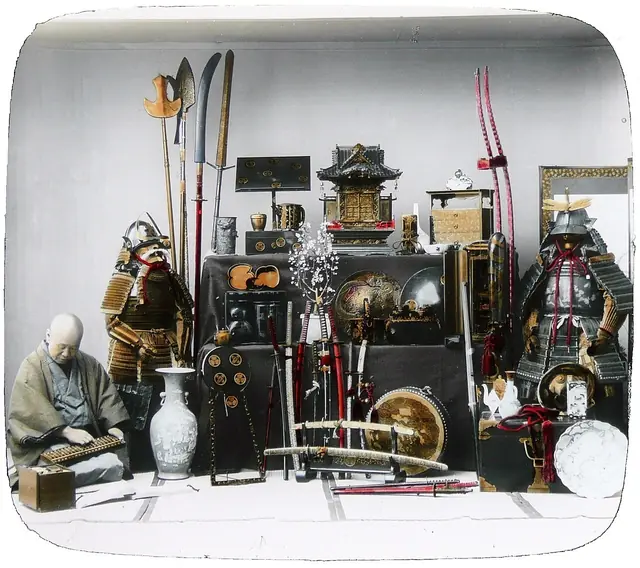
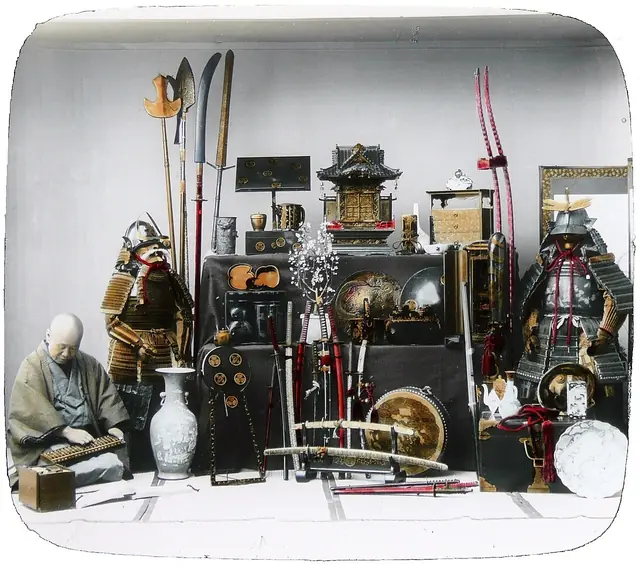
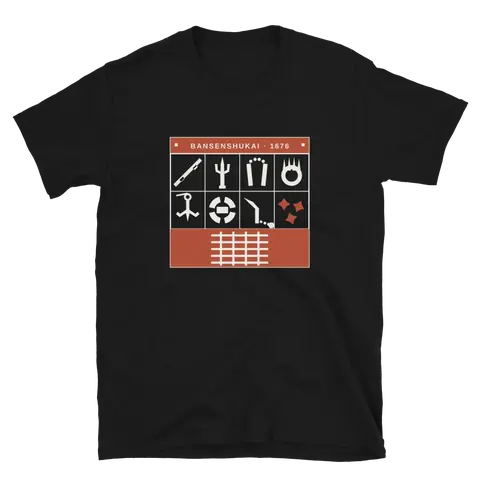
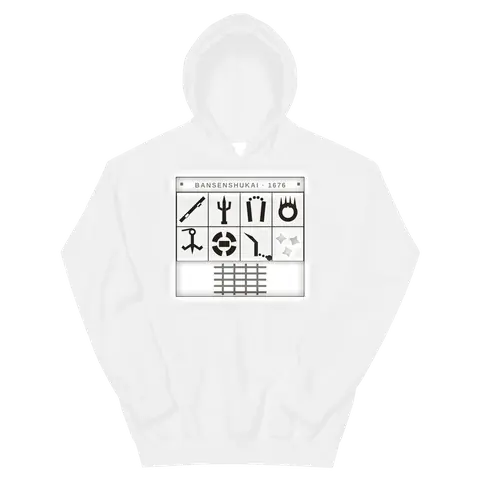
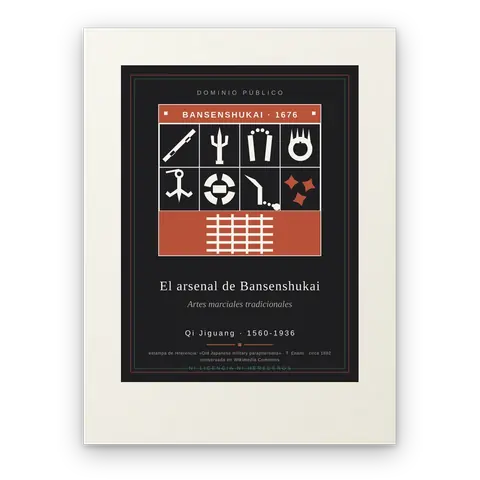
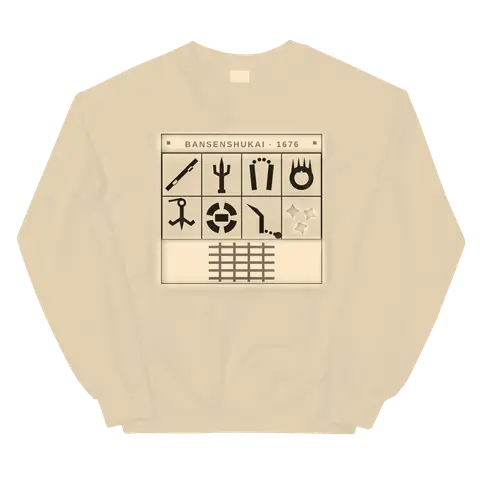
The Bansenshukai ("Ten Thousand Rivers Flowing into the Sea") was finished by Fujibayashi Yasutake in 1676: twenty-two volumes gathered into ten books, collecting what was left of the shinobi traditions of Iga and Koga. It was written late on purpose: the trade was already dead and its practitioners were angling for posts in the Tokugawa bureaucracy. Drawn in its pages are the shuko hand claws, the kaginawa rope hook, the kunai and the mizugumo, floats for crossing moats that the cinema turned into shoes for walking on water. Five years later Natori Masazumi put his name to the Shoninki (1681), shorter and more practical.
And here is the detail: the black outfit appears in neither of them. It comes from the theatre. In kabuki the stagehands dress in black from head to foot and are called kuroko; the audience accepts the convention that they are not there. All the playwrights had to do was dress the ninja as a kuroko to tell the house "nobody can see this one". By about 1800 the image was fixed, and that is the version the West copied.
Copied by hand from Fujian to Okinawa
The Bubishi has no author and no date. It is written in Chinese characters with readings from the Fujian dialect, it talks about Monk Fist and White Crane, and it circulated among the masters of Okinawa, hand-copied down the generations. Inside there are:
- forty-eight self-defence diagrams, two little figures tangled together in each one;
- maps of the body's vital points;
- herbal recipes for treating blows.
Itosu Anko took out his own copy; his student Mabuni Kenwa put it into print for the first time in 1934. Miyagi Chojun, founder of Goju-ryu, called it "the Bible". The Korean equivalent does have a date and signatures: the Muyedobotongji, commissioned by King Jeongjo in 1790 from Yi Deok-mu (1741-1793), Bak Je-ga (1750-1805) and Baek Dong-su (1743-1816), lays out twenty-four infantry and cavalry disciplines with their plates.
The prints that gave it a face
Utagawa Kuniyoshi (died 1861) published One Hundred and Eight Heroes of the Popular Suikoden between 1827 and 1830, prints based on the Chinese novel Water Margin. It occurred to him to tattoo the bandits over their whole bodies, something nobody had done, and he set off the craze for irezumi that is still with us. A good deal of the martial imagery we take to be Japanese comes from there: dragons, tigers and tattooed monks fighting with a pole.
At the other end stands Lam Sai-wing, a student of Wong Fei-hung, who opened a school in Hong Kong in the 1930s and published three Hung Ga manuals photographing himself position by position: Gung Ji Fuk Fu Kyun (1936), Fu Hok Seung Ying Kyun, with a hundred and twelve images, and Tit Sin Kyun. He died in 1943, during the Japanese occupation.
From the page to the frame
The first serious wuxia film was The Burning of the Red Lotus Temple (1928), directed by Zhang Shichuan for Mingxing: nineteen feature-length instalments between 1928 and 1931, twenty-seven hours in all. It was a runaway hit, and in the early thirties the Kuomintang banned the genre for inciting rebellion. Not a single copy survives.
Then, in 1949, came Wong Fei-hung: Kwan Tak-hing played him in seventy-seven films up to the eighties, twenty-five of them in 1956 alone, and Guinness rates the series the longest-running in the world. The style on screen is Hung Ga, the one Lam Sai-wing had committed to paper. The chain never breaks: The 36th Chamber of Shaolin (1978) was directed by Lau Kar-leung, who learned Hung Ga from his father, Lau Cham, a student of Lam Sai-wing. Shaolin Temple (1982), shot on the mainland, plucked Jet Li out of nowhere.
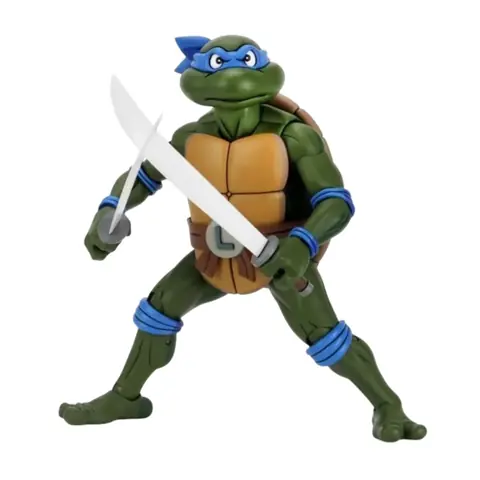
Kung Fu Hustle (2004) invents nothing either: the coolie performs the Twelve Kicks of the Tan family, the tailor fights with iron rings doing Tit Sin Kyun, the most advanced Hung Ga form, attributed to Tit Kiu Sam, and the baker handles the eight-trigram staff. The Karate Kid (1984) works the other way round: the crane kick appears in no manual anywhere. It was dreamed up by the screenwriter Robert Mark Kamen and designed and performed by the stunt player Darryl Vidal, who gave it the arms; Pat Morita's double for the rest of the film was Fumio Demura, ninth dan in Shito-ryu. And the ninja turtles wield sai, nunchaku, bo and katana, straight out of the Okinawan kobudo armoury, so much so that the British censors cut the nunchaku, the series went out in 1990 as Teenage Mutant Hero Turtles, and in the sequel they even had to trim the sausages Michelangelo was twirling above his head.