Owen coined the word in 1842, but the picture came first
In 1842 Richard Owen gathered up three creatures nobody knew where to file — Megalosaurus, Iguanodon and Hylaeosaurus — and called them Dinosauria. The word arrived late: the first picture of a vanished world had been circulating since 1830.
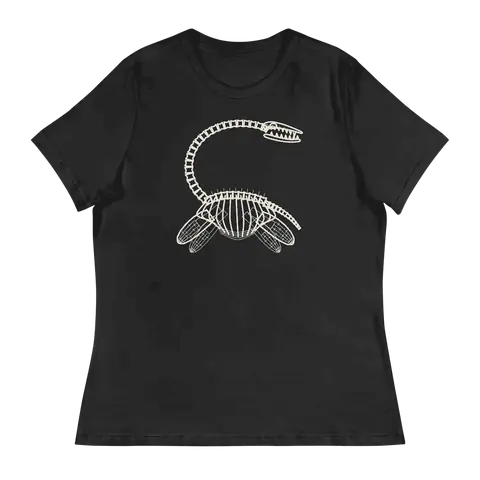
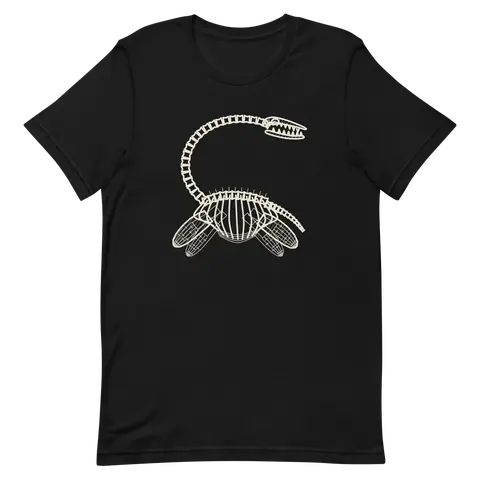
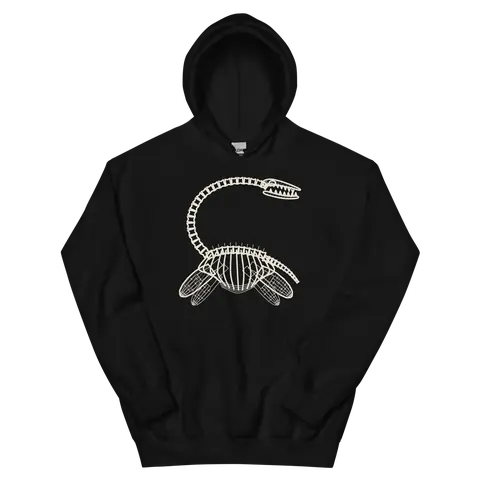
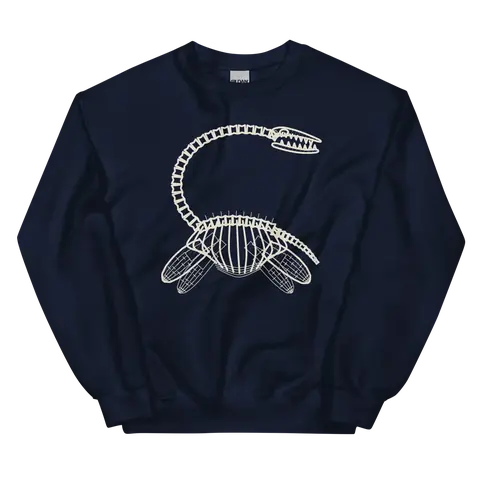
It was signed by Henry De la Beche (1796-1855), a geologist with a good hand for drawing. Duria Antiquior — “a more ancient Dorset” — is a watercolour crowded with ichthyosaurs biting into plesiosaur necks, turtles, fish and pterosaurs, lithographed by Georg Scharf. It is the first prehistoric landscape reconstructed from real fossils.
One detail makes it odd: several of the animals are defecating in the middle of the scene. William Buckland had just identified coprolites, and De la Beche painted them because they were evidence.
It was never made to sell. The prints went out at £2 10s to raise money for Mary Anning, the Lyme Regis fossil hunter who had dug up half the scene and whose name was on none of those finds. Buckland sent a hundred copies to her shop so she could sell them herself.
A dinner for twenty-one inside an Iguanodon
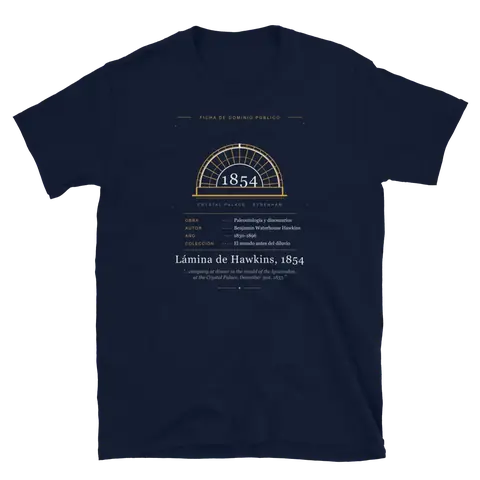
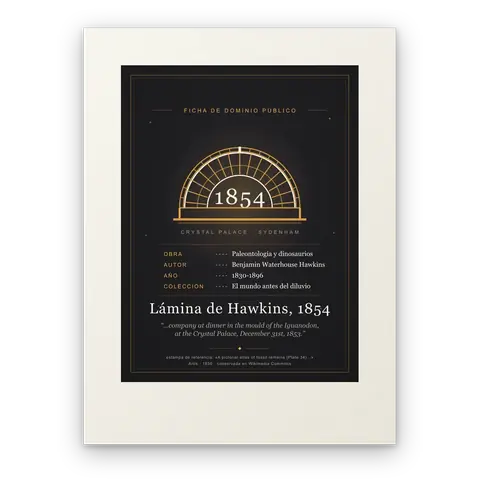
Between 1852 and 1854, in the Sydenham park where the Crystal Palace had been re-erected, Benjamin Waterhouse Hawkins (1807-1894) put up fifteen genera of extinct animals at life size in brick, iron and cement. Only three were actually dinosaurs. They cost £13,729. Queen Victoria opened them on 10 June 1854 and there they still stand, listed at the highest grade since 2007.
On New Year's Eve 1853, with the Iguanodon still in its mould, Hawkins laid on a dinner inside the animal. Twenty-one guests: eleven seated in the belly and the rest at a table pushed up alongside, with Owen at the head. The invitation was written across a drawing of a pterodactyl's wing.
“Mr. Waterhouse Hawkins solicits the honour of ____ company at dinner, in the mould of the Iguanodon, at the Crystal Palace, on Saturday evening, 31 December 1853, at five o'clock. An answer will oblige.”
He got the obvious thing wrong. The Iguanodon wears a horn on its snout because Gideon Mantell, with no skull to consult, reasoned that the pointed bone belonged on the nose. It was a thumb. That became clear from 1878, when two miners at Bernissart, Jules Créteur and Alphonse Blanchard, ran into almost forty Iguanodon skeletons 322 metres underground.
The sequel went worse. Hawkins went to New York to build a Palaeozoic Museum in Central Park, and on 3 May 1871 men broke into his workshop with sledgehammers and buried the wreckage near the park's south-west corner. For a century the blame fell on Boss Tweed; work by Vicky Coules and Michael Benton published in 2023 in Proceedings of the Geologists' Association points instead to Henry Hilton, the lawyer Tweed had installed on the park board.
Who did the drawing: Riou, d'Orbigny, Marsh
Édouard Riou (1833-1900) made the 25 “ideal views” for La Terre avant le déluge, Louis Figuier's 1863 book that taught half of Europe what the past looked like. For Hetzel he also illustrated Verne's Journey to the Centre of the Earth: the first edition, of 25 November 1864, came out without plates, and his arrived with the expanded edition of 1867. The same hand did the textbook and the novel, which is why Verne's monsters and the monsters of popular science are the same animal. In Figuier's second edition, in 1867, the Garden of Eden that had closed the first one disappeared.
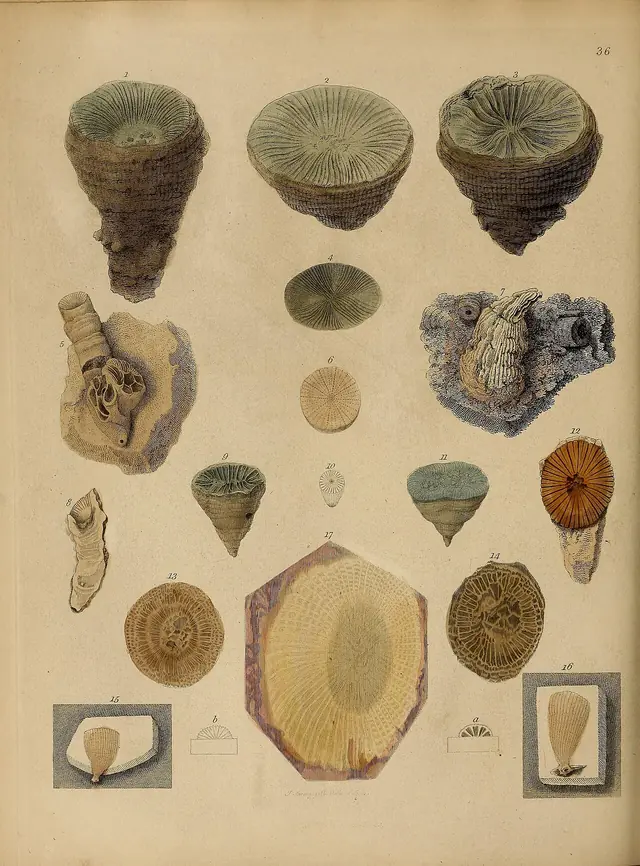
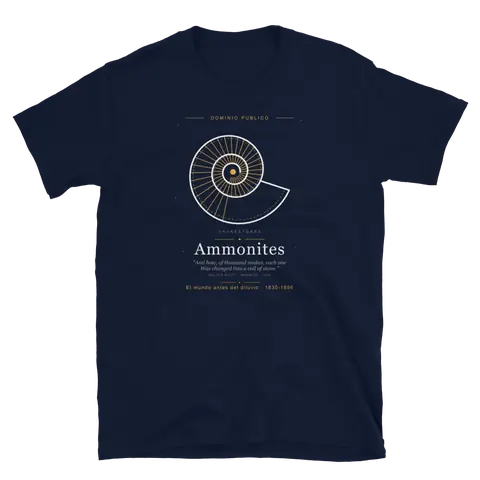
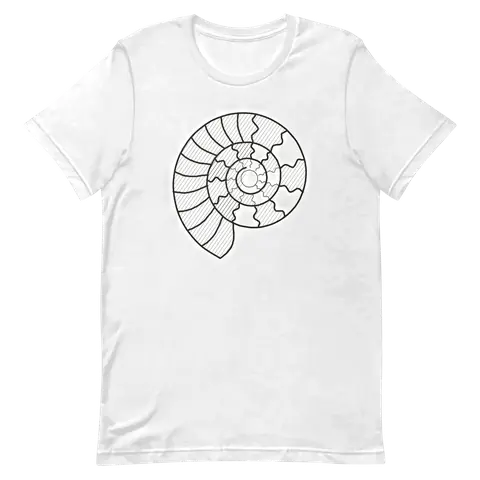
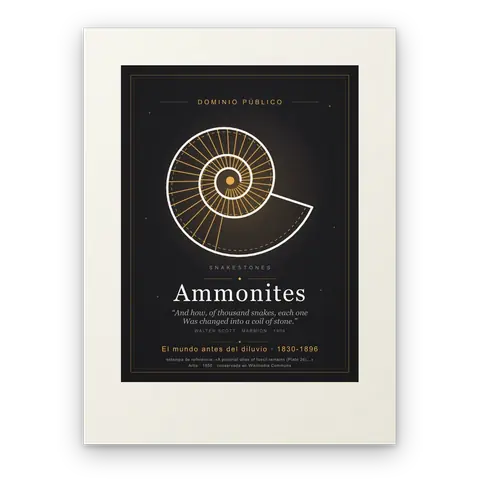
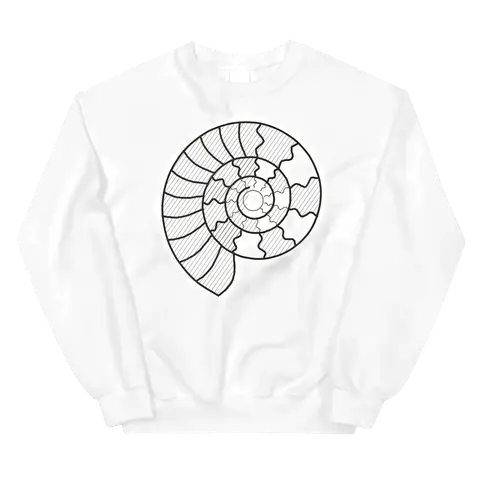
Alcide d'Orbigny (1802-1857) is the other extreme: no landscapes, just the shell. His Paléontologie française, published between 1840 and 1860, left 1,440 lithographs; the volume on Cretaceous cephalopods, of 1840-1842, runs to 148 plates of ammonites seen in profile, head-on and in section.
Othniel Charles Marsh (1831-1899) supplied the skeleton. The Dinosaurs of North America, of 1896, fixed the black silhouette on a white ground that is still used everywhere today. He also blundered: he fitted Brontosaurus with a Camarasaurus skull. The New York museum's mount carried it that way from 1905. David Berman and John McIntosh showed in 1978 that the right head was a different one; the Carnegie in Pittsburgh changed theirs in 1979 and New York did not until the 1995 refurbishment.
Teresa Madasú drew the fossils of Spain and hardly anyone says her name
The Geological Map Commission asked Lucas Mallada (1841-1921) for a Sinopsis de las especies fósiles que se han encontrado en España, a synopsis of the fossil species found in Spain. It appeared in seventeen instalments of the Boletín between 1875 and 1892, with 250 plates.
206 of those 250 were drawn by Teresa Madasú y Celestino, born in Zaragoza on 13 May 1848 and dead in Madrid on 11 March 1917. She was the first woman enrolled at the Escuela Especial de Pintura, Escultura y Grabado in Madrid, in the 1873-74 session, and the first documented palaeontological illustrator in the country.
Her ammonites, brachiopods and trilobites are Spanish public-domain material: fine lithography, no rhetoric, and nobody has ever reissued it.
From the page to the frame
The Lost World (1925), by Harry O. Hoyt, is the first feature to trust its creatures to frame-by-frame animation. Willis O'Brien animated it and Marcel Delgado built the models by copying Charles R. Knight's paintings.
There was a prank before the release. On 2 June 1922 Conan Doyle screened some test footage at the Society of American Magicians banquet, in the Hotel McAlpin in New York, without explaining what it was. The New York Times ran “Dinosaurs Cavort in Film for Doyle” the following day. On 4 June the paper printed his letter: he had only wanted to mystify the mystifiers.
The rest is a chain:
- O'Brien did it again in King Kong (1933).
- Disney signed up Roy Chapman Andrews, Barnum Brown, Julian Huxley and Edwin Hubble for the Rite of Spring sequence of Fantasia (1940).
- The designers of Godzilla (1954), Akira Watanabe and Teizo Toshimitsu, blended Iguanodon, Stegosaurus and Tyrannosaurus with the Life of 7 September 1953 open in front of them.
- Ray Harryhausen animated One Million Years B.C. (1966) and then The Valley of Gwangi (1969), a project O'Brien had left half-finished.
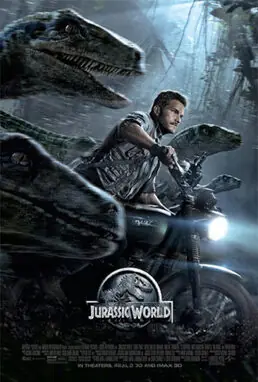
Jurassic Park (1993) closes the circle: Michael Crichton's velociraptor is the Deinonychus John Ostrom described in 1969. Ostrom used to say it was his animal “in almost every detail”, and that Crichton had telephoned to let him know he was changing the name because the other one sounded better.
Ammonites, snakes and an abbess
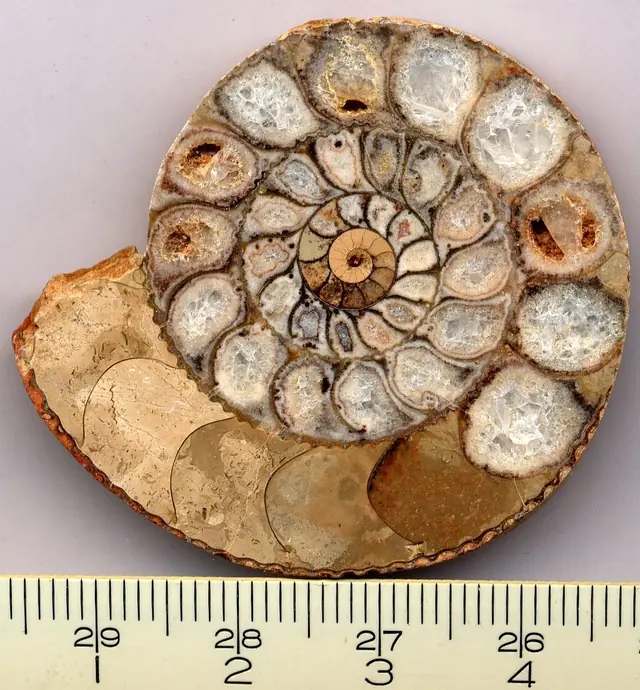
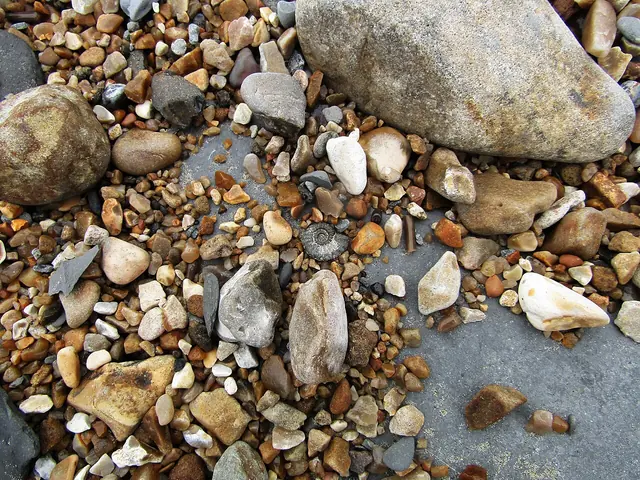
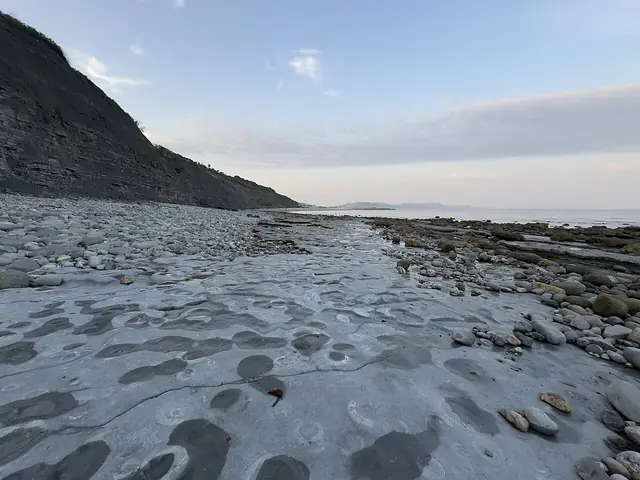
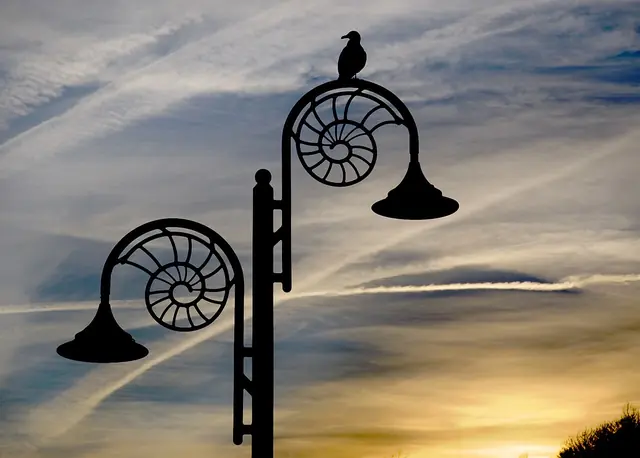
In Whitby, Yorkshire, ammonites were known as snakestones. The legend held that the Abbess Hilda had turned to stone the snakes infesting the cliff; the earliest written reference is in William Camden's Britannia, 1586. Victorian dealers carved a snake's head into the end of the spiral so that the story held up and the piece sold better. The town's coat of arms carries three ammonites with heads, and there is a genus named Hildoceras after the abbess.
That same beach is where Bram Stoker runs the Demeter aground in Dracula (1897), a scene filmed again and again, from Coppola in 1992 to The Last Voyage of the Demeter in 2023. The fossil spiral and the vampire came off the same cliff.